GCSE revision is one of the most stressful rites of passage for families across England. Yet despite the high stakes, most students rely on revision methods that cognitive science has shown to be among the least effective — re-reading notes, copying out textbooks, and last-minute cramming. The good news is that decades of research in educational psychology has identified a handful of techniques that genuinely work, and they are far simpler than most students expect.
This guide walks through the evidence-based revision strategies that help students retain more information, feel more confident on exam day, and ultimately achieve better GCSE grades — told from the perspective of both parents and students.
📌 Did You Know?
A landmark review of learning techniques by Dunlosky et al. (2013) rated re-reading (the most popular student revision method) as having low utility. Retrieval practice and spaced repetition were rated high utility — yet far fewer students use them.
Why the Most Popular Revision Methods Don't Work
Ask most GCSE students what they do to revise and they will say: re-read their notes, highlight their textbooks, or rewrite their notes out neatly. These feel productive. They create a familiar "fluency illusion" — the material feels known because it looks familiar. But familiarity is not memory. When the same content appears on an exam paper stripped of its context and format, recognition fails.
Effective revision forces the brain to work harder. The discomfort of struggling to recall something is precisely the signal that memory is being strengthened.
Technique 1: Retrieval Practice (The Most Powerful Method)
Retrieval practice — also called "the testing effect" — means trying to recall information from memory rather than looking at it. The act of retrieving a memory actively strengthens it in a way that passive re-reading never does.
How to implement retrieval practice:
- Close the notes. Write down everything you can remember about a topic from scratch.
- Use flashcards (physical or apps like Anki or Quizlet) — see the question on one side, recall the answer before flipping.
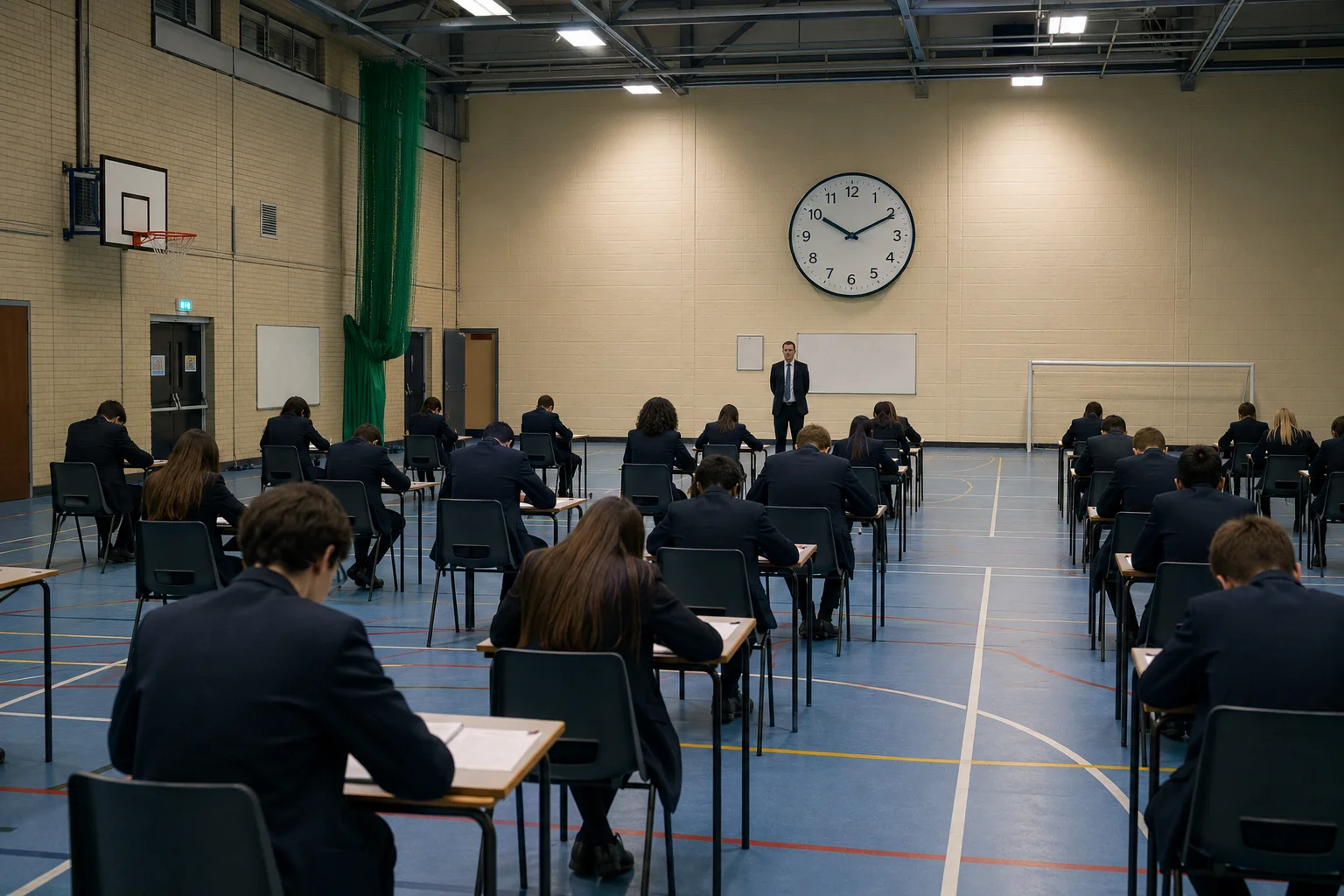
- Complete past exam papers under timed, exam-like conditions — the single best form of retrieval practice for GCSEs.
- Use the "Brain Dump" method: at the end of a revision session, close everything and write on a blank page everything you just covered.
💡 Parent Tip
You don't need to understand the subject to help with retrieval practice. Simply ask your child questions aloud from their revision cards. Have them explain topics back to you as if you were a complete beginner. This "teach-it-back" technique is one of the most effective retrieval methods available.
Technique 2: Spaced Repetition ("The Spacing Effect")
Spaced repetition means spreading revision across time rather than massing it into one long session. Instead of spending a full day on one topic, you revisit topics at increasing intervals — for example: Day 1, Day 3, Day 7, Day 14, Day 30.
Each time information is recalled after a gap, memory strength increases. The gaps mean the brain has partially forgotten, so retrieval feels harder — but this "desirable difficulty" is exactly what drives long-term retention.
Practical tools for spaced repetition:
- Anki — free flashcard app that schedules cards automatically based on how well you recalled them
- Revision timetables — plan early and distribute subjects across weeks rather than covering them once per week
- The Leitner Box — a physical flashcard system using boxes to sort cards by how well they are remembered
Technique 3: Interleaving (Mixing Subjects and Topics)
Most students revise by "blocking" — they spend Monday on Biology, Tuesday on History, Wednesday on Maths. This feels organised but produces weaker learning than interleaving — mixing topics within a session or across sessions.
Interleaving forces the brain to constantly switch gears, discriminate between concepts, and apply knowledge more flexibly — precisely the skills demanded in GCSE exams, where questions often combine multiple topic areas unpredictably.
| Blocking (Less Effective) | Interleaving (More Effective) |
|---|---|
| Session 1: All of Macbeth | Session 1: Macbeth themes + Cell Biology + World War 1 causes |
| Session 2: All of Cell Biology | Session 2: Power & Conflict poetry + Algebra + Weimar Republic |
| Session 3: All of Algebra | Session 3: Macbeth quotes + Trigonometry + British Depth Study |
Technique 4: Elaborative Interrogation ("Why?" Questions)
Rather than memorising facts passively, elaborative interrogation means asking why something is true and constructing the answer. For example:
- Instead of: "Photosynthesis produces glucose."
- Ask: "Why does photosynthesis produce glucose? What does the plant use it for? Why does the equation balance this way?"
Answering "why" questions forces students to connect new information to prior knowledge, creating richer, more retrievable memory traces. Encourage your child to question everything they are memorising.
Technique 5: Dual Coding (Words + Visuals Together)
Dual coding means pairing verbal information with visual representations — diagrams, mind maps, timelines, or simple sketches. When the brain encodes information both verbally and visually, it creates two retrieval pathways instead of one.
Effective dual coding is not simply copying a textbook diagram. Students should draw their own diagram from memory, label it, and explain it without looking at the source. The act of constructing the visual actively strengthens memory.
What About Revision Timetables?
A revision timetable is only effective if it is realistic and immediately actionable. Common pitfalls include:
- Spending more time designing the timetable than actually revising
- Scheduling ten subjects across two days without prioritising
- Not accounting for fatigue, sport, social time, or buffer slots
A simple framework for GCSE timetabling:
- List every GCSE subject and calculate weeks remaining until exams
- Identify your child's weakest and strongest subjects — weight revision hours accordingly
- Schedule 2–4 focused revision sessions per day (45–50 minutes each with breaks)
- Leave the weekend before each exam group for past papers only
- Review and adjust the timetable weekly — rigid plans rarely survive contact with reality
⭐ Key Takeaway
The single highest-value GCSE revision activity is completing past exam papers under timed conditions and then reviewing every wrong answer carefully. No flashcard or note-taking technique rivals the combination of retrieval, exam technique, and mark scheme familiarisation that past papers provide.
How Parents Can Support Without Adding Pressure
Parental involvement in GCSE revision has been consistently linked to better outcomes — but only when it supports rather than stresses. Here is how to help effectively:
- Provide a quiet, consistent study space with no phone notifications
- Quiz your child using their revision cards — no subject knowledge needed
- Acknowledge effort over outcomes: "I can see you've worked hard today" matters more than "What mark did you get?"
- Ensure sleep is protected — cognitive recall is dramatically impaired by sleep deprivation
- Limit revision guilt: short, effective sessions beat hours of unproductive sitting at a desk
Summary
Helping your child revise effectively for GCSEs is one of the most tangible ways you can support their academic future. By replacing passive re-reading with retrieval practice, spacing revision sessions over time, mixing subjects intelligently, and ensuring past papers are central to the final preparation phase, students can walk into exam halls genuinely prepared — rather than merely hopeful. Start early, stay consistent, and let the science do the heavy lifting.