

When parents look for a school in England, one of the first things many check is the Ofsted rating. A single word — Outstanding, Good, Requires Improvement — can shape whether a family even considers visiting. But what do these ratings actually measure? And with Ofsted's major reforms rolling out from November 2025, what does the new five-point Report Card mean for parents today?
This guide explains exactly how Ofsted grades schools, what changed in 2025, what the ratings do and do not tell you about a school, and how to use them sensibly when choosing where your child will learn.
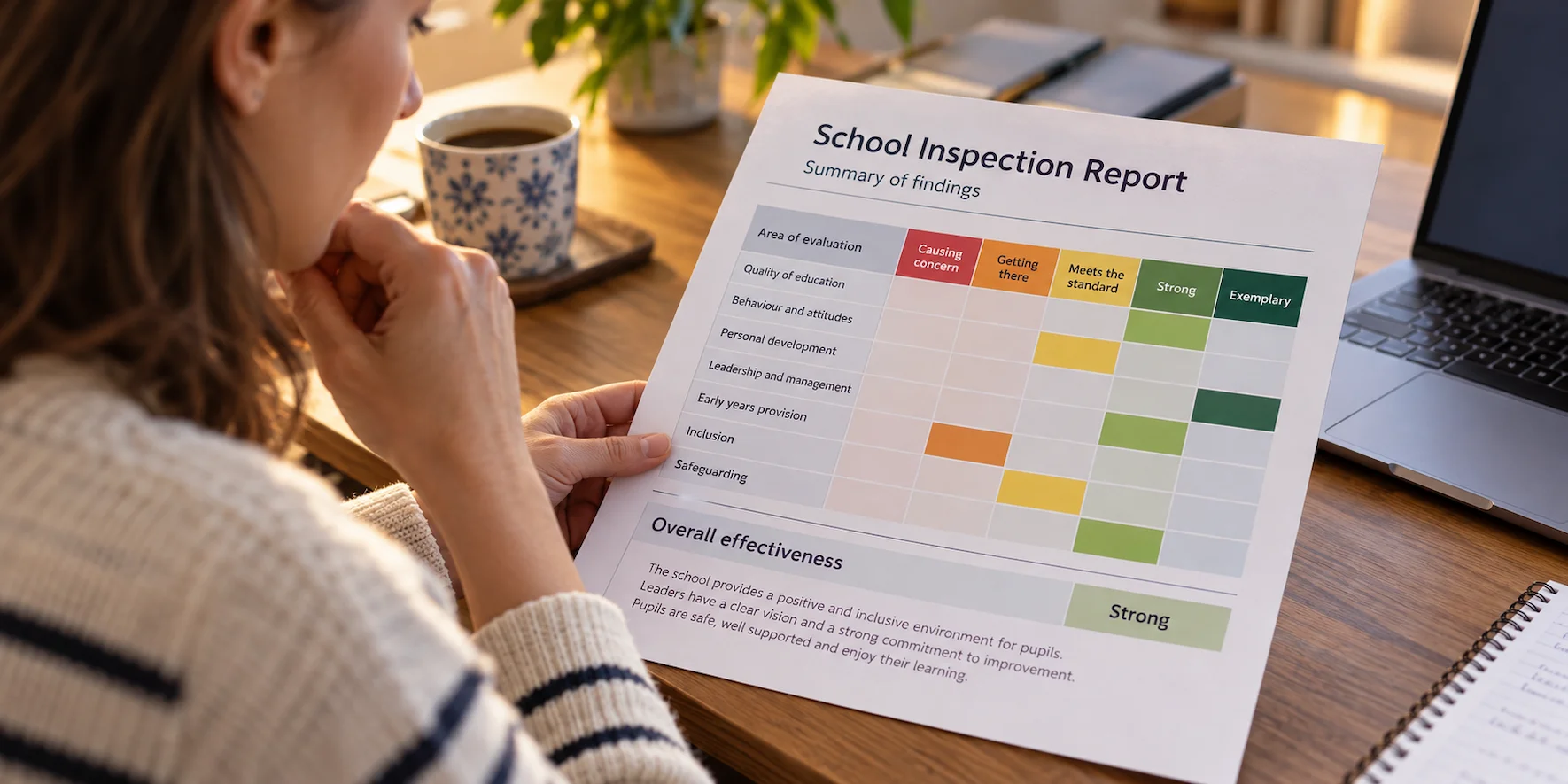
As of 2025, Ofsted no longer issues a single overall grade for schools in England. Instead, the new Ofsted Report Card — introduced from November 2025 — assesses schools across multiple areas using a five-point scale, replacing the previous Outstanding/Good/Requires Improvement/Inadequate system for most inspections going forward.
What Is Ofsted and What Does It Do?
Ofsted (the Office for Standards in Education, Children's Services and Skills) is the independent government body responsible for inspecting and regulating services for children and young people in England. It inspects:
- State-funded schools (including academies, free schools, grammar schools, and maintained schools)
- Independent (private) schools
- Early years providers, further education colleges and more
Ofsted inspections are unannounced for most schools. Inspectors visit for one to two days and observe lessons, speak to pupils, parents and staff, and examine the school's own data before writing a detailed report. Those reports are published publicly on the Ofsted website.
You can search for any school in England on our directory and find a direct link to its Ofsted report.
The Old Four-Grade System (Before November 2025)
Until Ofsted's 2025 reforms took effect, schools were judged on four areas and given an overall single-word grade:
- Outstanding — The school is performing significantly above average. Typically, teaching is highly effective, outcomes are strong and leadership is excellent.
- Good — The school meets a high standard in all key areas. Most parents would consider a Good school a positive choice.
- Requires Improvement — The school is not yet Good. It must improve within a defined period or face a more critical judgement.
- Inadequate — Serious concerns exist. The school may receive a Special Measures or Serious Weaknesses designation and is subject to intensified oversight.
Many schools inspected before November 2025 still carry one of these four grades on their public reports. The old grades remain visible and relevant while the transition to the new Report Card takes place over time.
 AI-generated image
The New Ofsted Report Card (From November 2025)
Following extensive public consultation and a review by Ofsted, the single overall grade was replaced with a Report Card system. The key changes are:
A Five-Point Scale Instead of Four
Each area of a school's work is now rated on a five-point descriptive scale:
- Causing concern — Serious failures requiring immediate action
- Getting there — Below standard; improvement needed
- Meets the standard — Satisfactory; broadly adequate provision
- Strong — Above the minimum standard; pupils are well served
- Exemplary — Exceptional practice that others can learn from
Multiple Areas Assessed Separately
Rather than collapsing everything into one word, inspectors now report on a range of separate areas, including:
- Quality of education (curriculum, teaching and outcomes)
- Behaviour and attitudes
- Personal development
- Leadership and management
- Early years (where applicable)
- Sixth form (where applicable)
This means a school might be rated Strong for Quality of Education but Getting there for Personal Development, giving parents a much more nuanced picture than a single grade.
When reading any Ofsted report — old or new — always check the date of inspection. A school rated Outstanding in 2016 may have changed leadership, pupil intake, and teaching staff several times since. An older grade tells you what the school was like then, not necessarily now. Use our school comparison tool to view multiple schools side by side alongside current performance data.
What Does "Outstanding" Actually Mean?
Under the old system, an Outstanding judgement was the highest possible grade. Inspectors awarded it when a school demonstrated exceptional practice across all assessed areas. In practice, Outstanding schools typically showed:
- Consistently high pupil progress and attainment relative to national benchmarks
- Teaching that was highly responsive to pupils' needs
- Strong safeguarding culture embedded across the whole school
- Highly effective leadership with a clear vision and strong governance
- Excellent personal development opportunities and a positive school culture
Under the new Report Card, the equivalent of Outstanding is the Exemplary rating for a specific area. A school may achieve Exemplary in one domain while only meeting the standard in another.
What Does "Good" Actually Mean?
A Good grade under the old system meant a school was performing to a high standard. The vast majority of schools in England carried a Good rating — around 73% of state-funded schools as of the last full Ofsted reporting cycle before the 2025 changes.
A Good school is one that Ofsted considers provides a sound education. Parents should not view Good as second-best: it represents a school that inspectors are satisfied is doing well by its pupils.
Under the new Report Card, Strong is broadly comparable to Good in a given area — it indicates that a school is serving pupils well and exceeding the minimum standard.
 AI-generated image
What Do "Requires Improvement" and "Inadequate" Mean?
Requires Improvement
A school rated Requires Improvement is not yet Good. Ofsted expects the school to improve and will reinspect — typically within 12 to 30 months. The school must work with its local authority or academy trust to address the identified weaknesses. Being in Requires Improvement does not mean a school is unsafe, but it does signal that change is needed.
Inadequate
An Inadequate judgement is the most serious outcome. Schools rated Inadequate receive one of two designations:
- Special Measures: Leadership is judged unable to bring about improvement without external support. Intensified intervention follows; the school may be required to join a multi-academy trust.
- Serious Weaknesses: Significant concerns exist but leadership has capacity to improve. Less intensive than Special Measures, but action is still required.
What Ofsted Ratings Do Not Tell You
Ofsted grades are a useful starting point but have real limitations every parent should understand:
- They are a snapshot in time. Inspections happen infrequently; a lot can change between visits.
- Context matters enormously. A school serving a highly deprived community may be doing exceptional work even with lower attainment scores.
- They do not measure fit for your child. Whether a school suits your specific child's learning style and personality is not something Ofsted can tell you.
- Outstanding schools were exempt from routine inspection — some went uninspected for over a decade under the old rules.
- Small schools have higher grade variability because small changes in pupil outcomes can significantly affect the data.
How to Use Ofsted Reports When Choosing a School
Here is a practical approach for parents:
- Find the school's most recent report via the Ofsted website or through our school search directory. Always check the inspection date.
- Read the narrative, not just the grade. The report body explains what inspectors actually observed — far more informative than the headline rating.
- Look at multiple data points. Use our school rankings and comparison tool to see progress scores and attendance alongside the Ofsted grade.
- Consider your catchment area. Use our catchment area tool to understand which schools are realistically accessible from your address.
- Visit the school. No report replaces spending time in a school, meeting staff and getting a feel for the culture.
Frequently Asked Questions
Is an Outstanding school automatically better than a Good school?
Not necessarily. Outstanding means inspectors found exceptional practice at the time of inspection. Good schools are, by definition, providing a high-quality education. Many parents find their children thrive in Good schools. The grade is one factor among many, not the only one to consider.
How often does Ofsted inspect schools?
Under the old system, Good schools were typically inspected every four to five years. Outstanding schools could go uninspected for a decade or more. Under the new Report Card system, Ofsted is moving towards more frequent, shorter monitoring visits alongside full inspections.
Can a school's Ofsted grade change?
Yes. Schools can be reinspected and receive a different rating. A school that was Good can be downgraded to Requires Improvement if standards slip, and a school in Requires Improvement can be upgraded to Good after demonstrating sufficient progress.
Are independent schools inspected by Ofsted?
Independent schools in England are inspected, but not always by Ofsted. Some are inspected by the Independent Schools Inspectorate (ISI) or the School Inspection Service (SIS). Ofsted does inspect some independent schools directly, and all independent schools must meet the Independent School Standards regulated by the Department for Education.
What is the new Ofsted Report Card?
Introduced from November 2025, the Ofsted Report Card replaces the single overall grade (Outstanding/Good/Requires Improvement/Inadequate) with ratings across several areas on a five-point scale: Causing concern, Getting there, Meets the standard, Strong, and Exemplary. This gives parents a more detailed, area-by-area picture of a school's performance.
Where can I find a school's Ofsted report?
Ofsted reports are published free of charge at reports.ofsted.gov.uk. You can also access links to individual school reports through our Schools in England directory, which covers all state-funded schools in England.


