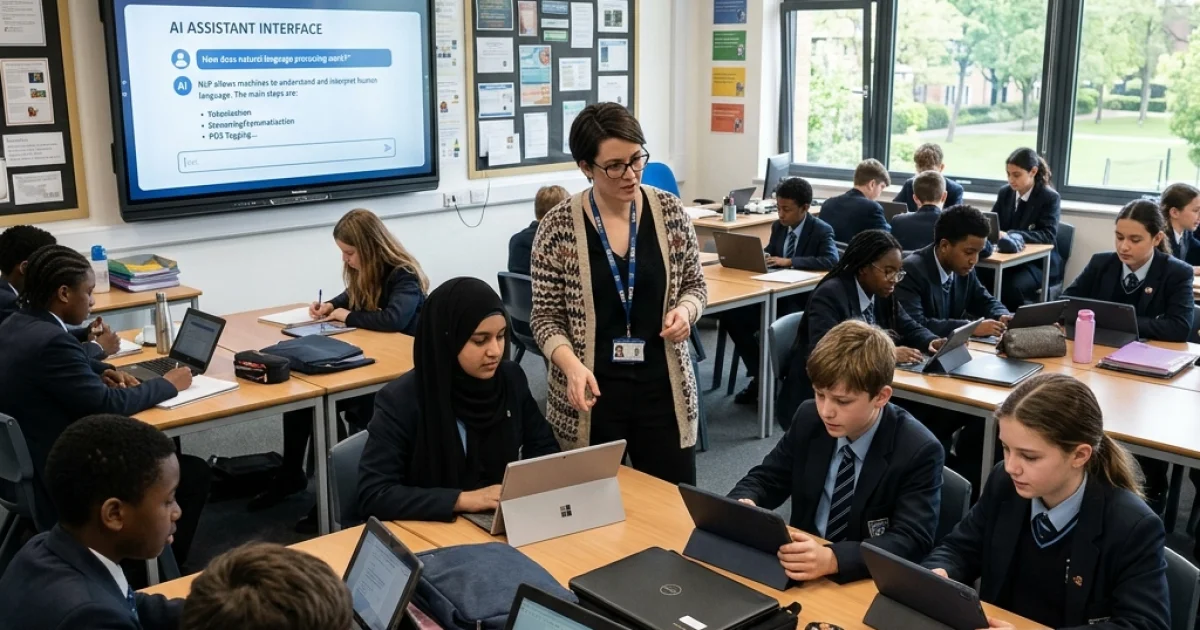
Artificial intelligence has entered England's classrooms — and it arrived faster than most schools were prepared for. Within months of ChatGPT's public launch in late 2022, secondary school teachers across the country were reporting students submitting AI-generated essays. By 2026, the conversation has shifted dramatically: from how do we prevent students using AI? to how do we embed AI responsibly as a learning tool?
This guide examines how English schools are navigating the integration of AI tools, what the government's position is, and what parents and students need to understand about the changing landscape of learning in an AI-augmented world.
📌 Did You Know?
A 2024 survey by BESA (British Educational Suppliers Association) found that over 60% of secondary school teachers in England had already encountered AI-generated work submitted by students — yet fewer than 20% reported receiving any formal guidance from their school on handling it.
Where Does England Stand on AI in Schools?
The Department for Education (DfE) published updated AI in education guidelines in 2024, acknowledging the technology's growing presence while stopping short of either banning or mandating specific tools. The official position in 2026 encourages schools to:
- Develop their own AI use policies tailored to their school context
- Prioritise AI literacy — teaching students how these tools work and their limitations
- Maintain academic integrity standards without blanket bans that could disadvantage pupils
- Explore AI as a differentiation and inclusion tool, particularly for SEND pupils
Ofsted has begun noting how schools approach digital literacy and emerging technology in inspection frameworks, though AI-specific criteria remain in development as of 2026.
How Schools Are Actually Using AI Tools in 2026
Across England, the use cases schools have adopted fall into a handful of broad categories:
1. Teacher Planning and Differentiation
The most widespread AI use in English schools is by teachers, not students. AI tools like Microsoft Copilot (integrated into Office 365, widely used across English schools) help staff generate differentiated lesson plans, create multiple reading levels of the same text, produce mark schemes, and write learning objective variants for mixed-ability classrooms in a fraction of the usual time.
2. Literacy Support and Feedback
Some schools — particularly those using platforms like Grammarly Education, Khanmigo (Khan Academy's AI tutor), or Microsoft's Reading Coach — are deploying AI to provide immediate writing feedback to students. Rather than waiting for teacher marking, pupils receive real-time suggestions on grammar, structure, and clarity.
3. Research Assistance in Controlled Conditions
A growing number of secondary schools allow controlled AI use during research phases of projects, treating it similarly to search engine use — with the explicit requirement that all sources are verified and the final output is the student's own original work.
4. SEND and EAL Support
AI tools have demonstrated particular value for students with special educational needs or English as an Additional Language. Text-to-speech, AI-powered translation assistants, and reading comprehension aids can provide differentiated access to curriculum content in ways that previously required extensive one-to-one support.
💡 Tip for Parents
Ask your child's school whether they have an AI Acceptable Use Policy. Many schools are still developing one. If your child is using AI tools to assist with homework, it is important both you and the school know — and that your child understands the difference between using AI as a learning scaffold and submitting AI work as their own.
The Academic Integrity Challenge
The most discussed AI issue in English schools remains academic dishonesty. AI-detection tools (such as Turnitin's AI detector, now integrated into most school plagiarism systems) have improved but remain imperfect. False positives can incorrectly flag human writing, particularly for students with certain writing styles or EAL backgrounds.
England's exam regulator, Ofqual, has clarified that:
- In controlled assessments and coursework, submitting AI-generated content as your own is treated as malpractice — the same as plagiarism
- In external examinations (GCSE and A-Level written papers), AI access is not possible, providing a natural verification point
- Schools must report confirmed cases of AI malpractice, which can result in disqualification from individual subjects
Is AI Widening or Narrowing the Attainment Gap?
This is one of the most pressing questions in English education research as of 2026. Early evidence is mixed:
- Potential to narrow the gap: When used as a personalised tutor (as Khan Academy's Khanmigo demonstrates), AI tools can provide Pupil Premium and SEND pupils with the kind of one-to-one adaptive support previously only available to better-resourced families through private tutors.
- Potential to widen the gap: Students from more affluent backgrounds with home access to premium AI tools, reliable broadband, and parents who can guide ethical use may benefit disproportionately — while disadvantaged pupils lack the infrastructure and guidance to engage with AI safely and productively.
⭐ Key Takeaway
AI in schools is not a threat to be feared or a shortcut to be exploited — it is a tool that reflects how it is used. Schools that integrate AI with clear policies, digital literacy education, and teacher development will produce students equipped for a world where AI competence is increasingly a baseline professional skill.
What Should Students Learn About AI?
Regardless of how individual schools approach AI tools, there are core AI literacy skills all secondary school students benefit from developing by Year 11:
- Prompt engineering basics — how to ask AI precise, contextual questions to get useful responses
- Critical evaluation of AI output — understanding that AI can hallucinate, fabricate citations, and reflect biases present in its training data
- Ethical AI use — knowing when using AI assistance is appropriate and when it constitutes academic dishonesty
- Data privacy awareness — understanding what information is safe to input into AI tools and what should never be shared
Summary
Artificial intelligence is already embedded in English classrooms in ways that range from invisible teacher planning tools to student-facing tutoring systems. In 2026, the schools navigating this shift most successfully are those with clear, flexible policies, strong digital literacy programmes, and a pragmatic recognition that AI literacy is now as fundamental as traditional literacy. For parents, the most important step is an open conversation with your child about what responsible AI use looks like — in and out of school.