
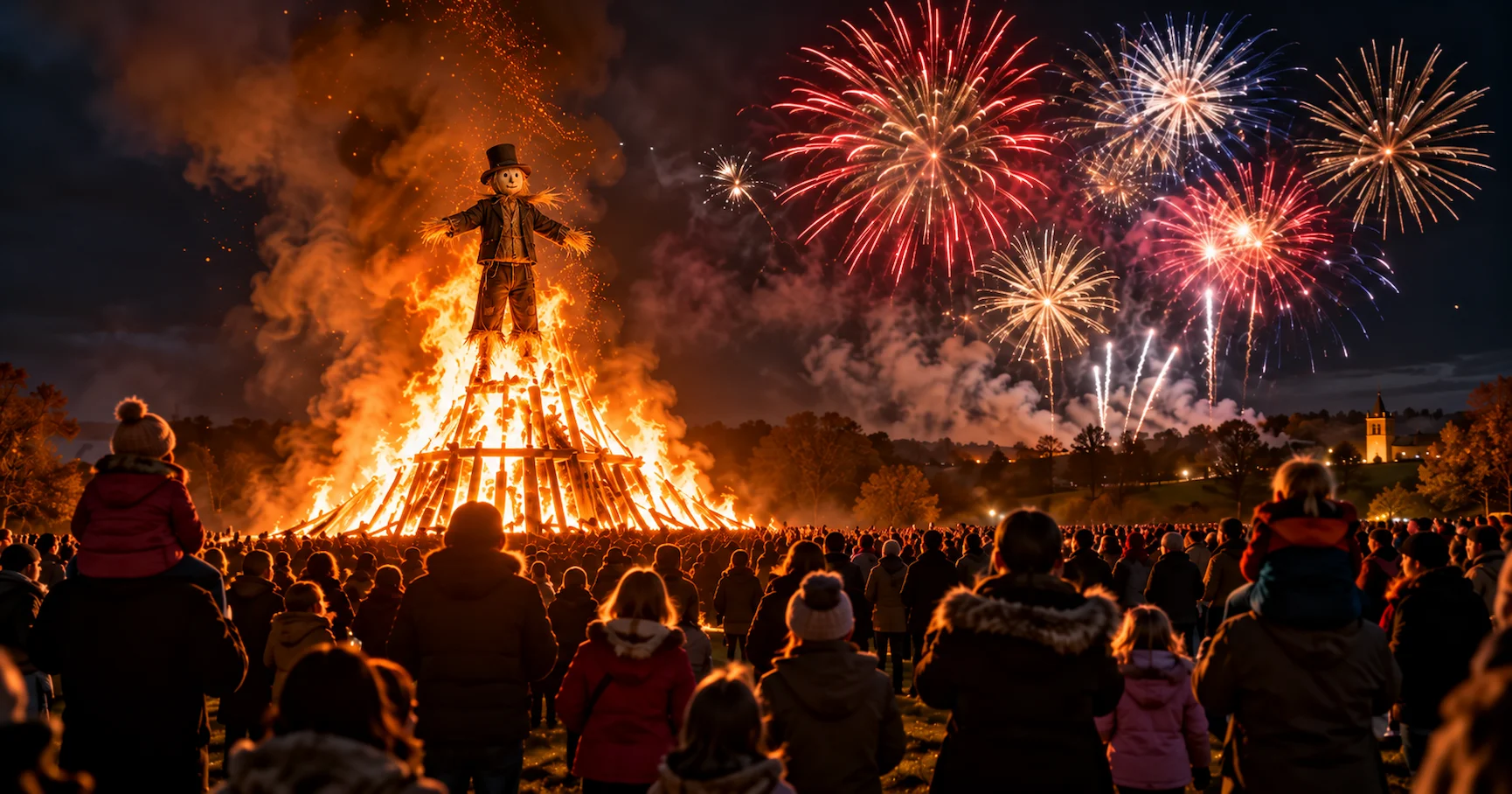
Every year on the evening of 5 November, bonfires are lit, fireworks fill the sky and "Remember, remember, the fifth of November" is recited across England. Bonfire Night — also called Guy Fawkes Night or Fireworks Night — is one of England's most distinctive annual traditions, with roots in a real historical conspiracy that unfolded more than four centuries ago.
For schools, Bonfire Night offers a rich cross-curricular opportunity: the Gunpowder Plot of 1605 sits within the KS2 history curriculum and connects naturally to topics in English, Art, PSHE and even science. This guide covers the historical background, the meaning of the tradition and practical classroom and home ideas.
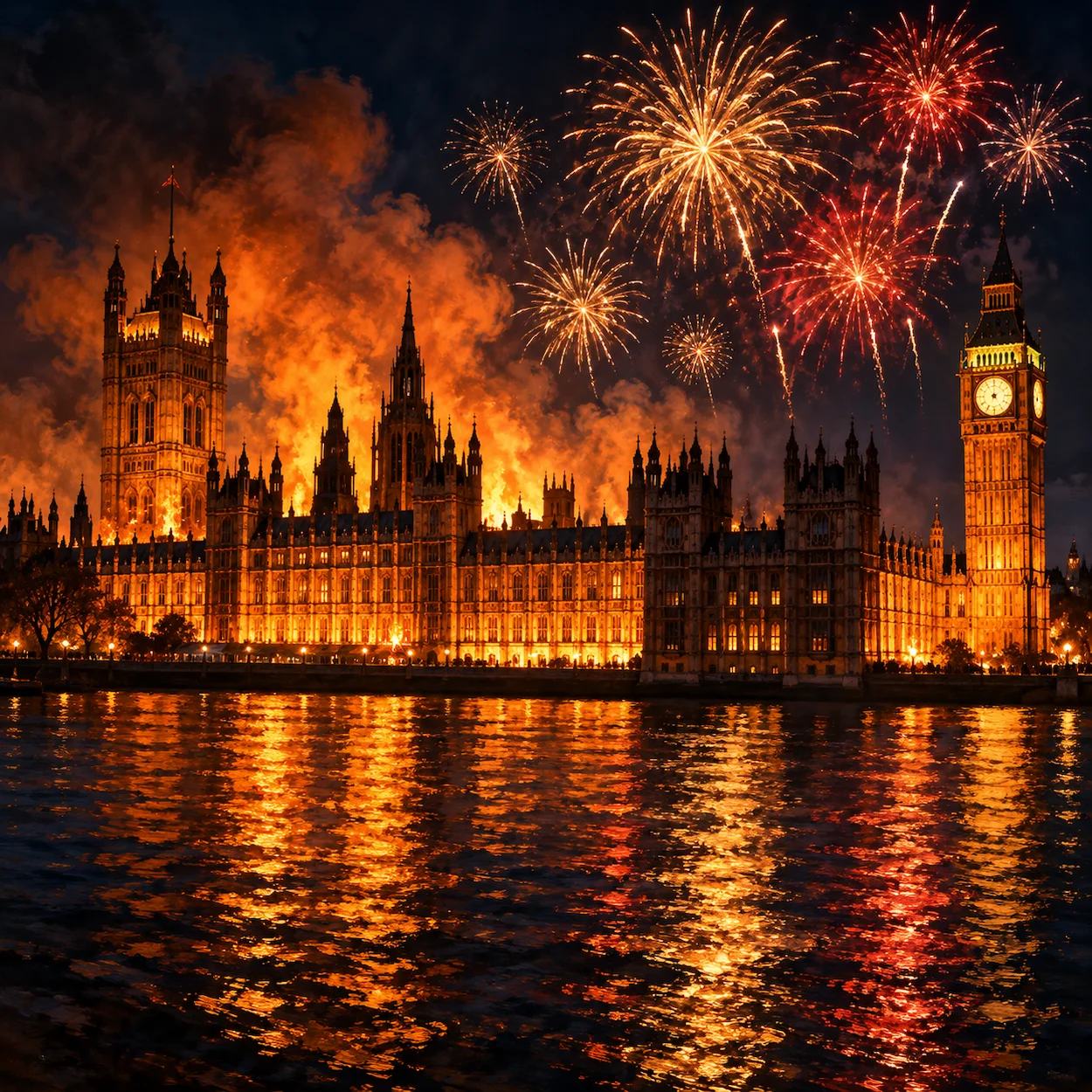
Bonfire Night has been celebrated in England virtually every year since 1606 — making it one of the oldest continuous public commemorations in the country. The original celebrations were authorised by Parliament through the Observance of 5th November Act 1605 (sometimes called the Thanksgiving Act), which required churches to hold a service of thanksgiving on 5 November each year. The Act remained on the statute book for over 250 years before being repealed in 1859.
What Was the Gunpowder Plot?
The Gunpowder Plot of 1605 was a failed assassination attempt against King James I of England and the entire Parliament, planned by a group of English Catholic conspirators frustrated by the persecution of Catholics under Protestant rule.
The key facts:
- When: The plot was planned for the State Opening of Parliament on 5 November 1605
- Who: A group of 13 conspirators, including Robert Catesby (the ringleader), Thomas Percy, John Wright and Guy Fawkes
- The plan: To blow up the House of Lords using 36 barrels of gunpowder smuggled into a cellar beneath the building
- Discovery: An anonymous letter was sent to William Parker, 4th Baron Monteagle, on 26 October 1605, warning him not to attend Parliament. The letter was passed to the authorities and the cellar was searched in the early hours of 5 November
- Arrest: Guy Fawkes was discovered guarding the gunpowder in the cellar and was arrested. Under torture, he revealed the names of the other conspirators
- Outcome: Fawkes and several co-conspirators were tried and executed for treason in January 1606
Who Was Guy Fawkes?
Guy Fawkes (1570–1606) was born in York into a Protestant family but converted to Catholicism following his mother's remarriage. He served as a soldier in the Spanish Netherlands and had military expertise in explosives — which is why the conspirators recruited him to guard and detonate the gunpowder.
Fawkes was not the ringleader of the plot (that was Robert Catesby), but he became the most famous figure associated with it because he was the man caught in the act. His name has become synonymous with the conspiracy itself.
After his arrest, Fawkes was tortured on the rack in the Tower of London. His signed confession — with a signature visibly weakened by the torture — is preserved in the National Archives. He was sentenced to be hanged, drawn and quartered, but jumped or fell from the scaffold and died of a broken neck before the disembowelling could take place, in January 1606.
 AI-generated image
Why Do We Burn a Guy?
The tradition of burning an effigy of Guy Fawkes on the bonfire began very shortly after the plot's discovery in 1605. Bonfires were lit across London on the night of 5 November 1605 to celebrate the King's survival, and effigies of the Pope and of Fawkes were burned as part of the anti-Catholic celebrations.
Over the centuries, the religious animosity faded and the tradition became a secular folk celebration. The practice of making a stuffed figure — a "Guy" — was traditionally a children's activity: children would parade their Guy through the streets beforehand, asking passers-by for "a penny for the Guy" to buy fireworks. This practice has largely died out in contemporary England, but the burning of a Guy on the bonfire remains common at organised public displays.
The word "guy" (meaning a person of strange appearance or, later, simply any person) entered the English language from this tradition — spreading to the United States where it became a general informal term for any person.
The Poem: "Remember, Remember"
The most famous verse associated with Bonfire Night is:
Remember, remember, the fifth of November,
Gunpowder, treason and plot.
I see no reason why gunpowder treason
Should ever be forgot.
This verse dates from the 17th century, though its exact origin is uncertain. Longer versions of the poem exist, with additional verses that are more explicitly anti-Catholic in tone — these are rarely quoted today. The opening quatrain, however, has become a cultural touchstone and is recognised across England.
Classroom Ideas for Schools
History (KS2 — Years 3–6)
- The Gunpowder Plot investigation: Present children with a simplified version of the evidence — the anonymous letter, the discovery of the cellar, Fawkes's confession — and ask them to piece together what happened, as if they are historical detectives
- Primary sources: The original "Monteagle Letter" warning of the plot is held in the National Archives and is available online. Looking at a facsimile of a 400-year-old document is a powerful historical experience for Year 5 and 6 pupils
- Timeline: Place the Gunpowder Plot within the broader context of the English Reformation, the reign of Elizabeth I, the Spanish Armada and James I's accession — showing how religious conflict shaped 17th-century England
- Cause and consequence: Why did the conspirators feel driven to act? What were the consequences — for Catholics in England, for Parliament, for attitudes to treason?
English and Literacy
- News report: Write a newspaper front page from 6 November 1605 reporting the discovery of the plot
- Diary entry: Write from the perspective of Guy Fawkes in the hours before his arrest, or of a guard making the discovery
- Retell the poem: Read the full traditional rhyme and ask children to identify the viewpoint — who is speaking and what do they think of the plotters?
- Persuasive writing: Was Guy Fawkes a terrorist or a freedom fighter? A structured debate or essay task for Year 6
Art and DT
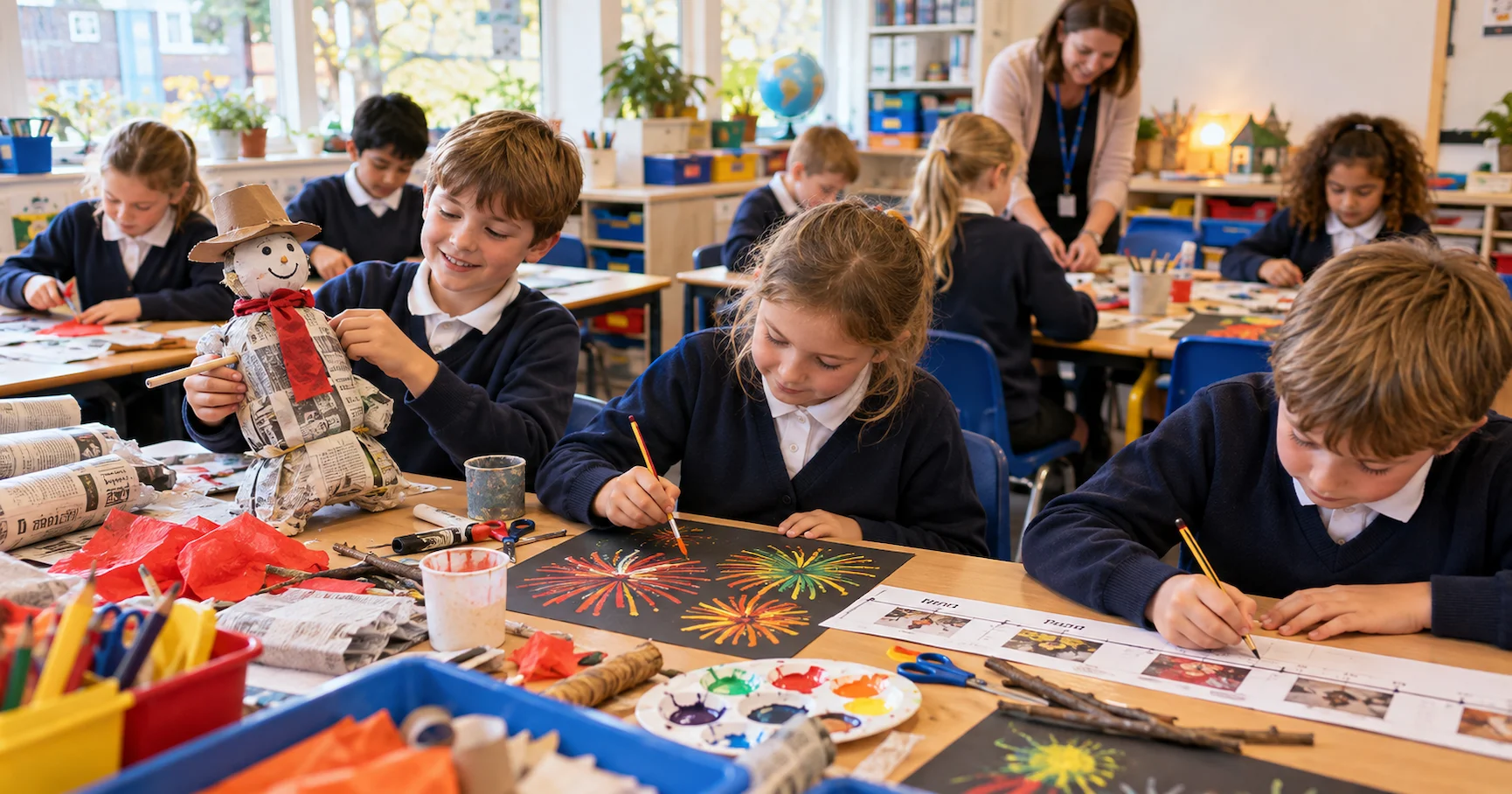
- Fireworks paintings: Use black paper and bright poster or acrylic paint to create firework burst images — a classic and effective art activity for all primary ages
- Make a Guy: Using old newspaper and clothing scraps, create a traditional stuffed Guy figure — a DT project with historical roots
- Collage bonfires: Torn paper in orange, red, yellow and black layered on dark card to create bonfire scenes
Science (KS2)
- How do fireworks work? A simplified explanation of combustion, chemical reactions and the metal salts that create different colours (strontium for red, barium for green, copper for blue)
- Firework safety: A PSHE-linked science discussion on the Firework Code and why safety rules exist
 AI-generated image
Firework Safety: Key Messages for Children
The Royal Society for the Prevention of Accidents (RoSPA) and the government's Firework Code recommend the following rules, which are appropriate to share with primary age children:
- Only adults should light fireworks — never children
- Keep fireworks in a closed metal box and take them out one at a time
- Never return to a firework once it has been lit
- Keep pets indoors — fireworks are distressing to animals
- Never throw fireworks
- Sparklers: hold at arm's length, wear gloves, never give to children under 5, and put used sparklers in a bucket of cold water
- Go to an organised public display rather than holding a private one where possible
Frequently Asked Questions
Is Guy Fawkes celebrated as a hero or a villain in England?
Historically, Fawkes was very much a villain — the original Bonfire Night celebrations were explicitly about celebrating his failure and the survival of the Protestant King. Over time, the meaning has become more ambiguous. In popular culture, particularly following Alan Moore's graphic novel and the 2005 film V for Vendetta, the Guy Fawkes mask has been adopted as a symbol of anti-establishment protest — largely divorced from the original Catholic context. In schools, the Gunpowder Plot is typically taught as a historical event without strong moral judgement on Fawkes personally, focusing instead on the religious and political causes and consequences.
Was Guy Fawkes the ringleader of the Gunpowder Plot?
No. The principal organiser was Robert Catesby, a charismatic English Catholic gentleman who conceived and led the conspiracy. Guy Fawkes joined as a military expert — he had experience with explosives from his time as a soldier in the Spanish Netherlands. Fawkes became the most famous figure because he was the one caught in the cellar on the night, but Catesby died fighting government forces in Staffordshire on 8 November 1605, four days after the plot was discovered.
Why is Lewes in East Sussex particularly famous for Bonfire Night?
Lewes holds one of the most elaborate Bonfire Night celebrations in England, featuring multiple processions by rival bonfire societies, elaborate costumes, flaming torches and the burning of effigies — including controversial ones of contemporary figures. The tradition in Lewes is exceptionally strong partly because the town also commemorates 17 Protestant martyrs who were burned at the stake in Lewes during the reign of Mary I in the 1550s. Lewes's Bonfire Night has both the Gunpowder Plot and this earlier martyrdom as its historical references.
What age is the Gunpowder Plot usually taught in English schools?
The Gunpowder Plot is most commonly taught in Year 4 or Year 5 (ages 8–10), within the KS2 history curriculum. It fits naturally within a topic on the Stuarts or on the causes and effects of religious conflict in early modern England. Some schools introduce it as early as Year 3 as a class topic around Bonfire Night, focusing on the story rather than detailed historical analysis. At Year 6, it can be revisited with a more analytical focus — looking at primary sources, cause and effect, and the ethics of political violence.
Are fireworks legal for the public to buy in England?
Yes, subject to restrictions. In England, members of the public can legally purchase Category F2 fireworks from licensed retailers during the periods around Bonfire Night, New Year's Eve, Diwali and Chinese New Year. Category F3 and F4 fireworks are restricted to professionals. There are rules about where fireworks can be set off (not within 50 metres of a highway, for example) and curfew hours apply — fireworks must not be set off after 11pm on most nights, extended to midnight on 5 November and 1am on New Year's Eve. Local authorities can also introduce additional restrictions in their area.
Is Bonfire Night celebrated anywhere else in the world?
Bonfire Night is primarily an English tradition, though it is observed to varying degrees in other parts of the United Kingdom and in some former British colonies — notably New Zealand, where Guy Fawkes Night has historically been celebrated with fireworks and bonfires, though public firework sales are increasingly restricted there. In most other countries, including the United States, Canada and Australia, 5 November has no cultural significance. The Guy Fawkes mask, however, has achieved worldwide recognition as a protest symbol through V for Vendetta and its adoption by the Anonymous movement.


