

Every August, parents across England face the same ritual: the back-to-school uniform shop. Whether it is a child starting Reception for the first time or a teenager heading into Year 7, the question is always the same — how much do I actually need to buy? Buy too little and you spend September doing emergency washes at 10pm. Buy too much and you discover by October that your child has grown out of the trousers you bought in bulk at the end of July.
This guide cuts through the confusion with practical quantities, cost estimates, shopping strategies, and tips on how to spend less without your child looking like they got dressed in the dark.
A 2023 survey by the Children's Society found that the average cost of a secondary school uniform in England — including all branded and non-branded items, shoes, and PE kit — was £442 per pupil per year. For primary school children, the average was £315. These costs fall disproportionately on lower-income families, which is why a growing number of local authorities offer uniform grants and schools are legally required to keep branded uniform requirements to a minimum.
Step 1: Read the School's Uniform Policy First
Before buying a single item, download or request the school's uniform policy from its website or office. This is the only document that tells you exactly what is and is not permitted. Pay close attention to:
- Branded vs. non-branded items: Schools can only require branded items (with a school logo) where the cost is reasonable and alternatives are available second-hand. Items such as PE kits, blazers, and ties are most commonly branded. Basic items like white shirts, grey trousers, black shoes, and plain jumpers are almost never required to be branded.
- Specific colours: Some schools specify exact shades (e.g., "royal blue" not "navy"). Getting this wrong is a common and avoidable mistake.
- Footwear rules: Many schools specify black leather or leather-look shoes — trainers are usually not allowed as school shoes even if they are black.
- Jewellery and hair: Understanding the policy before the first week saves your child from unnecessary detention on day one.
If branded items are required (blazers, ties, PE kits with the school logo), buy exactly what the school specifies — these items usually cannot be substituted. But for every non-branded item (white shirts, grey/black trousers or skirts, plain jumpers), you can buy from any retailer. Supermarket own-brand school uniforms from Asda, Tesco, Sainsbury's, and Matalan are significantly cheaper than department stores and typically just as durable for primary-age children.
Step 2: How Many of Each Item?
The honest answer to "how many uniforms do I need?" is: enough to get through a week without doing laundry mid-week, with one spare for emergencies. Here are practical quantities for different school stages:
Primary School (Reception – Year 6)
| Item | Recommended Quantity | Notes |
|---|---|---|
| School polo shirts / shirts | 5–7 | Young children get dirty; 5 lets you wash at weekends only; 7 gives breathing room |
| School jumper / cardigan | 2–3 | 1 on, 1 spare, 1 for when the first two disappear |
| Trousers / skirts / pinafores | 3–5 | 3 is minimum; 5 is comfortable for Reception and Year 1 where accidents can happen |
| School shoes | 1 pair | Buy in August; check fit in October — feet grow fast |
| PE kit (shorts + t-shirt) | 2 sets | Some schools do PE twice a week; having 2 means you can wash after each session |
| Plimsolls / trainers (for PE) | 1 pair | Keep in school bag in a drawstring bag |
Secondary School (Year 7 – Year 11)
| Item | Recommended Quantity | Notes |
|---|---|---|
| School shirts / blouses | 5 | Teenagers are more careful than primary-age children; 5 covers the week |
| School blazer | 1 (2 if budget allows) | Most expensive item; second blazer is a luxury but useful when first is at the dry-cleaner |
| School tie | 2 | They get lost; buy a spare immediately |
| Trousers / skirt | 2–3 | Older children change less often; 2 is usually enough |
| School shoes | 1 pair | Quality matters more at secondary — they walk further and carry heavier bags |
| Full PE kit | 2 sets | Secondary PE includes outdoor sports — check if kit includes football/hockey socks, gum shields, etc. |
| Sports trainers | 1 pair | Separate from school shoes; kept in the PE bag |

Step 3: Where to Buy — From Cheapest to Most Expensive
1. Your School's Second-Hand Uniform Shop ⭐ Cheapest
Many primary and secondary schools in England run a second-hand or pre-loved uniform shop — often managed by the PTA. Branded items (blazers, ties, PE kits with the school logo) in good condition are available for a fraction of the retail price. Check the school website or ask at the office. These items are identical to new ones — just previously worn.
2. Supermarkets (Asda, Tesco, Sainsbury's, Matalan)
For non-branded basics — white shirts, polo shirts, grey trousers, school pinafores, black school shoes — supermarket own-brand ranges are excellent value. Most run annual back-to-school promotions in July and August with significant discounts. A complete set of 5 polo shirts can cost as little as £5–£10 for primary-age children.
3. M&S, Next, John Lewis
Higher price point but noticeably better fabric quality and construction — particularly for blazers, trousers, and skirts. Many parents find that mid-range uniform items last longer and look better after repeated washing, making the higher upfront cost worthwhile. These retailers also tend to have better size ranges, including slim, regular, and plus fits, and girls' options beyond skirts and pinafores.
4. School's Official Uniform Supplier
For branded items (with the school logo), schools usually specify one or two approved suppliers — either the school office itself, or a local or online uniform specialist. These are the most expensive items and typically non-negotiable, but check whether the school runs end-of-year sales or whether second-hand branded items are available before buying new.
The smart strategy is to mix and match: buy branded items (blazer, tie, PE kit) second-hand from the school's pre-loved shop, and buy non-branded basics (shirts, trousers, skirts) from a supermarket. This combination can reduce a £442 average secondary uniform cost to under £150 — without any visible difference in your child's appearance at the school gate.
Step 4: How to Make Uniform Last Longer
Label Everything
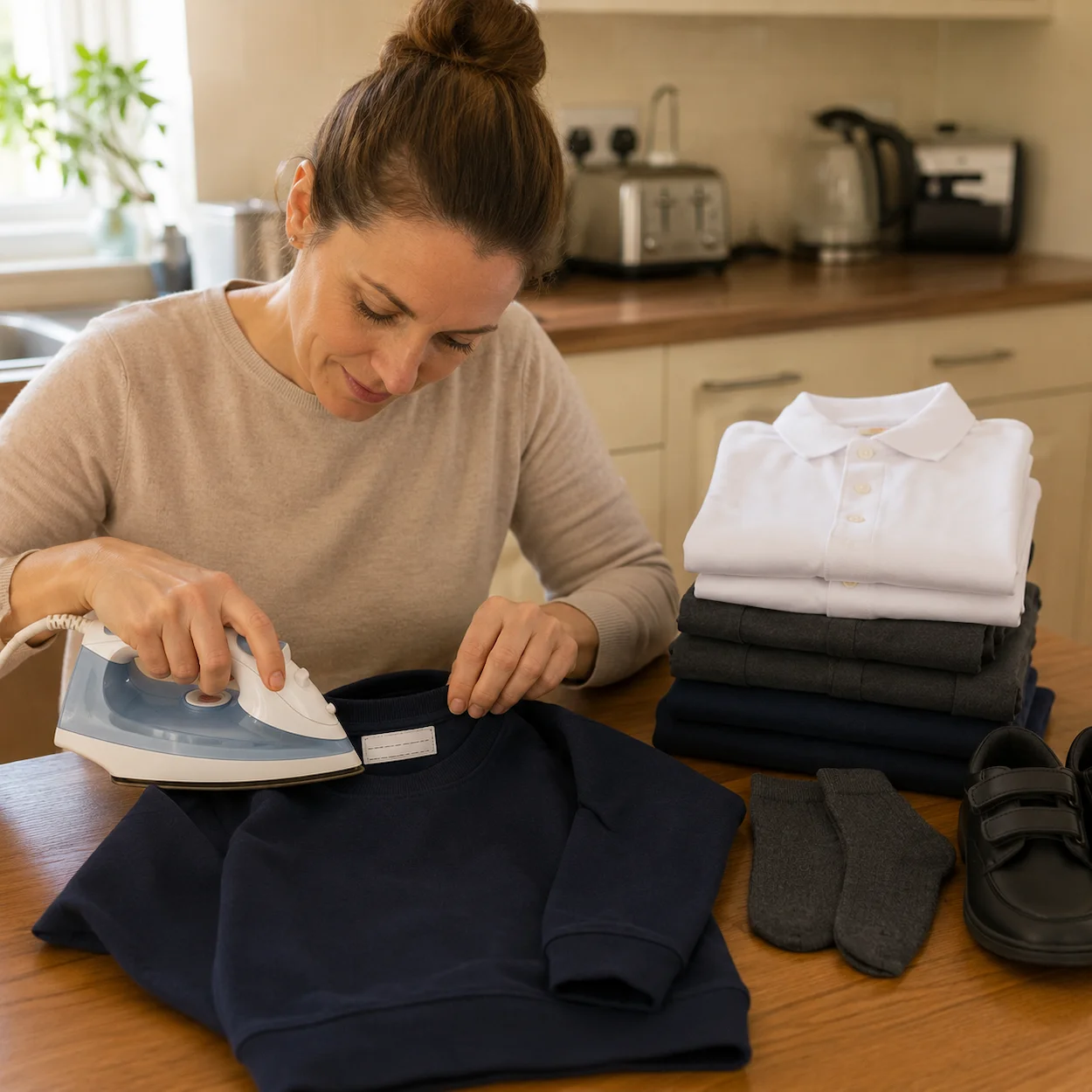
The single most effective way to reduce uniform costs is to ensure lost items are returned. Unlabelled jumpers, PE kits, and coats that are left in changing rooms, on the sports field, or on pegs simply disappear. Iron-on name labels, stick-on labels, or a permanent fabric marker applied to the label or inside the collar are all effective. Apply labels to every item including shoes, PE bag, and water bottle.
Buy One Size Up for September
Children grow fastest in spring and summer. A uniform bought in August to fit exactly will often feel tight by Christmas, particularly for primary-age children. Buying trousers with adjustable waists (standard in most supermarket ranges) and shirts one size larger than current means they will still fit at Easter — saving you a mid-year purchase.
Wash on the Right Cycle
Most school polo shirts and shirts are polyester-cotton blends. Washing at 30–40°C on a short cycle and line-drying (rather than tumble-drying) significantly extends the life of the fabric and reduces pilling and shrinkage. School jumpers knit from acrylic or wool-blend fibres should be turned inside out before washing to reduce pilling on the visible outer surface.
Step 5: Financial Help — Uniform Grants and Free Uniform
If the cost of school uniform is a genuine financial barrier, there are several sources of support available in England:
Local Authority Uniform Grants
Some local councils in England offer one-off grants to help with uniform costs. Eligibility is typically linked to receiving Free School Meals or being in receipt of certain benefits. There is no national scheme — provision is a "postcode lottery" — so the starting point is to contact your local council directly and ask what support is available for school uniform costs.
Free School Meals Link
Children who are eligible for Free School Meals are also usually eligible for any LA uniform grant where one exists. If you have not registered for Free School Meals and think you may be eligible, do so immediately — it also generates Pupil Premium funding for the school that supports your child's learning. See our guide to Free School Meals eligibility in England.
Charitable Grants
A small number of national charities offer grants specifically for school uniform costs to families in financial hardship. The Fashion and Textile Children's Trust (FTCT) is the most widely known, offering grants of £50–£150 for uniform costs to eligible families. Applications are made online and grants are paid directly to the retailer.
School Hardship Funds
Many schools in England have an informal hardship fund — managed by the headteacher or pastoral team — that can provide uniform items directly to families who need them without a formal application process. This is not widely publicised but is worth asking about discreetly if cost is a significant concern.
Frequently Asked Questions
Can the school make me buy only from their official supplier?
Schools can specify branded uniform items (with their logo) and direct you to an approved supplier for those items. However, they cannot require branded items for the majority of what a child wears. Government guidance requires schools to limit branded uniform requirements to keep costs down. For non-branded items — white shirts, grey trousers, plain jumpers — you can buy from any retailer.
My child has just started school and the uniform is already destroyed — is that normal?
For Reception and Year 1 children — absolutely. Young children eat, paint, play in mud, and generally treat clothing as a creative canvas. This is developmentally normal and why buying cheaper supermarket basics for younger children is wise. Save investment in quality items for older children who are more careful with clothing and whose body shape is more stable.
What do I do with uniform my child has grown out of?
Donate it back to the school's second-hand uniform shop — especially branded items like blazers and PE kits, which are the most expensive items for incoming families. Most schools welcome uniform donations and some PTA groups will collect at the end of each school year. Non-branded items in good condition can also be donated to local charity shops or sold on platforms like Vinted, Facebook Marketplace, or eBay.
Do I need to buy uniform before the school sends an official list?
No. Wait for the official uniform list — which is usually sent in the offer letter or available on the school's website — before purchasing anything. Buying in advance based on a general assumption about what the school requires is how families end up with the wrong shade of blue or the wrong type of shoe. The wait is worth it.


