
Around one-third of all state-funded mainstream schools in England have a designated religious character — commonly known as faith schools. That is approximately 6,800 schools, educating millions of pupils from every background. Whether you are a practising member of a faith community or not, there is a good chance that a faith school is among the options available to you when choosing a primary or secondary school. This guide explains how they work, how their admissions policies operate, what their curriculum looks like, and what your rights are as a parent — regardless of your own beliefs.
Approximately 31% of all state-funded schools in England have a religious character. Of these, around 68% are Church of England, 29% are Roman Catholic, and roughly 3% are other faiths (Jewish, Muslim, Sikh, Hindu, Methodist and others). All faith schools are free to attend, inspected by Ofsted, and must follow the School Admissions Code. They exist across all four school types: voluntary aided, voluntary controlled, academies and free schools.
What Is a Faith School?
A faith school is a state-funded school that has a designated religious character. This means it was established by or in partnership with a religious organisation — most commonly the Church of England or the Roman Catholic Church — and retains a religious ethos that shapes its values, worship, curriculum and sometimes its admissions criteria.
Faith schools are not the same as independent religious schools. All state-funded faith schools in England are free to attend, do not charge tuition fees, and are subject to the same Ofsted inspections and national standards as any other state school. What distinguishes them is their religious character and — in some cases — their ability to give priority in admissions to children from families of the same faith.
Types of Faith School: VA, VC, Academies and Free Schools
Understanding the legal type of a faith school matters because it determines who controls admissions and how the school is funded and governed.
| Type | Who sets admissions? | Who employs staff? | Funding route | Can use faith criteria? |
|---|---|---|---|---|
| Voluntary Aided (VA) | Governing body | Governing body | Via local authority | Yes — if oversubscribed |
| Voluntary Controlled (VC) | Local authority | Local authority | Via local authority | Limited or none |
| Faith Academy | Academy trust | Academy trust | Direct from government | Yes — if oversubscribed |
| Faith Free School | Academy trust | Academy trust | Direct from government | Up to 50% of places |
Voluntary Aided (VA) Schools
VA schools are the most distinctively faith-based type. The governing body — rather than the local authority — is the employer of staff and the admissions authority. Religious foundation governors hold a majority on the board, ensuring the faith ethos is maintained. The religious trust or diocese typically owns the land and buildings, and is legally responsible for contributing 10% of capital costs (repairs and improvements), with the government funding the remaining 90%.
VA schools have the most latitude to use religious criteria in admissions when oversubscribed. Most Roman Catholic schools and many Church of England secondary schools operate as VA schools.
Voluntary Controlled (VC) Schools
VC schools have a religious character but operate more like standard community schools. The local authority is the employer of staff and sets the admissions criteria — the religious trust appoints a minority of foundation governors but has less direct control. VC schools generally cannot use faith criteria as heavily in admissions and usually follow the local authority's agreed RE syllabus rather than their own denominational one. Many Church of England primary schools operate as VC schools.
Faith Academies and Free Schools
Academies with a religious character operate outside local authority control, funded directly by central government. They follow their own admissions arrangements (within the School Admissions Code) and may use faith criteria if oversubscribed. Faith free schools — a subset of academies established from scratch — are subject to a specific rule: they may allocate a maximum of 50% of places on the basis of faith if oversubscribed. This cap does not apply to converted academies (those that were previously VA or VC schools).
Admissions: How Faith Schools Select Pupils
This is the area parents most frequently want to understand. The fundamental rule is straightforward: a faith school can only use religious criteria to select pupils if it is oversubscribed. If a faith school has more places than applicants, it must admit every applicant regardless of faith background. Religious criteria only apply when demand exceeds supply.
When oversubscribed, faith schools typically apply their oversubscription criteria in a priority order that complies with the School Admissions Code. The code requires that looked-after children (children in care) and previously looked-after children are always given top priority at all state schools, including faith schools. Religious criteria then apply within that framework.
 AI-generated image
Church of England Schools: Admissions in Practice
Church of England schools vary considerably in how they apply faith criteria, reflecting the Church's self-description as both a distinctively Christian institution and a school for the whole community. Key points:
- Many C of E primary schools, particularly VC schools, do not use faith criteria at all — they operate on the same basis as community schools (distance, siblings)
- Where C of E VA schools do use faith criteria, they typically ask for evidence of regular church attendance — for example, attendance at Sunday services at least once or twice a month over a specified period, verified by the vicar or minister of the church
- Some schools ask for attendance at any Christian church, not necessarily Anglican
- C of E schools generally do not require baptism certificates in the same way Catholic schools do, though some do require them
- Criteria and weighting vary significantly between individual schools — always read the specific school's admissions policy carefully
Catholic Schools: Admissions in Practice
Catholic schools tend to have more standardised and stricter faith criteria, reflecting the higher demand for Catholic secondary places in particular. Typical oversubscription priority for a Catholic VA school:
- Looked-after and previously looked-after Catholic children
- Baptised Catholic children with a Certificate of Catholic Practice (signed by a parish priest confirming regular Mass attendance)
- Other baptised Catholic children (without the certificate, or not yet practising regularly)
- Other looked-after children
- Children of other Christian denominations (usually requiring their own baptism certificate or minister's letter)
- Children of other faiths
- All other children
The Certificate of Catholic Practice is a key document for Catholic school applications. It is signed by the family's parish priest and confirms that the child was baptised Catholic and that the family attends Mass regularly. Families planning to apply to a Catholic school are advised to obtain this certificate well before the application deadline and to ensure they are registered at a parish.
Jewish, Muslim, Sikh and Other Faith Schools
There are smaller numbers of state-funded schools with Jewish, Muslim, Sikh, Hindu and other Christian denomination designations. Their admissions criteria follow the same legal framework — religious criteria only when oversubscribed, must comply with the Admissions Code — but the specific evidence required (for example, proof of Jewish identity via the mother's religion for some Jewish schools, or confirmation of mosque attendance for some Muslim schools) varies. Always check the individual school's admissions policy and supplementary information form (SIF) directly.
Many faith schools use a Supplementary Information Form (SIF) alongside the local authority's common application form. The SIF collects the religious evidence the school needs to apply its faith criteria — for example, baptism certificates, parish priest letters or attendance records. Crucially, you must submit both forms: submitting only the local authority form without the SIF means the school cannot assess you under any faith criteria and will treat your application as a non-faith applicant. Always check whether a school uses a SIF and submit it by the school's own deadline.
Curriculum: What Is Taught Differently in Faith Schools?
Faith schools follow the same broad curriculum as all other state schools, but there are specific differences — most importantly in Religious Education and collective worship.
Religious Education (RE)
RE is a compulsory subject in all state-funded schools in England. In non-faith schools, RE must follow the locally agreed syllabus produced by the local SACRE (Standing Advisory Council on Religious Education), which must reflect the fact that Christianity is the main religion in Britain while also covering other principal faiths.
In faith schools:
- VA schools and faith academies can teach RE in accordance with the tenets and practices of their designated faith — so a Catholic VA school can teach distinctively Catholic RE
- VC schools usually follow the local agreed syllabus, the same as community schools
- Parents retain the absolute legal right to withdraw their child from RE at any school, including faith schools. Sixth-form students (ages 16–18) can withdraw themselves without parental consent
Collective Worship
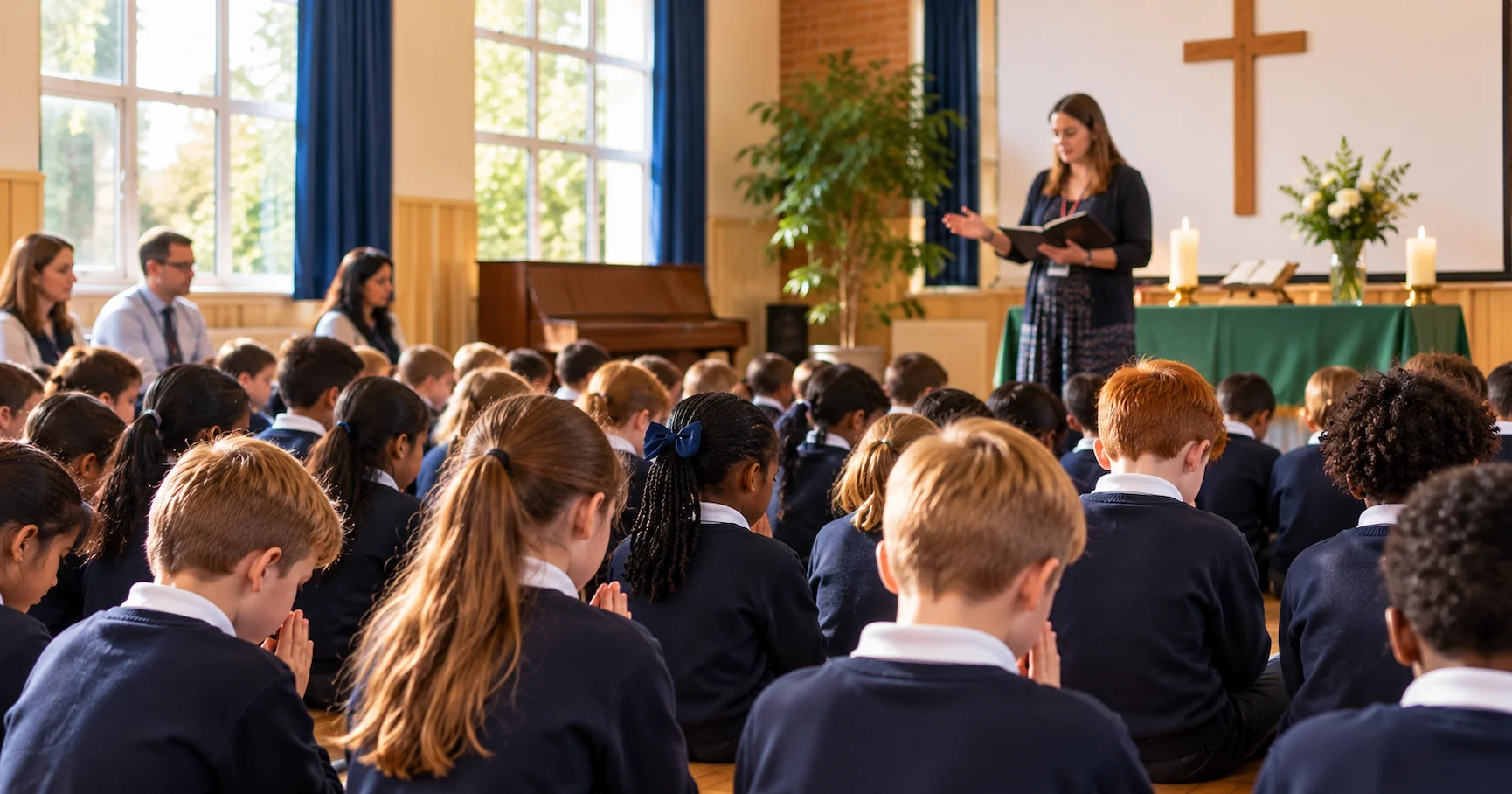
All state-funded schools in England are required by law to provide a daily act of collective worship for all pupils. In non-faith schools, this must be "wholly or mainly of a broadly Christian character". In faith schools, collective worship reflects the tenets and practices of the school's designated faith — so worship in a Catholic school is distinctively Catholic, in a Jewish school it is distinctively Jewish, and so on.
Parents have an absolute right to withdraw their child from collective worship at any state school, without needing to give a reason. In faith schools, this right is the same as in any other school. If your child is withdrawn, the school must provide appropriate supervision during the worship period but is not required to provide alternative education at that time.
 AI-generated image
The Rest of the Curriculum
Beyond RE and collective worship, faith schools teach the same subjects as all other state schools — English, mathematics, science, history, geography, languages, art, music, PE and so on. In VA schools and VC maintained schools, the National Curriculum applies. Faith academies and free schools have flexibility over curriculum design but must still provide a broad and balanced curriculum and must teach RE.
Inspection: How Are Faith Schools Assessed?
Faith schools are subject to two separate inspection regimes:
- Ofsted (Section 5 or Section 8): Inspects overall quality of education, leadership, behaviour and attitudes, personal development, and safeguarding — the same framework as all other state schools. Ofsted does not inspect or grade the content of denominational RE or the quality of religious worship in faith schools.
- Denominational inspection (Section 48): A separate inspection of the school's religious character, the quality of denominational RE and collective worship. For Church of England and Methodist schools, this is the SIAMS inspection (Statutory Inspection of Anglican and Methodist Schools), arranged by the relevant diocese. For Catholic schools, it is arranged by the Catholic Diocesan Education Service. The outcome of a Section 48 inspection is separate from the Ofsted grade and does not affect the Ofsted rating.
Can a Non-Religious Family Apply to a Faith School?
Yes — and many do. Several important points:
- If a faith school is not oversubscribed, it must admit every applicant regardless of religion. In many areas, particularly for less in-demand faith schools, this means faith criteria never come into play at all.
- Even when oversubscribed, faith schools admit pupils who do not meet their faith criteria — they are simply lower in the priority order. If all faith-criterion places are filled but the school still has capacity, non-faith applicants will be offered places.
- Once admitted, all pupils — regardless of their religious background — attend the same lessons, including RE and collective worship, unless parents exercise their right of withdrawal.
- Faith schools are legally prohibited from discriminating against pupils once admitted on the basis of religion or non-religion in how they are treated within the school.
For parents considering a faith school primarily for academic or pastoral reasons rather than religious ones, it is worth checking the school's specific admissions criteria carefully to understand your realistic chance of securing a place. The catchment area tool on this site can help you identify which schools are within reach and how competitive they are likely to be. You can also compare schools side by side to weigh up faith and non-faith options in your area.
Frequently Asked Questions
Do faith schools have to follow the National Curriculum?
Voluntary Aided and Voluntary Controlled faith schools must follow the National Curriculum in the same way as other maintained schools. Faith academies and faith free schools have freedom over parts of the curriculum (as all academies do), but must still provide a broad and balanced curriculum and are required to teach Religious Education. All state-funded faith schools teach the same core subjects — English, maths, science and so on — as any other state school.
Can I withdraw my child from RE or collective worship at a faith school?
Yes. Parents have an absolute legal right to withdraw their children from RE and from collective worship at any state-funded school, including faith schools. You do not need to give a reason. The school must provide supervision for your child during withdrawn periods but is not required to provide alternative education during collective worship time. Students aged 16 and over in sixth form can exercise this right themselves, without parental consent.
Do I need to be religious to get my child into a faith school?
Not necessarily. Faith schools can only use religious criteria when they are oversubscribed. If a faith school has more places than applicants, it must admit everyone regardless of faith. Even when oversubscribed, non-faith applicants may still receive places if there is capacity after faith-criterion places are allocated. The extent to which religious criteria matter depends entirely on how competitive the individual school is for places — this varies significantly between schools and areas.
What is a Supplementary Information Form (SIF) and do I need one?
A Supplementary Information Form (SIF) is a form used by some faith schools to collect the religious evidence needed to assess applications under faith criteria — such as baptism certificates, parish letters or evidence of regular religious attendance. You must submit both the local authority's common application form AND the school's SIF to be considered under faith criteria. If you submit only the local authority form, the school will treat your application as a non-faith applicant. Always check whether a school uses a SIF and submit it by the school's own deadline, which may differ from the local authority deadline.
What is the difference between a Voluntary Aided and a Voluntary Controlled faith school?
In a Voluntary Aided (VA) school, the governing body (not the local authority) sets admissions criteria, employs staff and can use faith criteria when oversubscribed. The religious trust is responsible for 10% of capital costs. In a Voluntary Controlled (VC) school, the local authority sets admissions and employs staff; the religious trust appoints a minority of governors. VC schools generally have less scope to use faith criteria and usually follow the local authority's agreed RE syllabus rather than a denominational one. Most Catholic schools and many C of E secondary schools are VA; many C of E primary schools are VC.
How many faith schools are there in England?
Approximately 31% of all state-funded mainstream schools in England have a designated religious character — roughly 6,800 schools in total. Around 68% of these are Church of England, around 29% are Roman Catholic, and the remaining 3% include Jewish, Muslim, Sikh, Hindu, Methodist and other Christian denomination schools. Faith schools exist at both primary and secondary level, though the proportion is higher at primary.