
Long division is one of the most commonly tested skills in the Year 6 KS2 SATs arithmetic paper. It is also one that many children — and parents — find confusing, largely because the standard method (called the "bus stop" method in England) requires a sequence of steps that must be followed in the right order every time.
This guide walks through the bus stop method from scratch with clear worked examples, starting with simple division by a single digit and building up to division by two-digit numbers and calculations with remainders.
In the Year 6 arithmetic paper, long division questions typically involve dividing a 3 or 4-digit number by a 2-digit number. Children are expected to show their working. The method does not have to be the bus stop — but it must be a written method, not just a mental calculation or guess. The bus stop method is the most widely taught written method in England and is what most Year 6 teachers prepare pupils to use.
Understanding the Bus Stop Method
The bus stop method gets its name from its layout: a curved line is drawn over the dividend (the number being divided), like the roof of a bus stop shelter. The divisor (the number you are dividing by) sits to the left, outside the shelter.
       _______
  16 ) 4 3 2
The method works from left to right through the digits of the dividend, asking at each step: "How many times does the divisor go into this number?" Any remainder from one step is carried across to the next digit.
Worked Example 1: Simple Division (No Remainder)
Calculate 432 ÷ 16
Step 1: Look at the first digit of the dividend: 4. Ask: does 16 go into 4? No — 16 is larger than 4. So we look at the first two digits together: 43.
Step 2: How many times does 16 go into 43?
16 × 1 = 16
16 × 2 = 32
16 × 3 = 48 — too big.
So 16 goes into 43 twice (16 × 2 = 32). Write 2 above the 3 in 43.
Subtract: 43 − 32 = 11. Carry this remainder across to the next digit.
Step 3: Bring down the next digit (2) alongside the remainder 11, making 112.
Step 4: How many times does 16 go into 112?
16 × 7 = 112 — exactly.
Write 7 above the 2.
Subtract: 112 − 112 = 0. No remainder.
Answer: 432 ÷ 16 = 27
         2  7
       _______
  16 ) 4 3 2
       3 2
       -----
         1 1 2
         1 1 2
         -----
             0
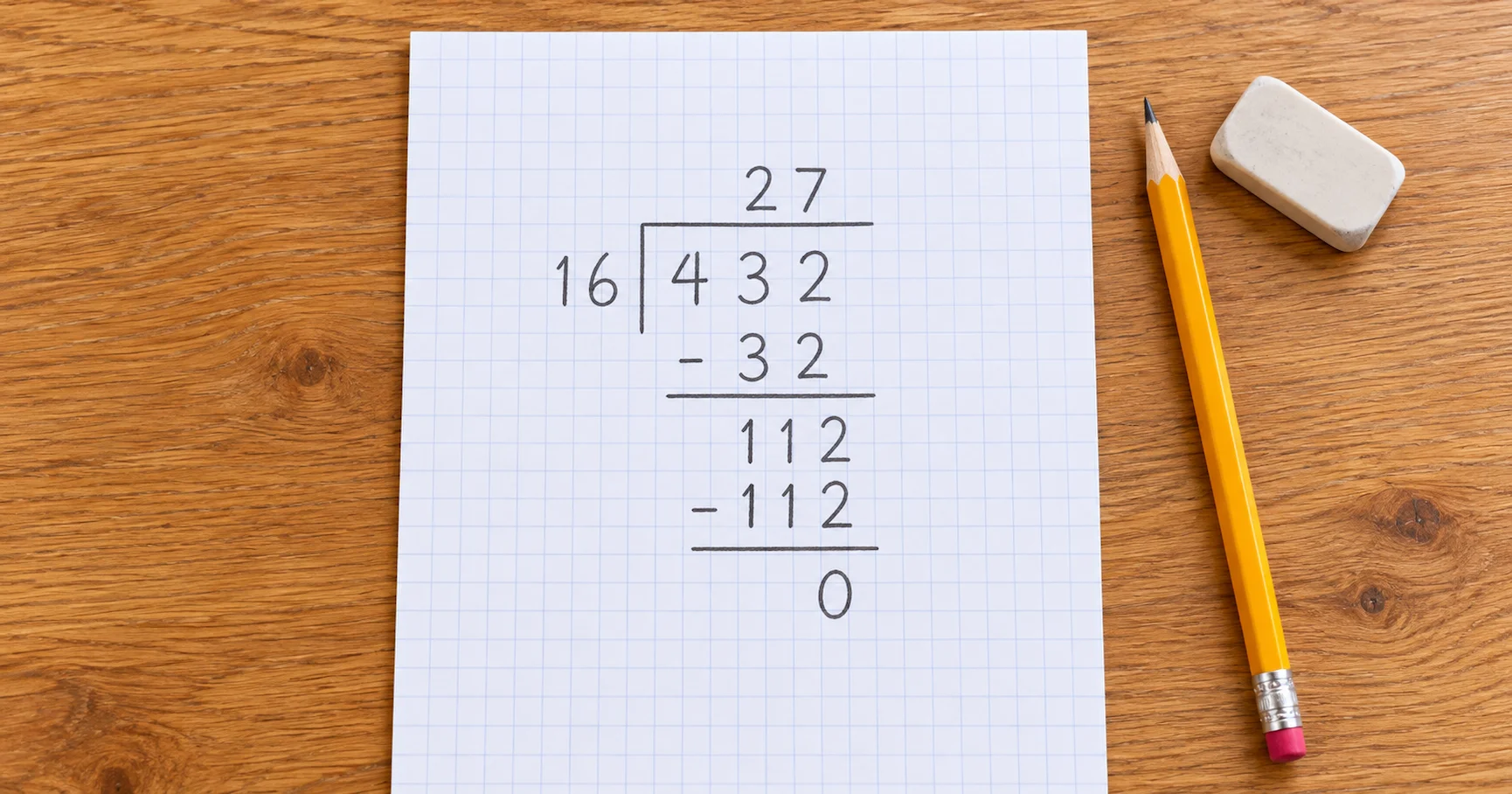 AI-generated image
Worked Example 2: Division With a Remainder
Calculate 589 ÷ 17
Step 1: Does 17 go into 5? No. Look at the first two digits: 58.
Step 2: How many times does 17 go into 58?
17 × 3 = 51
17 × 4 = 68 — too big.
17 goes into 58 three times. Write 3 above the 8.
Subtract: 58 − 51 = 7. Carry this remainder across.
Step 3: Bring down the next digit (9) alongside remainder 7, making 79.
Step 4: How many times does 17 go into 79?
17 × 4 = 68
17 × 5 = 85 — too big.
17 goes into 79 four times. Write 4 above the 9.
Subtract: 79 − 68 = 11.
There are no more digits to bring down, so the remainder is 11.
Answer: 589 ÷ 17 = 34 remainder 11
         3  4 r11
       _______
  17 ) 5 8 9
       5 1
       -----
         7 9
         6 8
         -----
         1 1  (remainder)
Worked Example 3: Dividing a 4-Digit Number
Calculate 2,496 ÷ 24
Step 1: Does 24 go into 2? No. Does 24 go into 24? Yes — exactly once. Write 1 above the second digit.
Subtract: 24 − 24 = 0.
Step 2: Bring down the next digit (9), alongside 0, making 09 = 9.
Does 24 go into 9? No. Write 0 above the 9 (this is important — do not skip it).
Remainder is 9.
Step 3: Bring down the next digit (6) alongside remainder 9, making 96.
How many times does 24 go into 96?
24 × 4 = 96 — exactly. Write 4 above the 6.
Subtract: 96 − 96 = 0.
Answer: 2,496 ÷ 24 = 104
         1  0  4
       _________
  24 ) 2 4 9 6
       2 4
       -----
         0 9
         0 0
         -----
           9 6
           9 6
           -----
               0
Step 2 above highlights one of the most common errors in long division: forgetting to write a zero when the divisor does not go into the current number. Skipping the zero makes the answer wrong even if all other steps are correct. Always write a digit above every position in the dividend — including a zero when needed.
Worked Example 4: Getting a Decimal Answer
Calculate 345 ÷ 12, giving the answer to one decimal place
Steps 1–3 (whole number part):
12 goes into 34 twice (12 × 2 = 24). Remainder: 34 − 24 = 10.
Bring down 5, making 105.
12 goes into 105 eight times (12 × 8 = 96). Remainder: 105 − 96 = 9.
Current answer so far: 28, remainder 9.
Step 4 (decimal part):
Add a decimal point above the answer line. Then add a zero after the 345, making the next digit to bring down 0.
Bring down the 0 alongside remainder 9, making 90.
12 goes into 90 seven times (12 × 7 = 84). Remainder: 90 − 84 = 6.
Write 7 after the decimal point.
Answer: 345 ÷ 12 = 28.7 (to one decimal place)
 AI-generated image
Common Mistakes to Avoid
| Mistake | What Happens | How to Avoid It |
|---|---|---|
| Skipping zero placeholders | Answer is wrong by a power of 10 | Write a digit above every position, even if it is 0 |
| Subtracting incorrectly | Carry-over remainder is wrong, corrupting all later steps | Write the subtraction out separately rather than doing it mentally |
| Miscounting multiples of the divisor | Wrong digit written at each step | Write a quick list of multiples before starting (2×, 3×, 4×...) |
| Forgetting to bring down the next digit | Step is skipped and the answer is too short | Draw a small arrow to remind yourself to bring down |
| Not showing working | Only the answer is marked — no method marks available if wrong | Always record every subtraction step |
Practise Problems
Try these calculations using the bus stop method. Check your answers below:
- 756 ÷ 18 = ?
- 952 ÷ 28 = ?
- 1,344 ÷ 32 = ?
- 867 ÷ 15 = ? (express any remainder)
Show Answers
- 756 ÷ 18 = 42
- 952 ÷ 28 = 34
- 1,344 ÷ 32 = 42
- 867 ÷ 15 = 57 remainder 12
Strong long division skills build directly on multiplication fact fluency. If your child is also working on their times tables, the guide on Year 3 multiplication using arrays and related facts covers the foundational relationship between multiplication and division that underlies every step of the bus stop method.
Frequently Asked Questions
Is the bus stop method the only acceptable method in KS2 SATs?
No — the KS2 arithmetic paper does not specify which written method must be used. However, the method must be written (not purely mental), and the working must be shown. The bus stop method is the most widely taught written method in English primary schools for long division, and most Year 6 teachers prepare pupils specifically for this method because it is efficient and systematic. An alternative written method — such as chunking (repeated subtraction of multiples) — is also acceptable if it produces a correct answer with clear working.
My child's school uses "chunking" — is that different from the bus stop method?
Yes. The chunking method (also called the partial quotients method) involves subtracting large multiples of the divisor repeatedly until the remainder is smaller than the divisor. It is an alternative approach that some children find more intuitive. Schools that teach chunking typically introduce the bus stop method later as a more efficient written method. Both are mathematically correct. By Year 6, most schools expect pupils to be using the bus stop method for speed and clarity in formal assessments.
How can I help my child learn the multiples needed for long division?
Quick recall of times tables is essential for long division. Before starting a division calculation, encourage your child to jot down the first 10 multiples of the divisor (for example, if dividing by 17: 17, 34, 51, 68, 85, 102, 119, 136, 153, 170). This takes about 30 seconds and removes the mental load of calculating multiples in the middle of a complex division. In a SATs context, this is a legitimate and sensible strategy.
Does long division appear in the Year 6 reasoning papers as well as arithmetic?
Long division as a standalone calculation appears primarily in the arithmetic paper. In the reasoning papers, division may appear within a multi-step problem where children need to choose the appropriate operation — so they still need the skill, but it is embedded in a problem-solving context rather than isolated as a division question. Understanding when to divide (not just how to divide) is what the reasoning papers test.
What if my child gets the right answer but uses a different layout?
In formal KS2 marking, the answer is what earns the mark in most cases. However, showing working is important for two reasons: first, if the final answer is wrong, method marks can be awarded for correct intermediate steps; second, some questions specifically require working to be shown. Encourage your child always to write out their steps, whatever layout they use. A consistent, readable layout — like the bus stop — also reduces careless errors.
At what point in Year 6 should my child be confident with long division?
By the spring term of Year 6 — typically January to March — most children should be working through long division problems with reasonable fluency in preparation for the KS2 SATs in May. Schools will usually introduce or consolidate the method in autumn and practise it intensively in spring. If your child is significantly behind in March or April, focused daily practice with worked examples (like those in this guide) is the most effective approach to build confidence quickly.