
Arrays are one of the most powerful visual tools in primary mathematics. In Year 3, children use them to build a deep understanding of multiplication — not just as a process of repeated counting, but as a relationship between rows, columns and totals that unlocks a whole family of related facts.
This guide explains what arrays are, how they connect to multiplication and division, and how you can use everyday household objects to practise at home with your Year 3 child.
The National Curriculum for Year 3 in England requires pupils to recall and use multiplication and division facts for the 3, 4 and 8 times tables, building on the 2, 5 and 10 times tables already secured in Year 2. Arrays are the primary visual model used to teach and consolidate these facts.
What Is an Array?
An array is an arrangement of objects, symbols or numbers into equal rows and columns. Every array represents a multiplication fact visually:
- The number of rows represents one factor
- The number of columns represents the other factor
- The total number of objects represents the product
For example, an array with 3 rows and 4 columns contains 12 objects in total. This represents the multiplication fact 3 × 4 = 12.
Arrays can be made from almost anything at home: coins, counters, grapes on a plate, sticker dots, building bricks or cereal pieces on a tray. The physical act of arranging objects into rows and columns helps children move from counting individual objects to recognising multiplication as a structure.
Arrays and the Commutative Property
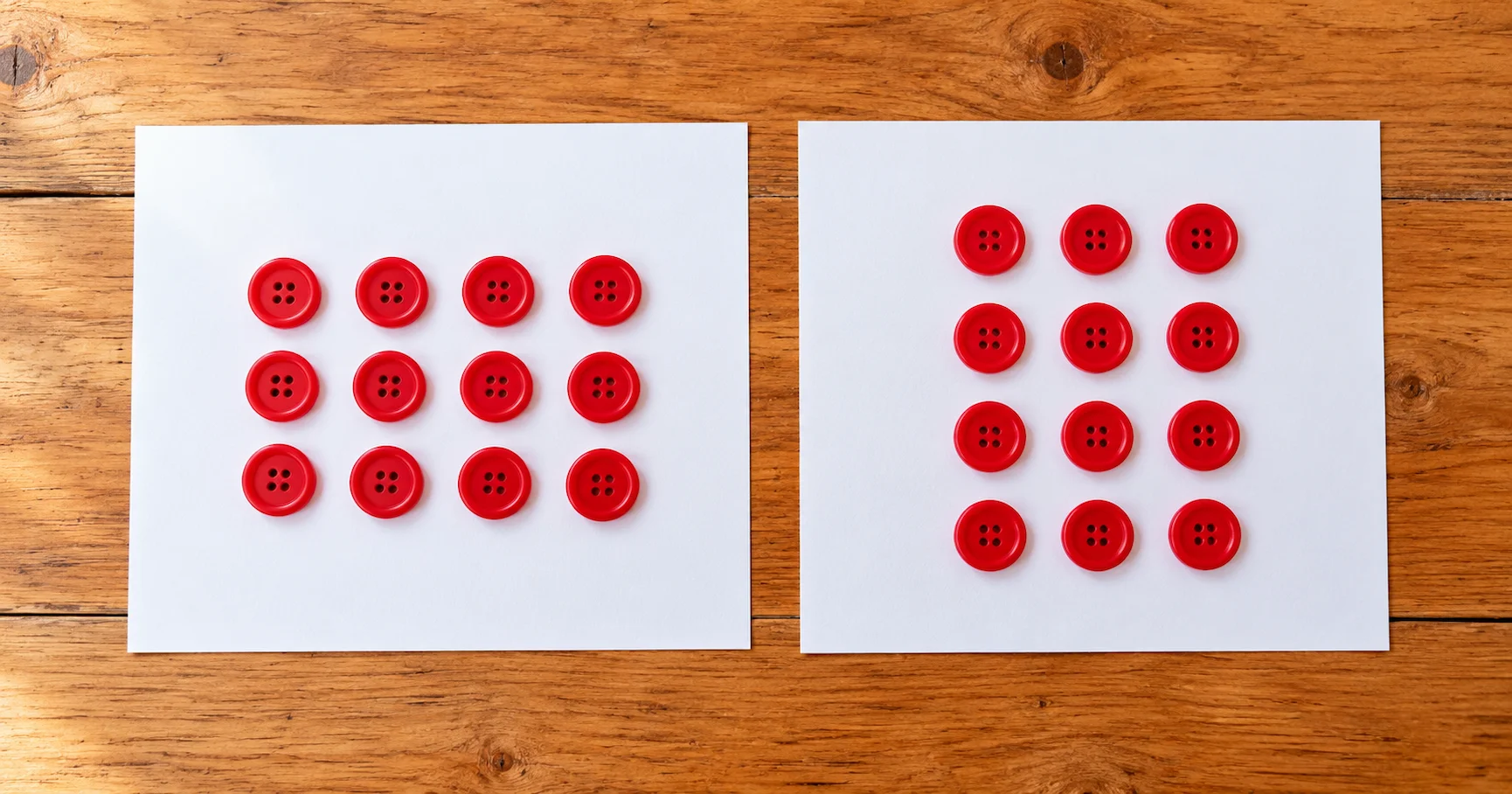
One of the most important things arrays demonstrate visually is that multiplication is commutative — the order of the factors does not change the product. If you rotate an array, the total stays the same.
An array of 3 rows × 4 columns contains 12 objects.
An array of 4 rows × 3 columns also contains 12 objects.
These are two different arrays but they encode the same fact. By making both with physical objects and placing them side by side, children see — rather than just hear — that 3 × 4 = 4 × 3. This is far more memorable than being told it is true.
 AI-generated image
Related Facts: The Fact Family
Every array contains four related mathematical facts — called a fact family. Because multiplication and division are inverse operations, a single array of 3 rows × 4 columns encodes all four of the following:
| Fact | What the Array Shows |
|---|---|
| 3 × 4 = 12 | 3 rows of 4 columns = 12 objects total |
| 4 × 3 = 12 | 4 columns of 3 rows = 12 objects total (rotated) |
| 12 ÷ 3 = 4 | 12 objects shared into 3 equal rows = 4 in each row |
| 12 ÷ 4 = 3 | 12 objects shared into 4 equal columns = 3 in each column |
When a child learns one of these facts securely, they actually know all four. Helping children see this connection dramatically reduces the amount of memorisation required and builds number sense at the same time.
Worked Example: The 3 Times Table
Let us work through the fact family for 3 × 8:
- Make an array: 3 rows, 8 columns (use 24 coins or counters)
- Count the total: 24
- Write the four facts:
- 3 × 8 = 24
- 8 × 3 = 24
- 24 ÷ 3 = 8
- 24 ÷ 8 = 3
Encourage your child to say each fact aloud while pointing to the array. The physical arrangement provides a mental image they can return to when trying to recall the fact in a test.
Worked Example: The 4 Times Table
Now try 4 × 6:
- Make an array: 4 rows, 6 columns (use 24 objects)
- Count the total: 24
- Write the four facts:
- 4 × 6 = 24
- 6 × 4 = 24
- 24 ÷ 4 = 6
- 24 ÷ 6 = 4
Notice that both examples produce a product of 24 — a useful discussion point. Ask your child: "Can you make two different arrays that both have 24 objects?" They may find 3×8, 4×6, 2×12, 1×24. Each is a valid array; each represents a different fact family.
The 8 Times Table: Doubling as a Strategy
The 8 times table is new in Year 3, and arrays support a particularly useful strategy for it: doubling.
- If a child knows 4 × 6 = 24, they can find 8 × 6 by doubling the 4-row array into an 8-row array: 24 × 2 = 48.
- Similarly: 8 × 3 = double (4 × 3) = double 12 = 24
- And: 8 × 7 = double (4 × 7) = double 28 = 56
Building this doubling strategy using physical arrays makes the relationship tangible. Start with a 4-row array, then physically add another identical set below it to create the 8-row version.
Home Activities Using Everyday Objects
Activity 1: Button or Coin Arrays
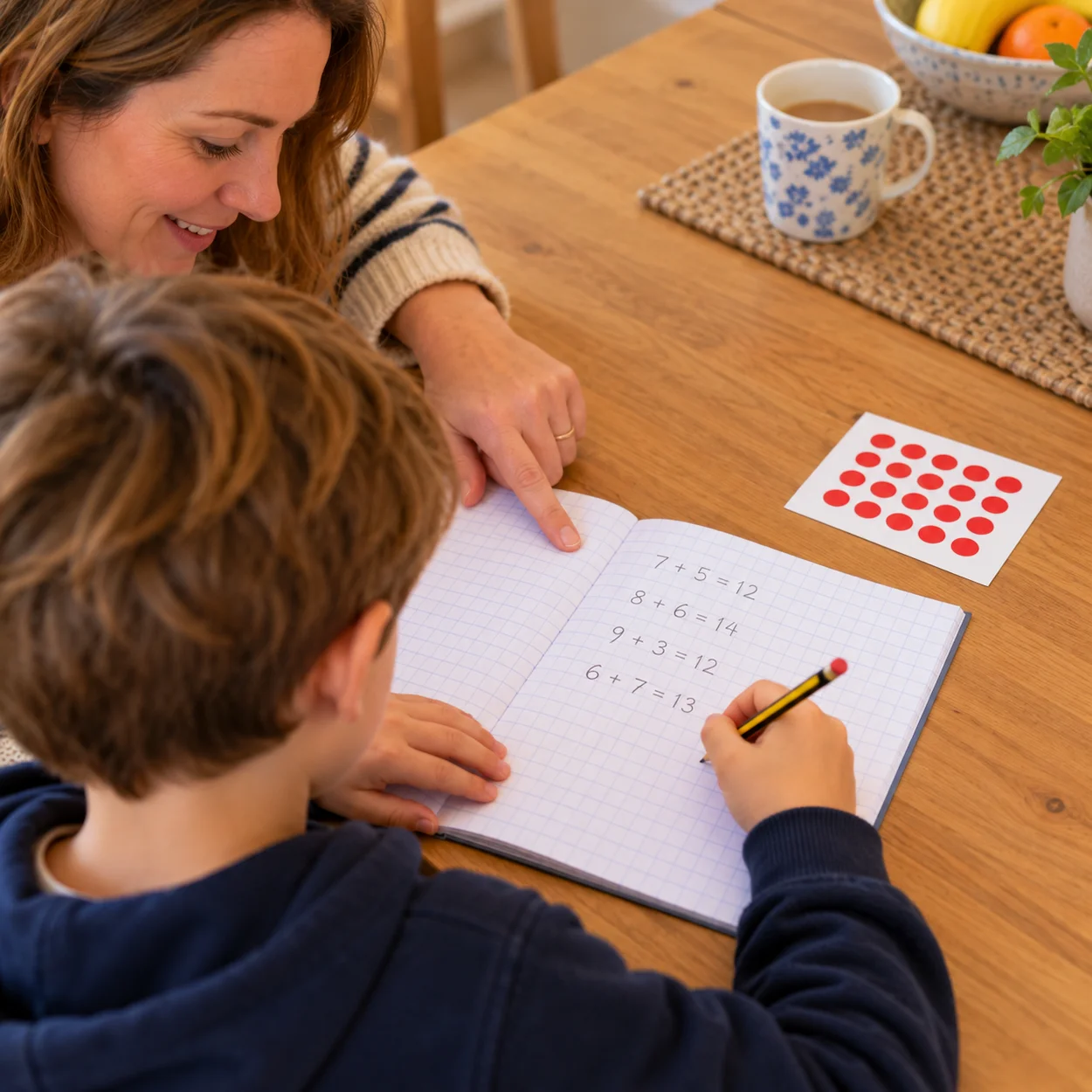
Place a selection of identical small objects (buttons, coins, dried pasta pieces) in front of your child. Call out a multiplication fact from the 3, 4 or 8 times table and ask them to build the corresponding array. Then ask: "What are the other three facts in the same family?"
Activity 2: Egg Box Multiplication
A standard 6-egg box arranged in 2 rows of 3 is a ready-made array. Use two boxes side by side to make 2 rows of 6. Stack two boxes to discuss 4 rows of 3. Egg boxes make the structure of equal rows and columns very clear.
Activity 3: Missing Number Arrays
Build an array together, then cover part of it with a piece of paper. Ask: "If there are 4 rows and 24 objects in total, how many columns are there?" This develops the division side of the fact family without using division notation — ideal for children who find ÷ symbols intimidating.
Activity 4: Draw Before You Count
Before making a physical array, ask your child to draw what 3 × 5 would look like: three rows of five dots. Then count to check. Drawing the array first engages working memory and builds the mental image that supports later recall without physical objects.
 AI-generated image
Common Misconceptions to Watch For
| Misconception | What It Looks Like | How Arrays Help |
|---|---|---|
| Order matters in multiplication | Child thinks 3×4 and 4×3 are different calculations | Rotate the array to show the total is unchanged |
| Multiplication is only repeated addition | Child counts in groups rather than seeing the structure | Array shows rows AND columns simultaneously |
| Division is unrelated to multiplication | Child cannot use 3×8=24 to solve 24÷3=? | Fact family from one array makes the link explicit |
| The 8 times table needs separate memorisation | Child treats 8× as entirely new | Doubling from 4× array shows the connection |
Once your child is confident with arrays in Year 3, this foundation feeds directly into the Year 4 Multiplication Tables Check — a statutory assessment in which children are tested on all times tables up to 12×12. Strong visual understanding of arrays makes that transition much smoother.
Understanding related facts also prepares children for dividing with remainders, where knowing the closest multiplication fact quickly is essential for calculating how much is left over.
Frequently Asked Questions
At what point in Year 3 will my child be taught arrays?
Arrays are typically introduced or revisited early in Year 3 as part of the multiplication and division unit, often in the autumn term. Most schools follow a structured maths scheme (such as White Rose Maths or Power Maths) that sequences this content carefully. Your child's teacher can tell you exactly where they are in the sequence and which times tables are currently the focus.
My child already knows their tables — do they still need arrays?
Yes, for a different reason. Arrays are not just about memorising facts — they develop the structural understanding of multiplication that underpins later topics including fractions, area, ratio and algebra. A child who only memorises tables without understanding the underlying structure may struggle when the application becomes less straightforward in upper KS2 and beyond.
Should the rows always represent one factor and the columns the other?
By convention, arrays are typically read as "rows × columns" (so a 3×4 array has 3 rows and 4 columns). However, because multiplication is commutative, this distinction becomes less important once the concept is secure. What matters is that the child can identify both factors and the product from the array, regardless of orientation.
How many objects do I need for home practice?
The largest product in the Year 3 times tables focus (up to 8 × 12) is 96. Realistically, most practice focuses on smaller facts. Having around 30–40 identical small objects (buttons, pennies, dried beans) is enough to build arrays for all the commonly practised facts. Anything beyond that can be drawn on squared paper rather than made physically.
What if my child finds it easier to use fingers or counting than arrays?
Counting and finger strategies are not wrong — they show the child is reasoning rather than guessing. However, they are slow and unreliable for larger facts, and they do not build the fluency children need for the Multiplication Tables Check in Year 4. Arrays help children move from counting to structural thinking. If a child is resistant, start with very small, familiar facts (2×3, 5×4) and build confidence before introducing new times tables.
Can I use squared paper instead of physical objects?
Absolutely. Squared paper is excellent for drawing arrays because the grid structure naturally produces equal rows and columns. Ask your child to shade a 3×4 rectangle on squared paper, then write the four related facts beside it. This is particularly useful for larger facts where gathering enough physical objects becomes impractical.