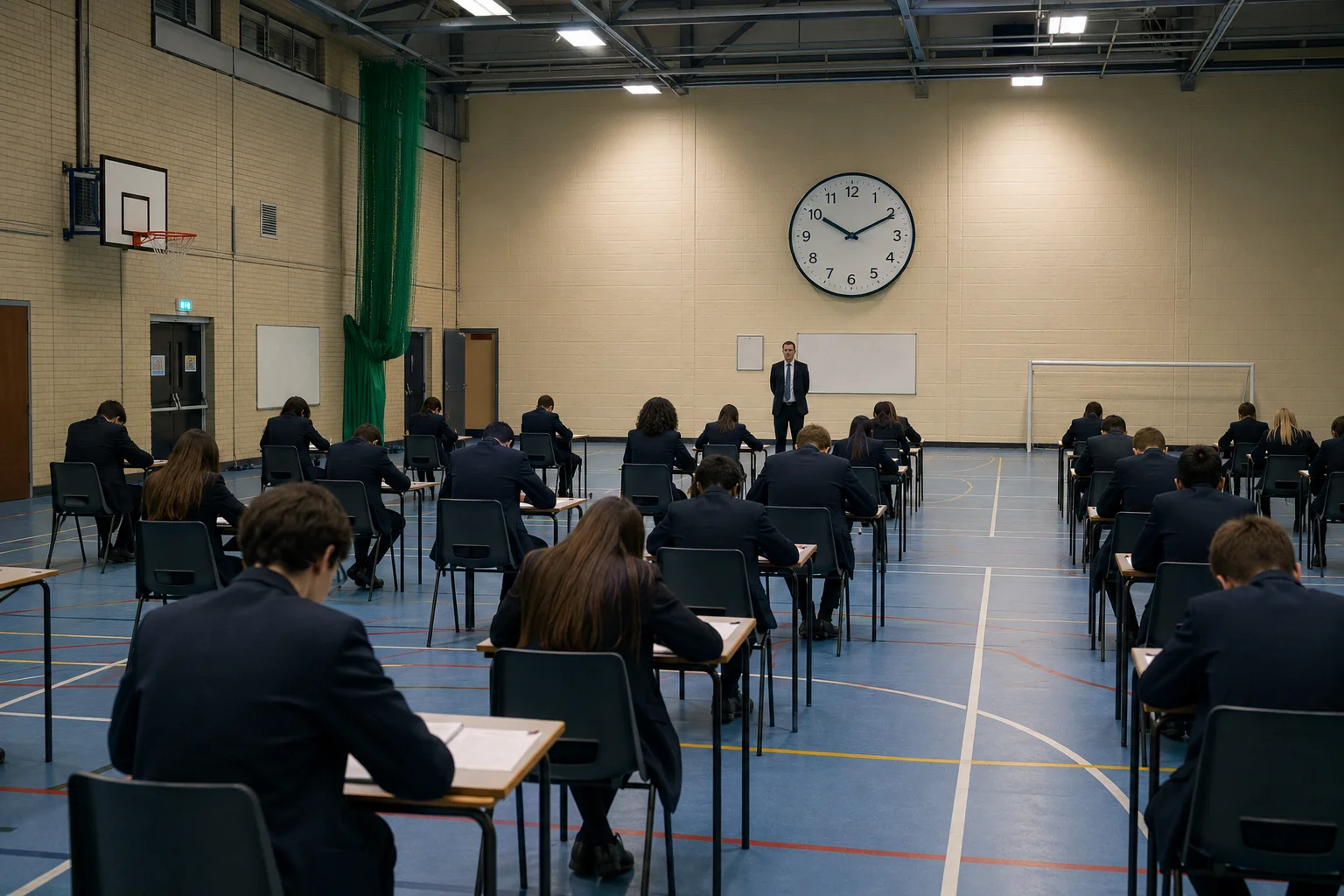
For most secondary school pupils in England, mock exams arrive in November or January of Year 11 — a dry run for the GCSEs that follow in the summer. For many years, mocks were treated as little more than a useful rehearsal: an opportunity to practise exam technique, identify weak topics, and experience the pressure of a formal sitting without the consequences mattering. In 2026, that framing is dangerously out of date.
Mock exam results now carry real weight — in predicted grades that influence sixth-form offers, in the data schools submit to universities under UCAS, and increasingly in discussions about whether a pupil is on track for the grades they need. This guide explains why mock exams have become so much more significant, what parents and students can do to take them seriously, and how to use the results constructively whatever they show.
During the COVID-19 pandemic years (2020 and 2021), mock exam results and teacher-assessed grades replaced GCSEs entirely. This raised the stakes of internal assessments permanently — both schools and students now understand that mock results can, in exceptional circumstances, become the only grades that exist.
Why Mock Exams Matter More Than Ever in 2026
1. Predicted Grades and Sixth-Form Conditional Offers
Most sixth forms — whether attached to the current school or a separate college — issue conditional offers based on predicted GCSE grades. Those predictions are made by subject teachers, and the single most important piece of evidence a teacher has when writing a predicted grade is mock exam performance. A student who performs significantly below expectation in their mocks risks receiving a lower conditional offer, or in competitive sixth forms, being passed over for a place entirely.
2. Early Entry and Post-16 Applications
Applications to oversubscribed sixth forms and further education colleges often close as early as January or February — before summer GCSEs take place. Schools routinely use November mock results as the basis for the predicted grades they submit with these applications. A student who underperforms in their November mocks may receive conditional offers that do not reflect their actual ability, placing unnecessary pressure on the summer sitting.
3. Identifying Grade Boundaries Early
Mock exams are marked to the same mark schemes as real GCSEs, and most schools report results using the 9–1 grading system. This means a student and their teacher can see, with reasonable accuracy, how close to — or far from — the next grade boundary they are. That data is invaluable for targeted revision planning in the crucial weeks and months before the summer.
Ask your child's school whether they will receive a full breakdown of mock results by question or topic — not just an overall grade. Most schools provide this analysis, and it is the most actionable revision information available. A student who knows they lost most marks on "source analysis in History" can target that specific skill; a student who only knows their overall grade has much less to work with.

When Do Mock Exams Take Place?
There is no nationally mandated mock exam timetable — each school sets its own. However, most secondary schools in England follow one of two broad patterns:
| Mock Sitting | Typical Timing | Purpose |
|---|---|---|
| First mock (Year 11) | November – December | Baseline assessment; informs predicted grades for sixth-form applications |
| Second mock (Year 11) | February – March | Progress check; identifies remaining gaps; final preparation marker |
| Pre-public examinations (PPEs) | March – April (some schools) | Final full-paper practice under exam conditions before summer |
Some schools hold a single round of mocks; others run two or three sets of practice papers across Year 11. It is worth asking your child's school for their internal assessment calendar at the start of Year 11 so revision can be planned accordingly.
How Are Mocks Marked and Reported?
Mock papers are typically marked by teachers at the school using the official mark schemes published by the awarding bodies (AQA, Edexcel, OCR, WJEC). The quality of marking varies — a specialist subject teacher marking their own subject will produce results that closely mirror the real exam; a non-specialist teacher marking under time pressure may be less precise. However, for the purposes of identifying broad strengths, weaknesses, and grade boundaries, mock marking is generally reliable enough to be useful.
Most schools report mock results to parents in the same format as summer results — a grade from 1 to 9, sometimes with a percentage or raw mark alongside. Some schools also issue a separate "working at" grade that reflects the teacher's holistic assessment of where a pupil is currently performing.
A mock grade is a snapshot, not a sentence. Students who perform below their target in November mocks have months of focused revision ahead. The research on revision effectiveness is clear: students who engage actively with their mock feedback — analysing errors, targeting weak topics, practising under timed conditions — make significantly more progress than those who simply revise broadly without direction.
How to Use Mock Results Effectively
Step 1: Analyse the Paper, Not Just the Grade
The grade tells you where you ended up; the marked paper tells you why. Go through every question where marks were lost and categorise the errors: Was it a knowledge gap (didn't know the content)? A technique gap (knew the content but didn't answer the question correctly)? A time management issue (ran out of time before finishing)? Different types of errors require different solutions.
Step 2: Prioritise by Impact
Not all topics are worth the same number of marks. Identify the highest-mark questions where performance was weakest — these represent the greatest opportunity for grade improvement. A student who consistently loses 6 marks on 8-mark extended writing questions should focus revision on that skill before targeting 1-mark recall questions.
Step 3: Create a Revision Plan with Specific Targets
Using mock analysis, build a revision plan that allocates more time to weaker areas and less to secure ones. Effective revision techniques — spaced repetition, active recall, past paper practice, self-quizzing — are well established. For detailed guidance on revision methods, see our article on Revision Techniques That Work for GCSEs.
Step 4: Revisit Under Exam Conditions
Once gaps have been addressed through revision, practise the same style of question again under timed conditions. This closes the loop: knowledge → practice → feedback → improvement. Schools typically provide past paper access through the school intranet or via awarding body websites.

The Mental Health Dimension
Mock exams can be a significant source of anxiety — particularly for pupils who are already prone to exam stress or who receive results that fall short of their expectations. Schools are increasingly aware of this, and many now offer structured debrief sessions, access to school counsellors around mock periods, and explicit teaching of stress management techniques alongside academic preparation.
For parents, the key is to model a constructive attitude toward mock results. A student who scores a Grade 4 when targeting a Grade 6 needs encouragement and a plan — not a reaction that amplifies their anxiety. Research consistently shows that performance mindset (believing effort and strategy can improve results) is more productive than fixed mindset (believing the grade reflects fixed ability). How parents respond to mock results significantly shapes which mindset their child adopts.
England's exam regulator Ofqual publishes detailed grade boundary data for every GCSE paper after results day each summer. These boundaries — which show exactly how many marks were needed for each grade — are publicly available and extremely useful for mock analysis, since teachers use the previous year's boundaries as a guide when providing mock feedback.
What If My Child Performs Poorly in Mocks?
A disappointing mock result is not a prediction of summer performance — it is a data point. What matters most is the response. Here is a practical checklist for families navigating a below-target mock result:
- Request a meeting with the form tutor or subject teacher — understand specifically where marks were lost and what the school recommends
- Review the revision strategy — was revision structured and active, or passive and last-minute? A change of approach often produces rapid improvement
- Check whether additional support is available — many schools offer revision sessions, drop-in clinics, and one-to-one support in the run-up to summer exams
- Consider external tutoring — targeted tutoring in specific weak subjects for 4–8 weeks before summer exams can produce meaningful grade gains
- Revisit sixth-form plans if necessary — if mock results suggest a pupil is unlikely to meet the conditions of a sixth-form offer, it is better to identify alternative options early rather than waiting for results day
Frequently Asked Questions
Do mock exam results go on any official record?
No. Mock exam results are internal school assessments and do not appear on any official academic record. They are not reported to awarding bodies or the DfE. Only the results of the actual summer GCSE examinations — sat externally and marked by the awarding body — appear on a student's official certificate.
Can I appeal a mock result?
Schools typically do not have a formal appeals process for mocks, as they are internal assessments. However, if a student believes their paper has been significantly under-marked — particularly in a subject where the marking involves some subjectivity, such as English or History — it is reasonable to ask the subject teacher to review specific questions. Raising this constructively with the teacher is usually well received.
Are mocks compulsory?
Schools can require pupils to sit internal assessments as part of their normal school life. Absence from a mock without good reason may result in the school having insufficient evidence to write an accurate predicted grade — which can directly harm a pupil's sixth-form application. In the rare cases where a pupil is absent due to illness, schools will typically offer an alternative sitting or base their predicted grade on other available evidence.
My child's school only runs one set of mocks. Is that enough?
One full set of mocks is the minimum required to give meaningful preparation feedback. Schools that run a single mock typically compensate with more frequent low-stakes class tests, PPE-style topic assessments, and past paper practice. If you are concerned that your child's school does not provide enough practice opportunities, supplementing with freely available past papers from the AQA, Edexcel, or OCR websites is straightforward and effective. For a broader overview of how England's exam system works, see our guide to GCSEs Decoded: Understanding the 9–1 Grading System.