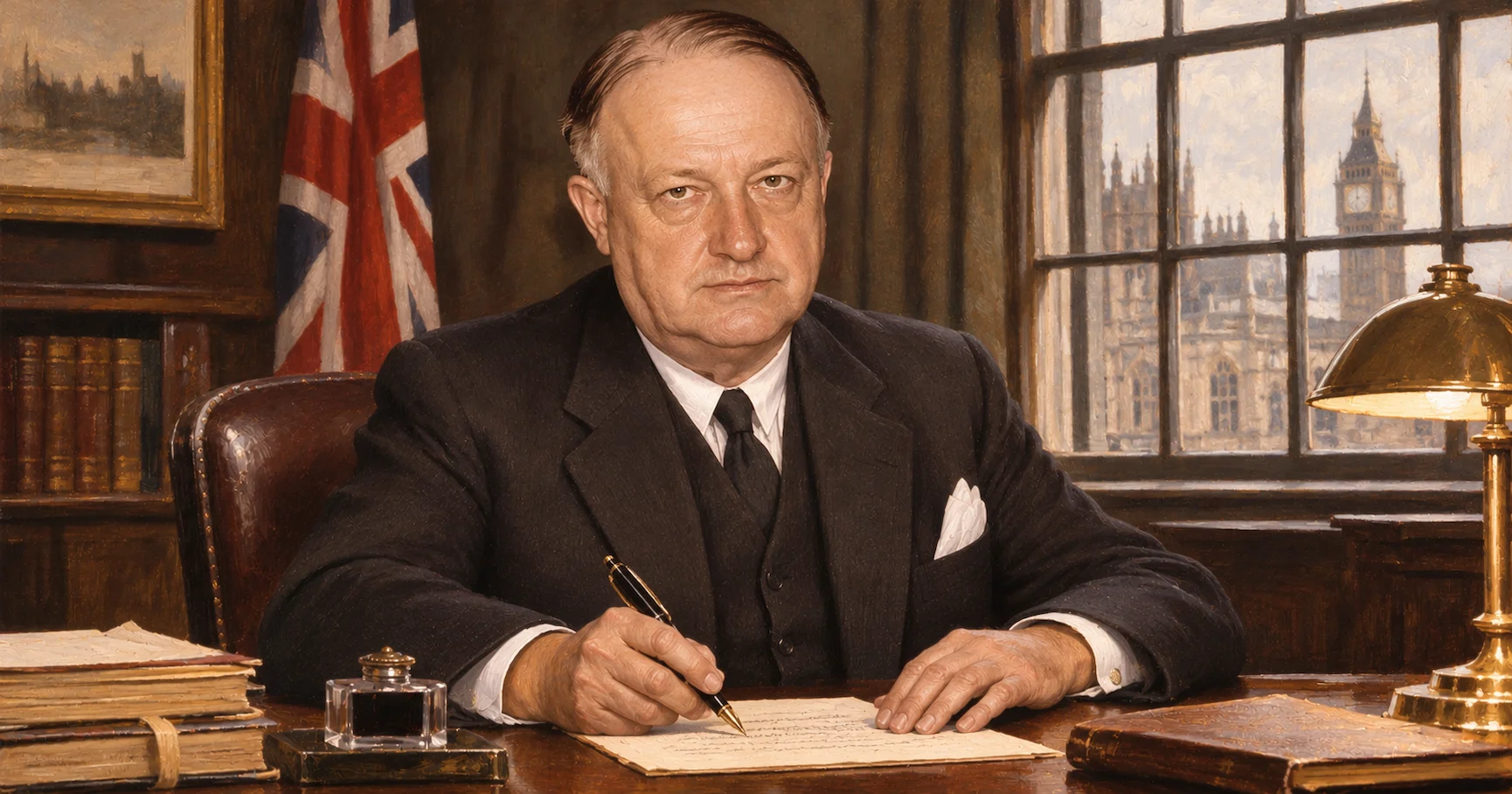
In August 1944, the Education Act received Royal Assent. Within a few years, it had reshaped the lives of millions of children across England and Wales. The person most responsible for that transformation was Richard Austen Butler — known universally as "Rab" Butler — President of the Board of Education in Churchill's wartime coalition government. The Act that bears his name is widely regarded as one of the most significant pieces of social legislation in twentieth-century British history, and its effects — both intended and unintended — are still felt in English schools today.
- Full name: Richard Austen Butler, Baron Butler of Saffron Walden
- Born: 9 December 1902, Attock Serai, Punjab (British India)
- Died: 8 March 1982
- Education: Marlborough College; Pembroke College, Cambridge (Double First)
- Constituency: Conservative MP for Saffron Walden, 1929–1965
- Role during the Act: President of the Board of Education (appointed July 1941)
- The Education Act 1944: Received Royal Assent on 3 August 1944
- Later offices: Chancellor of the Exchequer (1951–55), Home Secretary (1957–62), Foreign Secretary (1963–64)
- Later life: Master of Trinity College, Cambridge (1965–1978)
The Man Behind the Act
Rab Butler came from a family with deep roots in Cambridge academia and the British imperial civil service. His father, Sir Montagu Butler, was a senior figure in the Indian Civil Service, and the family's connection to Pembroke and Corpus Christi Colleges stretched back generations. Butler himself won a Double First in Modern and Medieval Languages and History at Cambridge, served as President of the Cambridge Union, and became a fellow of Corpus Christi College — a formidably academic background that shaped his approach to educational policy.
He entered Parliament in 1929 as Conservative MP for Saffron Walden — a constituency he would represent for 36 years. His early career was marked by junior ministerial roles at the India Office, the Ministry of Labour and the Foreign Office. As Under-Secretary of State for Foreign Affairs in the late 1930s, he was associated with Neville Chamberlain's appeasement policy toward Nazi Germany, a legacy that would shadow him for years.
When Winston Churchill formed his wartime coalition government, Butler's association with appeasement initially kept him from the front ranks of the Cabinet. Churchill distrusted him personally. But in July 1941, Churchill appointed Butler President of the Board of Education — a position that many in Whitehall regarded as a backwater. Butler would transform it into the stage for one of the century's great domestic reforms.
England's Schools Before 1944: The Problem Butler Inherited
To understand what the 1944 Act achieved, it is essential to understand what it replaced. Before the Act, English education was a patchwork of provision — elementary schools run by local authorities and voluntary bodies, a small number of selective secondary schools for those who could pay fees or win scholarships, and a vast majority of children who left school at 14 with no meaningful secondary education at all.
The system was deeply class-stratified. Children from professional and middle-class families typically attended fee-paying grammar schools or independent schools. Working-class children overwhelmingly attended elementary schools until the minimum leaving age and then entered the workforce. The idea that every child, regardless of background, was entitled to a secondary education was genuinely radical in the context of 1940s England.
Butler's task was not only to draft new legislation but to negotiate it through a wartime coalition involving Conservative, Labour and Liberal politicians, while simultaneously managing the fierce interests of the Church of England and the Roman Catholic Church — both major providers of school buildings across the country.
The Education Act 1944: What It Changed
The Education Act 1944 — commonly known as the Butler Act — was passed on 3 August 1944. Its key provisions were sweeping:
A Ministry of Education
The old Board of Education — a relatively low-prestige government body — was abolished and replaced by a full Ministry of Education with a Secretary of State at its head. For the first time, central government took direct statutory responsibility for promoting education and executing national policy across England and Wales.
Three Stages of Education
The Act reorganised public education into three continuous and compulsory stages: Primary (up to age eleven), Secondary (from eleven to the school-leaving age), and Further Education (post-school). This tripartite structure of the education system — as opposed to the tripartite structure of schools within secondary education — remains the basic framework of English education to this day.
Universal Free Secondary Education
This was the Act's most radical democratic provision. Before 1944, secondary schooling for most children was either inaccessible or dependent on scholarship competition. After the Act, secondary education became compulsory and entirely free for all children in state-maintained schools. Fee-charging in state grammar schools was abolished. For the first time, every child in England and Wales was guaranteed a secondary education funded by the state.
Raising the School-Leaving Age
The Act raised the compulsory school-leaving age from 14 to 15. This change came into effect in 1947. The Act also included provisions for an eventual further raise to 16 — though this was not implemented until 1972 (taking effect in 1973), nearly three decades later.
Local Education Authorities
Local Education Authorities (LEAs) — county and county borough councils — were given statutory responsibility for executing the Act at the local level. They were required to submit development plans to the new Ministry, setting out how they would provide adequate primary and secondary places in their areas. This devolved structure meant that the precise shape of secondary education varied considerably from area to area.
 AI-generated image
The Tripartite System and the 11-Plus
The Act's most controversial legacy was not one it explicitly mandated but one it made possible. The Act required local authorities to provide secondary education suited to the "age, ability, and aptitude" of each pupil. The practical interpretation of this requirement was profoundly shaped by the Norwood Report (1943) — a wartime government report that argued children naturally fell into three distinct psychological types: those suited to abstract thinking (grammar schools), those with mechanical and technical aptitudes (technical schools), and the majority suited to a more practical, general education (secondary modern schools).
Most LEAs implemented what became known as the tripartite system:
- Grammar schools — for approximately the top 15–20% of pupils, focused on academic subjects and preparation for university and professional careers
- Secondary technical schools — for pupils with practical and scientific aptitudes, focused on engineering, trades and applied science
- Secondary modern schools — for the majority of pupils (around 75–80%), providing a general practical education oriented toward employment
To allocate pupils to these schools, local authorities introduced the 11-plus examination — a selection test taken at approximately age eleven, typically covering arithmetic, English and verbal reasoning. Performance in this single examination effectively determined a child's educational trajectory and, to a significant degree, their life opportunities.
Although the tripartite system envisaged three equal but different types of school, the secondary technical school was almost never built in practice. High construction costs, a shortage of specialist teaching staff, and a lack of political will meant that by the 1950s the system had effectively become bipartite: grammar schools for those who passed the 11-plus, and secondary modern schools for the majority who did not. The missing technical tier weakened the system's claim to parity of esteem from the very beginning.
 AI-generated image
Criticisms and Controversies
By the 1950s and 1960s, the tripartite system and the 11-plus were attracting powerful criticism from multiple directions:
The Secondary Modern Stigma
The Act's architects spoke of "parity of esteem" between the different types of secondary school — the idea that grammar, technical and secondary modern schools would be equally valued. In practice, this never materialised. Children who failed the 11-plus were widely regarded — and often regarded themselves — as educational failures, labelled at age eleven as unsuited for academic work. The psychological damage of this classification was significant and well-documented by sociologists and educationists from the 1950s onwards.
Class and the 11-Plus
Research consistently showed that middle-class children disproportionately passed the 11-plus. The reasons were multiple: coaching by parents, more stimulating home environments, and access to books and cultural capital. Far from dismantling the class hierarchy in education, the 11-plus in many areas reinforced it — directing the children of professionals and skilled workers to grammar schools while secondary modern schools remained predominantly working-class institutions.
The Move Toward Comprehensive Schools
Discontent with the rigidity and inequity of the tripartite system grew throughout the 1950s and gathered decisive political momentum in the 1960s. In 1965, Labour's Secretary of State for Education Anthony Crosland issued Circular 10/65, requesting that local education authorities submit plans to reorganise secondary education along comprehensive lines — abolishing selection at eleven and educating all children of all abilities in the same schools.
The comprehensive transition was not immediate or uniform — it played out over decades and remains incomplete today, with selective grammar schools surviving in parts of England, where they continue to attract fierce political debate. But Circular 10/65 marked the decisive turning of the tide against the tripartite system that Butler's Act had set in motion. For more on Crosland's role in this transformation, see our article on Anthony Crosland and comprehensive school reform in England.
Butler's Wider Political Legacy
The 1944 Act was Butler's greatest achievement, but his political career extended far beyond it. After the Conservative defeat in the 1945 general election, Butler became the first chairman of the Conservative Research Department and spearheaded the party's ideological renewal through the Industrial Charter (1947) — a document that accepted the core institutions of the post-war welfare state, including the National Health Service and full employment policy, as permanent features of British life. This pragmatic accommodation with the new settlement saved the Conservative Party from the political margins.
When the Conservatives returned to power under Churchill in 1951, Butler served as Chancellor of the Exchequer until 1955, presiding over a period of rising living standards and economic recovery. His fiscal pragmatism led the political journalist Norman Macrae to coin the portmanteau "Butskellism" — combining Butler's name with that of Labour's Hugh Gaitskell — to describe the centrist, consensus-based economic policy that both men essentially shared. It became one of the defining political labels of postwar Britain.
Butler subsequently served as Home Secretary (1957–1962) and then as Foreign Secretary (1963–1964) under Alec Douglas-Home — having been passed over for the Conservative leadership, and therefore the premiership, on three occasions: in 1955 in favour of Anthony Eden, in 1957 in favour of Harold Macmillan, and again in 1963. He is remembered in political history as, in a common phrase of the era, "the best Prime Minister we never had".
On leaving active politics in 1965, Butler was created Baron Butler of Saffron Walden and returned to Cambridge as Master of Trinity College — the university's largest and most distinguished college — a position he held until 1978. He died on 8 March 1982.
The Education Act 1944 in Historical Perspective
Measured against the context of its time, the Education Act 1944 was a remarkable achievement. It was drafted and negotiated during the most destructive war in human history, by a Conservative minister in a coalition government, at a moment when the very survival of the country was uncertain. It delivered universal free secondary education to a generation of children who would otherwise have had none. It established the structural framework — primary, secondary, further education — that English schooling still follows.
Its failures and limitations — the inequity of the 11-plus, the unrealised vision of parity of esteem, the missing technical schools — were real and consequential. But they were largely failures of implementation rather than of intention. Butler himself was not an advocate of rigid social division; he believed, within the intellectual framework of his time, that the Act would expand opportunity. The degree to which it did — and the degree to which it perpetuated existing inequalities in new forms — is a question that historians of education continue to debate.
The Act's broader significance lies in the principle it established: that the state had a duty to provide every child with a secondary education, and that this education should be free. That principle, once enacted, proved irreversible. No subsequent government has sought to reimpose secondary school fees in state schools. In that sense, the Butler Act permanently enlarged the social contract between the state and the people of England — and that is the measure of its reformer's legacy.
For the broader history of educational reform in England, see our article on W. E. Forster and the 1870 Education Act, which established the foundations of universal elementary schooling that Butler's Act built upon.
Frequently Asked Questions
What did the Education Act 1944 actually do?
The Education Act 1944 — the "Butler Act" — made secondary education compulsory and free for all children in state-maintained schools in England and Wales for the first time. It replaced the old Board of Education with a Ministry of Education, raised the school-leaving age from 14 to 15, organised education into primary, secondary and further stages, and placed on local education authorities a duty to provide adequate secondary places. In practice, most LEAs implemented the tripartite system: grammar schools, secondary technical schools and secondary modern schools, with selection by the 11-plus examination.
What was the tripartite system and why was it controversial?
The tripartite system divided secondary schooling into three types: grammar schools (academic, for approximately the top 15–20% of pupils), secondary technical schools (practical, for mechanical aptitudes) and secondary modern schools (general education for the majority). Children were allocated to these schools by the 11-plus examination at age eleven. The system became highly controversial because the promised "parity of esteem" between school types never materialised — secondary moderns were perceived as inferior, the 11-plus consistently favoured middle-class children, and the technical school tier was almost never actually built. Mounting criticism led to the comprehensive school reform of the 1960s and 1970s.
Was Butler a Conservative or a Labour politician?
Butler was a Conservative — he served as Conservative MP for Saffron Walden from 1929 to 1965. The 1944 Education Act was passed while he served as President of the Board of Education in Churchill's wartime coalition government, which included Conservative, Labour and Liberal members. The Act's passage required Butler to negotiate across party lines and with the Church of England and Roman Catholic Church. His willingness to work across ideological divides — and his post-war acceptance of the welfare state — led to the political term "Butskellism", describing the broad consensus he shared with Labour's Hugh Gaitskell on economic policy.
Why is Butler called "the best Prime Minister we never had"?
Despite his seniority, intellect and record of achievement — the 1944 Education Act, postwar Conservative renewal, the Industrial Charter, the chancellorship — Butler was passed over for the Conservative leadership and the premiership on three separate occasions: in 1955 (when Anthony Eden succeeded Churchill), in 1957 (when Harold Macmillan was chosen over him after the Suez Crisis), and again in 1963 (when Alec Douglas-Home emerged from the "magic circle" leadership consultation). His inability to project the commanding authority that his party elders expected of a Prime Minister, combined with the lingering taint of his association with pre-war appeasement, repeatedly cost him the top office.
Are grammar schools in England a legacy of the 1944 Act?
Yes. The grammar schools that still exist in England — approximately 163 selective state grammar schools — are the surviving remnant of the tripartite system established in the wake of the 1944 Act. Most local education authorities phased out grammar schools during the comprehensive reorganisation of the 1960s and 1970s, but a number of LEAs — predominantly in certain English counties and in Northern Ireland (which has its own separate system) — retained their grammar schools. Under current legislation, no new selective grammar schools can be opened in England, though this restriction has been the subject of periodic political debate.
What happened to Butler's legacy after he left politics?
After leaving the House of Commons in 1965, Butler was elevated to the peerage as Baron Butler of Saffron Walden and became Master of Trinity College, Cambridge — one of the most prestigious academic appointments in the country — a role he held until 1978. He died on 8 March 1982. His legacy is multifaceted: the architect of universal free secondary education in England; the man who modernised the Conservative Party after the 1945 election defeat; and the intellectual force behind post-war political consensus. The "Butler Act" remains the term historians and educationists most commonly use when referring to the Education Act 1944.