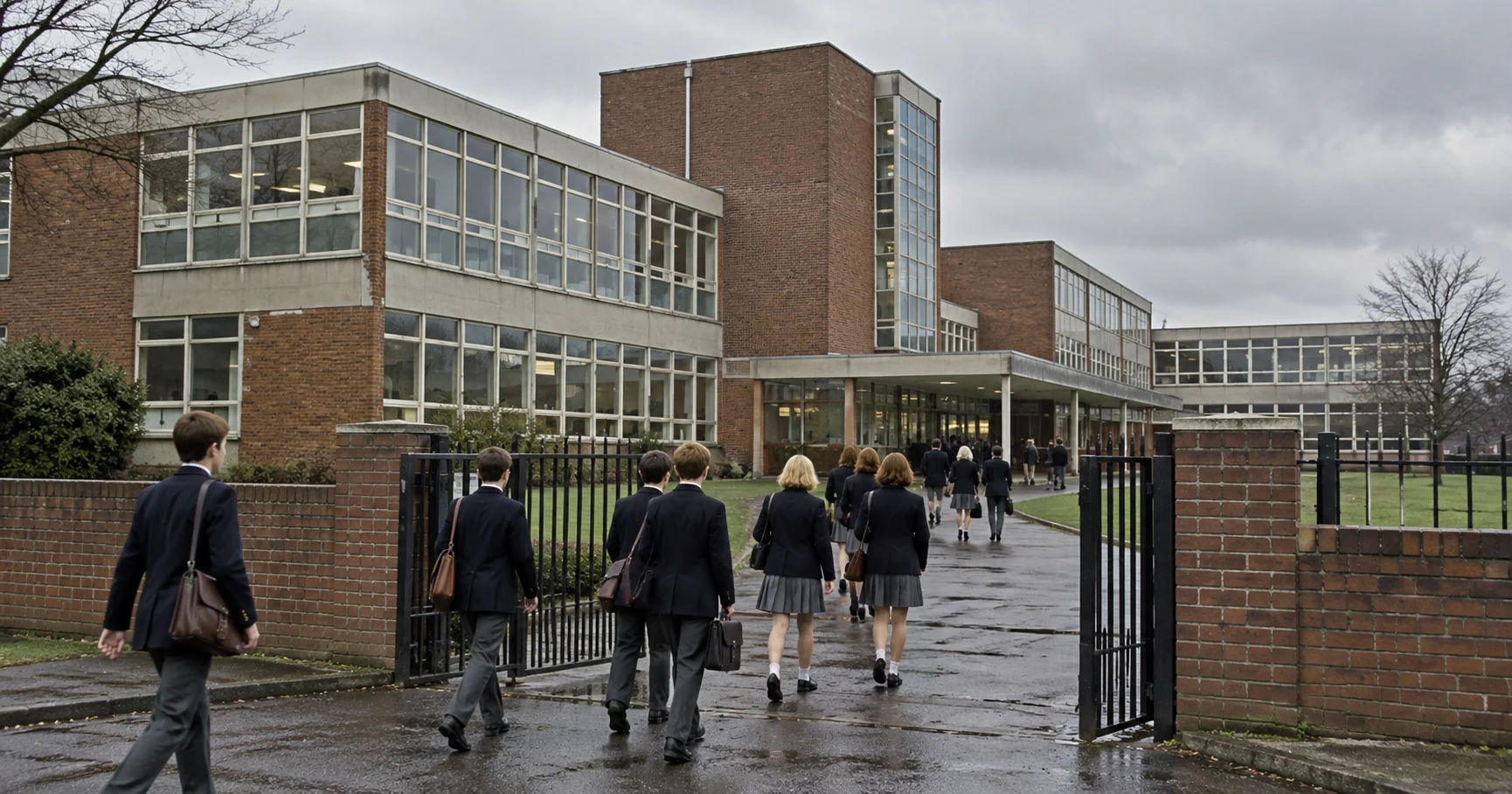
On 12 July 1965, the Secretary of State for Education and Science sent a circular to every Local Education Authority in England and Wales. It was four pages long, it used the word "request" rather than "demand", and it did not carry the force of law. Yet Circular 10/65, issued by Anthony Crosland, triggered a transformation of English secondary education that was faster and more far-reaching than almost any policy change before or since. Within fifteen years, the tripartite system that had sorted children into grammar schools, secondary modern schools and technical schools at the age of eleven had been replaced — across most of the country — by a single, non-selective secondary school serving all abilities. This is the story of how that happened, why Crosland drove it, and why the debate it started has never fully ended.
Anthony Crosland (1918–1977) was a Labour politician and one of the most influential social democratic thinkers of post-war Britain. His 1956 book The Future of Socialism provided the intellectual framework for comprehensive education reform. As Secretary of State for Education and Science from January 1965 to August 1967, he issued Circular 10/65, which requested all Local Education Authorities to submit plans to reorganise secondary education along comprehensive lines. He later served as Foreign Secretary under James Callaghan and died in office in 1977.
The World Crosland Inherited: The Tripartite System
To understand what Crosland changed, it is necessary to understand what existed before him. The Education Act 1944 — the Butler Act — had reorganised secondary education in England and Wales into a tripartite structure of three distinct school types:
- Grammar schools: Academic institutions for the top 15–20% of pupils, teaching a traditional curriculum oriented towards university entrance and professional careers
- Secondary technical schools: Intended to provide vocational and technical training — in practice, very few were ever built
- Secondary modern schools: Non-selective schools for the majority of pupils, providing a general education without the formal qualification routes available at grammar schools
Entry to grammar school was determined by the 11-plus examination, taken at the end of primary school. Children who passed entered grammar school. Those who did not went to the secondary modern. The system was presented as meritocratic — a ladder of opportunity based on ability rather than wealth. In practice, critics argued, it was something else entirely.
By the mid-1950s, research was accumulating to suggest that the 11-plus was not the neutral ability test its architects had claimed. It was more likely to be passed by children from middle-class and professional families. It tested a kind of cultural familiarity — the sort acquired at home over years of reading, conversation, and educational support — as much as raw intelligence. Children who "failed" at eleven were effectively labelled at the start of adolescence, and the label stuck. Secondary modern schools, starved of the resources and prestige that flowed to grammars, could rarely offer the academic pathways their pupils needed to overturn the verdict.
Crosland's Intellectual Framework: The Future of Socialism
When Anthony Crosland published The Future of Socialism in 1956, it was immediately recognised as the most serious attempt in a generation to rethink what democratic socialism meant in an affluent, post-war society. On education, Crosland was direct and unsparing. The British class system, he argued, was sustained in large part by a segregated educational structure that sorted children by social background under the guise of sorting them by ability. Grammar schools were not engines of meritocracy; they were mechanisms for reproducing privilege with a veneer of academic legitimacy.
Crosland's proposed solution was the comprehensive school: a single, non-selective secondary institution that would take all children from a neighbourhood regardless of ability and educate them together. The argument was both egalitarian and practical. Children from different class backgrounds, educated together, would have their life chances determined by what they achieved rather than by the accident of their social origins — and by the further accident of how they performed on a single test taken at the age of ten or eleven.
The intensity of Crosland's commitment to comprehensive reform was captured in a remark recorded by his wife, Susan Crosland, in her 1982 biography Tony Crosland. Shortly after becoming Education Secretary, he reportedly said: "If it's the last thing I do, I'm going to destroy every grammar school in England." Whether or not the remark was made in quite those terms, it accurately reflected the policy he pursued — and the political battles it provoked.
Circular 10/65: The Request That Reshaped England
Anthony Crosland was appointed Secretary of State for Education and Science in January 1965, in Harold Wilson's Labour government. Wilson had fought the 1964 general election on a platform of modernisation — the "white heat of technology" — and comprehensive education was central to Labour's vision of a more meritocratic, less class-stratified society.
On 12 July 1965, Crosland issued Circular 10/65. It declared the government's intention to end selection at eleven and reorganise secondary education along non-selective, comprehensive lines. It requested every Local Education Authority (LEA) to submit, within twelve months, plans describing how it intended to reorganise its secondary schools.
The circular was a request, not a legal compulsion. Secondary schools were administered locally, and the government had limited statutory power to force LEAs to reorganise. Crosland was deliberately pragmatic: a heavy-handed mandate would have provoked constitutional resistance from Conservative-controlled councils and consumed political capital in legal battles. Instead, he deployed financial leverage. A follow-up circular — Circular 10/66 — made clear that central government funding for new school buildings would only be approved for plans that conformed to comprehensive principles. At a time when the post-war baby boom was pushing millions of children into secondary school and LEAs urgently needed new buildings, this was a lever of considerable power.
| Year | Event |
|---|---|
| 1944 | Education Act (Butler Act) establishes the tripartite system and the 11-plus |
| 1956 | Crosland publishes The Future of Socialism, laying the intellectual case for comprehensive reform |
| Jan 1965 | Crosland appointed Secretary of State for Education and Science |
| Jul 1965 | Circular 10/65 issued: LEAs requested to submit comprehensive reorganisation plans |
| 1966 | Circular 10/66 links capital building grants to comprehensive plans, applying financial pressure |
| 1967 | Crosland leaves Education (succeeded by Patrick Gordon Walker, then Edward Short) |
| 1970 | Conservative government issues Circular 10/70, withdrawing the request — but conversion continues |
| 1976 | Education Act 1976 makes comprehensive reorganisation a legal requirement (later repealed) |
| 1979 | Education Act 1979 (Thatcher) repeals the 1976 Act; remaining grammar schools survive |
| 1998 | School Standards and Framework Act bans new grammar schools; 163 remain in England |
Implementation and Political Turbulence
The response to Circular 10/65 was rapid. By the time Labour left office in 1970, the vast majority of LEAs had submitted reorganisation plans, and roughly one-third of state-educated secondary pupils in England were attending comprehensive schools. The momentum behind the change was already substantial.
When the Conservatives won the 1970 general election, the new Secretary of State for Education — Margaret Thatcher — withdrew Circular 10/65 by issuing Circular 10/70. The compulsion (such as it had been) was removed, and LEAs were free to retain or restore grammar schools if they chose. Thatcher later described approving more grammar school closures than any other Education Secretary — not from ideological sympathy with Crosland's position, but because reorganisation plans already submitted and approved were too far advanced to reverse without enormous cost and disruption. The comprehensive revolution, once started, had its own institutional momentum.
 AI-generated image
In 1976, a second Wilson-Callaghan Labour government passed the Education Act 1976, which made comprehensive reorganisation a statutory requirement — the compulsion that Crosland had deliberately withheld in 1965. The Act was short-lived. Thatcher's Conservative government, elected in 1979, repealed it immediately with the Education Act 1979. The remaining grammar schools — those that had survived the 1965–1979 period — were now safe.
The School Standards and Framework Act 1998, passed by Tony Blair's Labour government, drew a definitive line: no new maintained grammar schools could be opened. The 163 grammar schools that survived were permitted to continue, but the selective sector could not expand. That position remains in force today.
What the Comprehensive System Changed
The scale of the transformation driven by Circular 10/65 and its successors is difficult to overstate. In 1964, the vast majority of state secondary pupils in England attended either a grammar school or a secondary modern. By the mid-1980s, the comprehensive school was the standard form of state secondary education across almost the entire country. The change happened in less than twenty years.
Supporters of the reform pointed to several outcomes:
- Wider access to academic qualifications: O-level and later GCSE entry rates rose significantly as comprehensive schools prepared a much broader range of pupils for formal qualifications
- Removal of the 11-plus verdict: Children were no longer categorised as successes or failures at age eleven, with all that implied for self-image and aspiration
- Social mixing: In areas where comprehensive schools genuinely drew from across the social spectrum, they brought together children who would previously have been educated in entirely separate institutions
Critics pointed to different evidence:
- Where grammar schools were retained, working-class and disadvantaged pupils rarely secured places in proportion to their numbers
- Middle-class families adapted, using house prices to access the catchments of high-performing comprehensive schools — a form of selection by wealth rather than by test
- The abolition of grammar schools removed, for some, a route out of poverty that had existed regardless of family income
 AI-generated image
The Debate Today
The questions raised by Anthony Crosland and Circular 10/65 have never been settled. England today operates a system that is, in most of the country, comprehensive by default — but the school choice landscape is considerably more complex than Crosland envisaged. Academies and free schools, introduced from 2000 and 2010 respectively, have created a more fragmented system in which schools operate with varying degrees of autonomy from local authority control. Oversubscribed schools of all types use admissions criteria that advantage families with the resources — financial, cultural and geographical — to navigate them.
The 163 surviving grammar schools remain concentrated in specific local authority areas — Kent, Buckinghamshire, Lincolnshire, Trafford and the London Borough of Sutton among the most selective — and educate approximately 5% of state secondary pupils in England. Their continued existence, and the question of whether the ban on new grammar schools should be maintained or lifted, remains one of the most politically charged issues in English education.
Crosland's central question — whether selective secondary education entrenches class division or offers genuine meritocratic opportunity — has lost none of its urgency. The data on grammar school admissions, consistently showing that disadvantaged pupils are significantly underrepresented, continues to be cited by both sides: by opponents of selection as evidence of structural unfairness, and by reformers within the selective sector as a problem to be solved rather than a reason to abolish.
For context on the structure of English secondary schools today — including the role of academies and free schools that have transformed the landscape since Crosland's era — see the related article on how state schools in England are organised. The 11-plus examination itself, still used in selective areas today, is explained in detail in the guide to the 11-plus exam for parents.
Frequently Asked Questions
What was Circular 10/65 and what did it do?
Circular 10/65 was a government document issued by the Secretary of State for Education and Science, Anthony Crosland, on 12 July 1965. It requested all Local Education Authorities in England and Wales to submit plans for reorganising their secondary schools along comprehensive lines — that is, replacing the selective tripartite system (grammar schools and secondary moderns, sorted by the 11-plus) with non-selective schools serving all abilities. It was a request, not a legal mandate, but was backed by financial pressure through the control of building grants. It triggered the most rapid structural transformation in English secondary education in the 20th century.
Who was Anthony Crosland and why did he oppose grammar schools?
Anthony Crosland (1918–1977) was a Labour politician and social democratic theorist who served as Secretary of State for Education and Science from January 1965 to August 1967. His 1956 book The Future of Socialism argued that the British class system was perpetuated by selective secondary education — that the 11-plus examination sorted children less by ability than by social background, and that grammar schools, far from offering meritocratic opportunity, largely reproduced existing class hierarchies. He believed comprehensive schools — educating all children together, regardless of ability — were essential to a genuinely equal society.
What was the tripartite system and why was it criticised?
The tripartite system was the structure of secondary education established by the Education Act 1944. It divided children at eleven into grammar schools (for the top academic performers), secondary technical schools (rarely built in practice) and secondary modern schools (for the majority). Critics argued that the 11-plus examination was biased towards middle-class children, that secondary modern schools were severely under-resourced compared with grammars, and that labelling children as academic successes or failures at age eleven had lasting psychological and social effects. By the 1960s, these criticisms had achieved broad political traction across both main parties, though disagreement about the solution was intense.
Did Margaret Thatcher close grammar schools?
Yes — more than any other Education Secretary. When the Conservative government came to power in 1970, the new Education Secretary Margaret Thatcher withdrew Circular 10/65 by issuing Circular 10/70, removing the government's request that LEAs reorganise comprehensively. However, reorganisation plans already approved and under way were too costly and disruptive to reverse, and Thatcher's government continued approving conversions throughout the early 1970s. This was a practical rather than an ideological choice: Thatcher later supported grammar schools and, as Prime Minister, expressed regret at the pace of their disappearance during the 1970s.
How many grammar schools are there in England today?
There are approximately 163 state-funded grammar schools in England, concentrated in 35 local authority areas. They educate roughly 5% of all state secondary pupils. The School Standards and Framework Act 1998, passed under Tony Blair's Labour government, banned the creation of new maintained grammar schools. The 163 surviving schools are permitted to continue operating and selecting by academic ability, but the selective sector cannot expand under current legislation.
Are comprehensive schools the same as community schools?
The term "comprehensive" describes a school's admissions policy — a non-selective school that takes pupils of all abilities — rather than its legal type. Community schools, voluntary-aided schools, foundation schools, academies and free schools can all operate on a comprehensive (non-selective) basis. The majority of state secondary schools in England today are non-selective, though their legal and governance structures vary considerably. The distinction between school types — particularly the role of academies, which are directly funded by central government rather than by local authorities — is one of the most significant changes to the English school system since Crosland's era.