Children in Reception and Year 1 in England learn to read through systematic synthetic phonics — a method that teaches the sounds (phonemes) that letters and letter combinations represent. Schools use structured programmes to deliver this, but the research is clear: regular, low-pressure practice at home makes a significant difference.
The good news is that effective phonics practice does not require worksheets, apps or specialist materials. Your kitchen, living room and bathroom contain everything you need. The four games below are designed to be played in five to ten minutes, to feel like play rather than work, and to build on whatever phonics your child is currently learning at school.
Ask your child's teacher which phonics phase or set of sounds they are currently working on. Each game below works for any set of sounds — you simply tailor the objects and prompts to the phonemes your child is practising. If you are unsure how to support your child with harder sounds, see the guide on practising tricky words without guessing.
Game 1: I Spy with a Phonics Twist
Best for: Ages 4–6 · Time: 5 minutes · You need: Nothing — just the room around you
Most children know "I Spy" as a guessing game using the names of letters ("I spy with my little eye, something beginning with B"). The phonics version uses sounds instead of letter names.
How to Play
- Say: "I spy with my little eye, something that starts with the sound /s/." (Say the sound, not the letter name — so /s/ not "ess".)
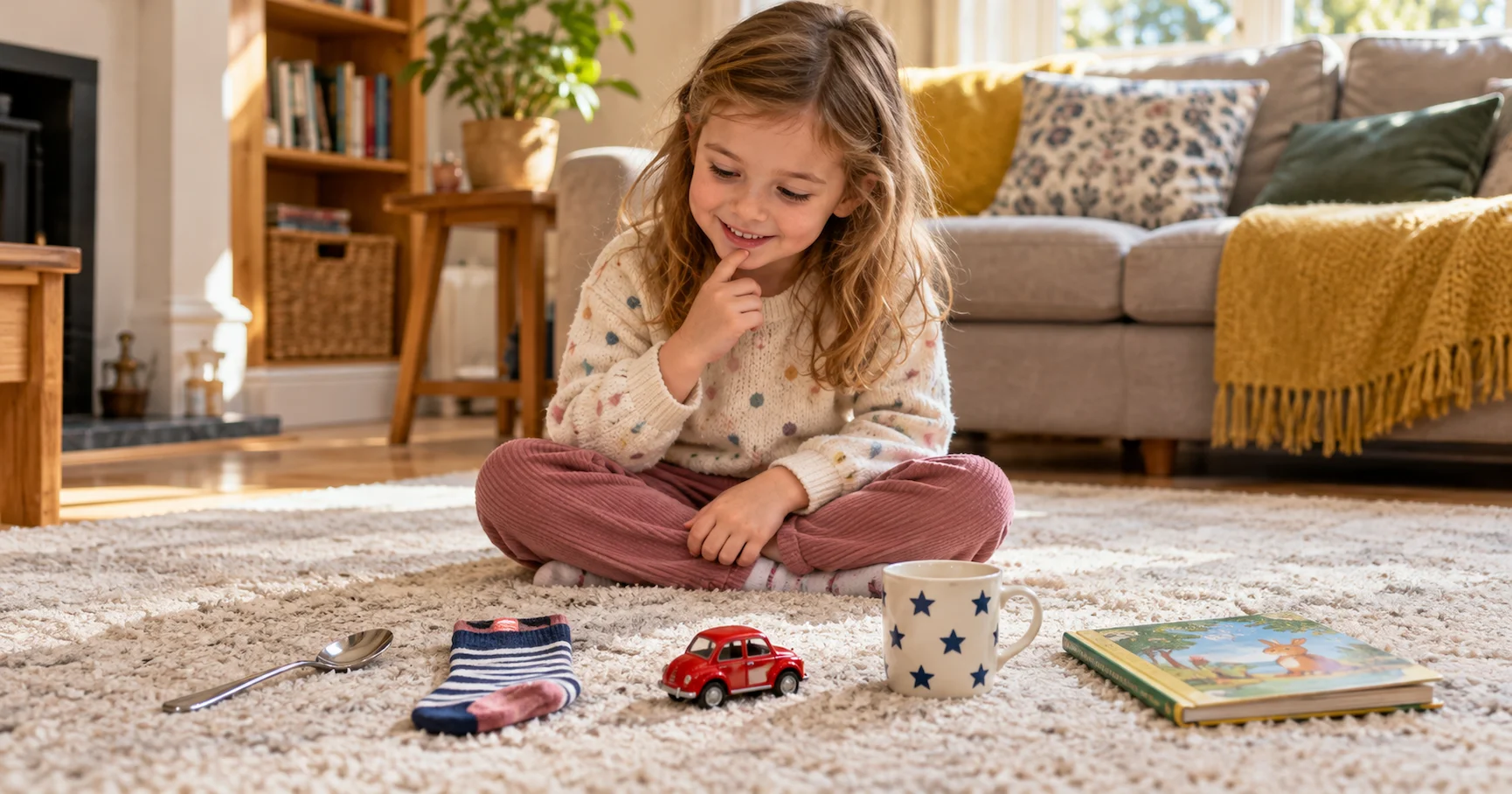
- Your child looks around the room and guesses objects that begin with that sound: sofa, sink, sock.
- Take turns. When your child takes a turn, encourage them to use the phoneme correctly — "I spy something beginning with /t/" rather than "tee".
How to Make It Harder
- Use ending sounds instead of initial sounds: "I spy something that ends with the sound /k/" (clock, book, fork)
- Use digraphs (two-letter sounds): "I spy something with the sound /sh/ in it" (shelf, cushion)
- Ask your child to segment the full word after guessing: "Can you sound it out? S-O-F-A — sofa!"
 AI-generated image
Game 2: Initial Sound Sorting
Best for: Ages 4–6 · Time: 5–10 minutes · You need: 8–12 small household objects, two containers (bowls, boxes or simply two areas of the table)
This game builds the ability to hear and distinguish the first sound of a word — a foundational phonics skill. It is particularly good for children in the early stages of phonics learning (Phase 2 and Phase 3 of the Letters and Sounds programme).
How to Play
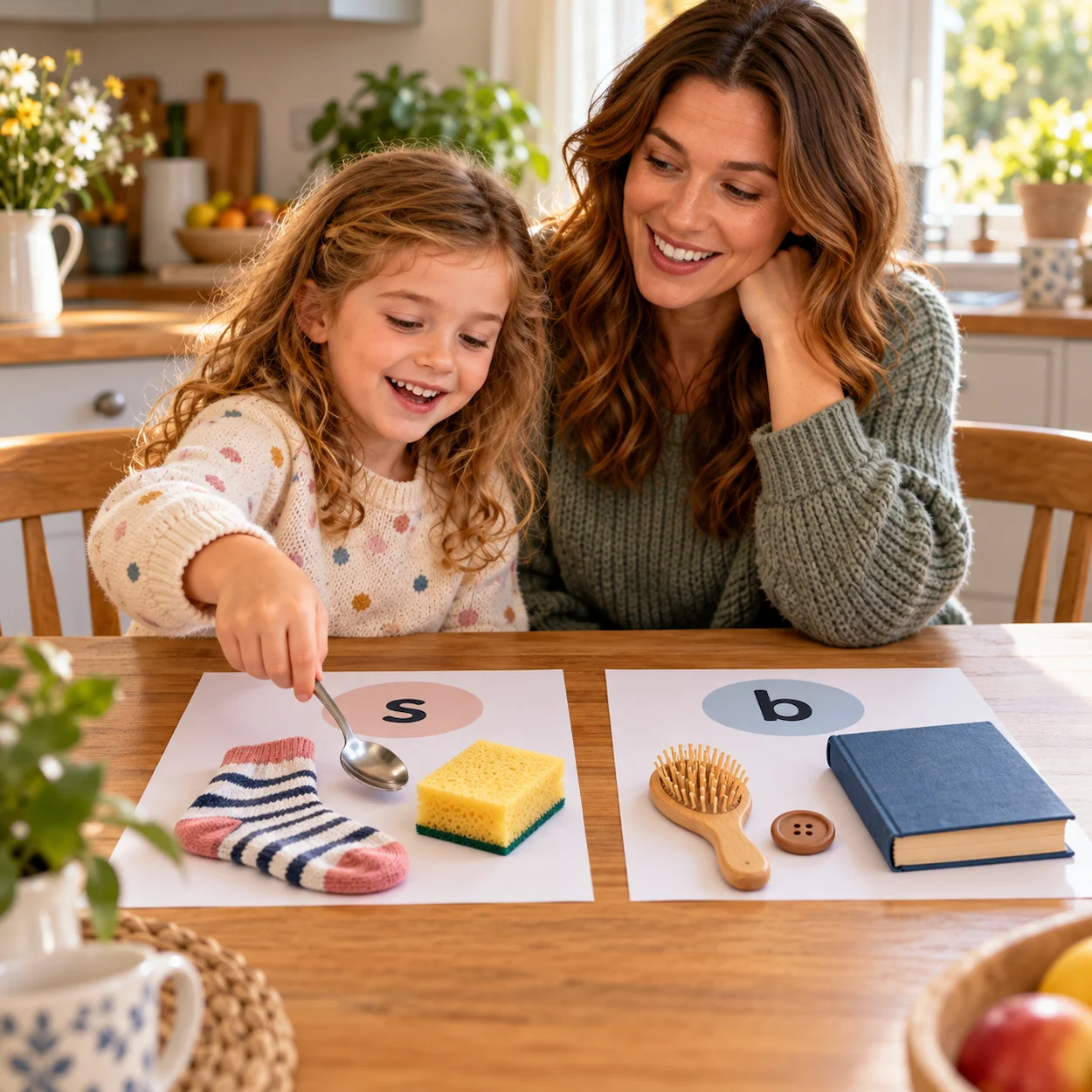
- Choose two target sounds — for example /p/ and /c/ (hard k sound).
- Gather 8–12 objects from around the house and place them in a pile: a pin, a pen, a pot, a cup, a cap, a coin, a key, a peg.
- Label the two containers with the target sounds (written on a sticky note, or just point to each).
- Your child picks up each object, says its name aloud, identifies the first sound, and places it in the correct container.
What to Use Around the House
- /s/ sounds: spoon, sponge, sock, soap, sellotape, scissors
- /b/ sounds: book, bowl, brush, button, bag, biro
- /m/ sounds: mug, mat, mirror, magnet, marker
- /t/ sounds: tape, tissue, toothbrush, tin, torch
 AI-generated image
Game 3: Phonics Scavenger Hunt
Best for: Ages 4–7 · Time: 5–10 minutes · You need: Access to more than one room, a small bag or box to collect items
A scavenger hunt gives children the chance to move around while practising phonics — movement helps consolidate learning, particularly for younger children. This version tasks them with finding objects that match a target sound.
How to Play
- Set a challenge: "Find me five things in the house that start with the sound /f/."
- Your child searches the house and collects qualifying objects: a fork, a feather (from a cushion or coat), a file (from a shelf), a flannel, a flower (plastic or real).
- When they return, they show you each item, say its name clearly, and confirm the initial sound.
- For added challenge, ask them to segment the whole word: "/f/ - /or/ - /k/ — fork!"
Variations
- Rhyming hunt: "Find me three things that rhyme with mat." (They may not find exact rhymes — that is fine. Cat, flat, hat can be hypothetical.)
- Two-sound hunt: "Find something with both the sound /r/ and the sound /oo/ in it." (ruler, room — trickier, good for Phase 4–5)
- Timed version: Set a one-minute timer. How many qualifying objects can they find?
 AI-generated image
Game 4: Mystery Sound Bag
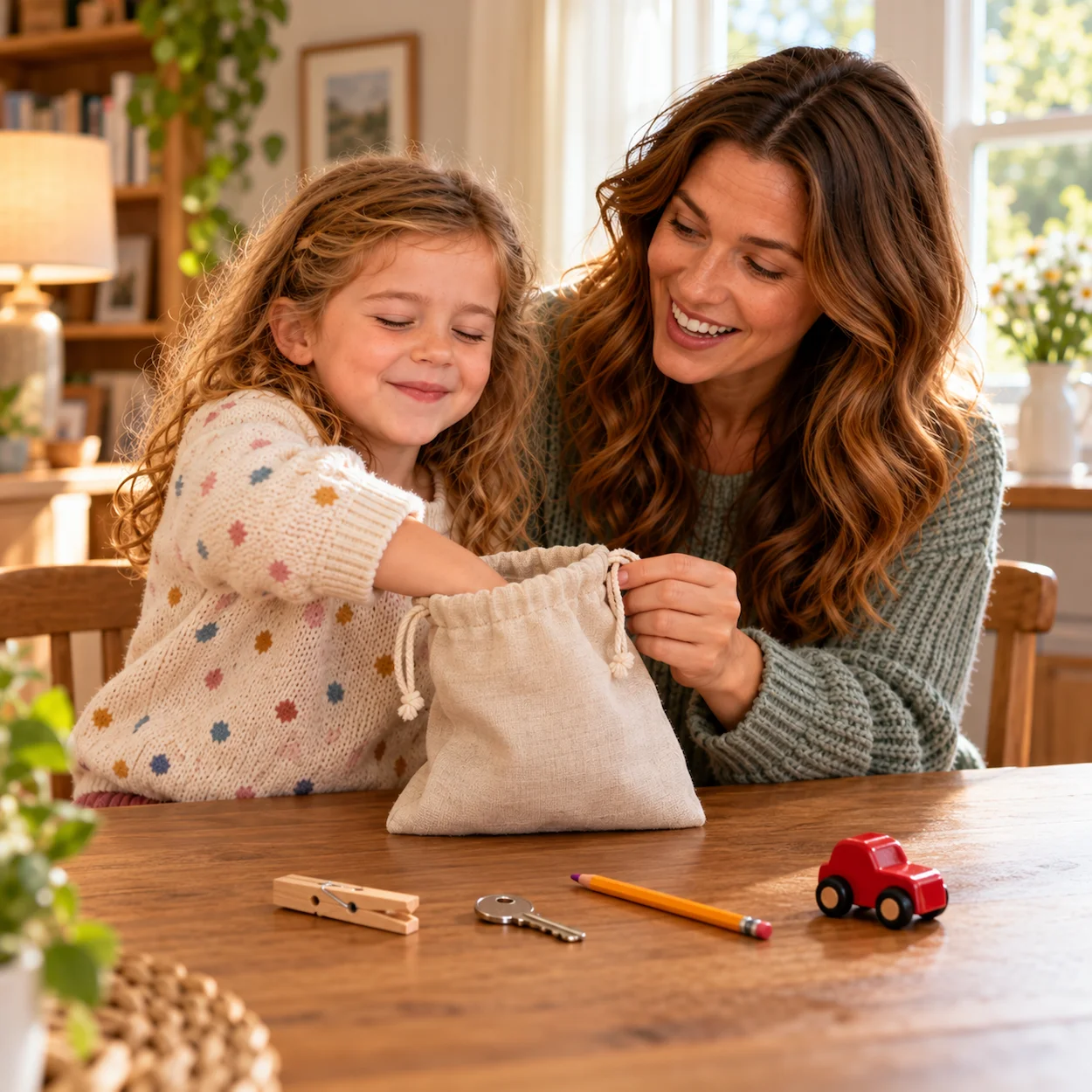
Best for: Ages 4–6 · Time: 5–10 minutes · You need: A fabric drawstring bag or pillowcase, 6–8 small objects
The Mystery Sound Bag adds an element of suspense and sensory engagement. Children reach into the bag without looking, feel the object, and use phonics to guess what it might be. The game builds phoneme awareness, blending and early reading skills simultaneously.
How to Play
- Place 6–8 small objects into the bag: a key, a peg, a pen, a pencil, a coin, a button, a small toy car, a leaf.
- Your child reaches in, feels an object without looking, and tries to guess what it is.
- Before revealing it, give a phonics clue: "It starts with the sound /k/." Or: "It has three phonemes — /p/ - /e/ - /g/."
- Your child uses the clue and their sense of touch to guess the object, then pulls it out to check.
Why This Works
The bag removes visual information, forcing children to rely on what they know about phonics and vocabulary. When they hear "/p/ - /e/ - /g/", they must blend those sounds into a real word — exactly the skill they need for reading. If blending is something your child is finding difficult, the guide on what to ask the teacher when a child struggles with phonics has practical advice for working with the school.
 AI-generated image
Tips for Making Home Phonics Practice Stick
- Keep sessions short. Five to ten minutes daily is far more effective than a long session once a week. Young children learn through frequent, low-pressure repetition.
- Follow your child's energy. If they are tired or resistant, stop. Phonics practice that feels like a struggle or a chore can create negative associations with reading.
- Use the sounds, not the letter names. "This object starts with /t/" is more useful phonically than "This object starts with tee." The sound is what the child needs to decode written words.
- Celebrate the effort, not just the answer. When a child segments a word confidently — even if they get it slightly wrong — acknowledge the skill they are building.
- Ask the school what to focus on. Your child's teacher can tell you which phoneme set is current. Practising sounds the child already knows thoroughly is useful, but practising the current teaching focus is most valuable.
For more ideas on supporting early language skills at home using everyday activities and conversation, see the guide on early years communication and language activities.
Frequently Asked Questions
What age are these phonics games suitable for?
All four games are designed primarily for children aged 4 to 6 — Reception and Year 1 in England. However, they can be adapted for younger children (from around age 3) by using simpler sounds, and for older children (Year 2 and beyond) by increasing the complexity of phonemes, moving to digraphs and trigraphs, or focusing on spelling patterns rather than individual sounds.
Do I need to know about phonics myself to play these games?
Not in depth. The most important thing is to use phoneme sounds rather than letter names when giving clues — so "/s/" rather than "ess", "/t/" rather than "tee". If you are unsure of the correct sounds, many schools provide a phonics pronunciation guide in their parent information packs, or you can find video guides on the Department for Education's early reading resources.
Should I correct my child immediately when they make a mistake?
Gentle correction is fine, but the way you correct matters. Rather than saying "No, that's wrong", try modelling the correct response: "That object is a fork — /f/ - /or/ - /k/. Can you hear the /f/ at the start?" Children learn more from hearing the correct answer than from being told they are wrong.
My child attends a school that uses a different phonics programme. Will these games still work?
Yes. All synthetic phonics programmes in England — including Letters and Sounds, Read Write Inc, Floppy's Phonics and others — teach the same underlying skill: mapping phonemes to graphemes. The games above practise phoneme awareness and blending at a general level and are compatible with any programme. If in doubt, ask your child's teacher which sounds to focus on this week.
How do I know which sounds to practise?
The simplest approach is to ask your child's class teacher or check the school's weekly phonics update if one is provided. As a general guide, Reception children typically begin with single-letter sounds (s, a, t, p, i, n...) and progress through consonant blends and digraphs (ch, sh, th...) across the year. Year 1 continues with more complex phonemes and alternative graphemes.
Can these games help a child who is finding phonics difficult?
Low-pressure, play-based phonics activities at home can help consolidate skills that are not yet secure, particularly for children who need more repetition than the classroom can provide. However, if your child is significantly behind their peers, it is important to speak with the school rather than trying to fix the gap through home activities alone. The teacher can explain whether additional support is in place and what you can do to complement it.