
The Flag of England is one of the most recognisable symbols in the country. A bold red cross on a white background, it is known as the St George's Cross and has represented England for centuries. Yet many pupils — and adults — are uncertain about its history, how it differs from the Union Flag, or why St George became England's patron saint. This guide explains it all in straightforward terms, with classroom activities included.
The Flag of England is a red cross on a white background, known as the St George's Cross. It has been associated with England since at least the 13th century and is flown officially on St George's Day (23 April) and other national occasions. It is not the same as the Union Flag (Union Jack), which combines the flags of England, Scotland and Northern Ireland.
What Does the Flag of England Look Like?
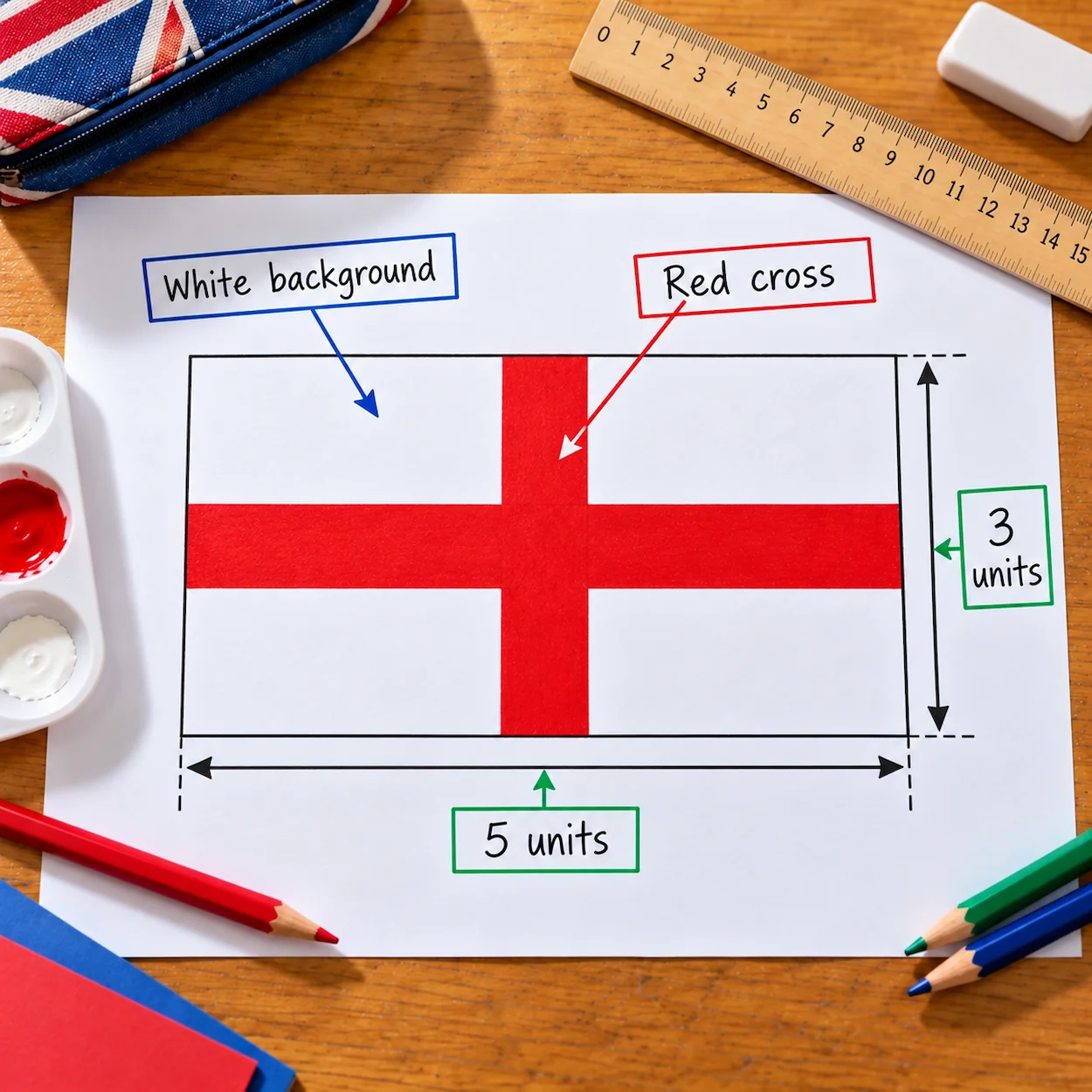
The Flag of England is simple in design:
- A plain white background (called the field)
- A bold red cross running horizontally and vertically, dividing the flag into four equal white rectangles
- The cross extends fully to the edges of the flag on all four sides
The official proportions are 3:5 (three units tall, five units wide), though flags in everyday use sometimes vary slightly. The red cross is centred on the flag and is the same width both horizontally and vertically.
 AI-generated image
Who Was St George?
St George is the patron saint of England, but he was not English. Historical accounts suggest he was born in Cappadocia (in what is now Turkey) around the 3rd century AD and served as a Roman soldier. He was a Christian martyr, executed for his faith around AD 303 under the Emperor Diocletian.
The famous legend of St George slaying a dragon is not a literal historical event — it is a medieval allegory. In the story, a dragon terrorises a town and demands human sacrifices. St George arrives on horseback, fights the dragon, saves a princess, and uses his victory to convert the townspeople to Christianity. The dragon represents evil or sin, and St George represents courage and Christian virtue.
St George became associated with England during the Crusades of the 11th and 12th centuries, when English soldiers reportedly rallied under his name. By the reign of Edward III in the 14th century, he had become England's official patron saint, and his feast day — 23 April — was established as a national celebration.
The story of St George and the Dragon is a rich text for primary English lessons. It can be used to explore narrative structure, character motivation, allegory and the difference between legend and history. Pupils often enjoy debating whether St George was a hero and what the dragon might symbolise in different interpretations.
When Did England Start Using the Red Cross?
The red cross on a white background was used as a military emblem by English soldiers from at least the 13th century. It appeared on soldiers' surcoats (cloth tunics worn over armour) and on shields during the Crusades. By the 14th century, under Edward III, the cross of St George was widely recognised as an English symbol.
A key moment came in 1606, when King James I combined the English cross (St George's Cross) with the Scottish cross (St Andrew's Cross — a white diagonal cross on blue) to create the first version of what would become the Union Flag. This is why the English flag and the Union Flag are so closely connected.
The Flag of England vs the Union Flag: What Is the Difference?
This is one of the most common points of confusion for pupils — and many adults. Here is a clear comparison:
| Feature | Flag of England | Union Flag (Union Jack) |
|---|---|---|
| Design | Red cross on white background | Combined crosses of England, Scotland and Northern Ireland |
| Represents | England only | The United Kingdom as a whole |
| Colours | Red and white | Red, white and blue |
| Named after | St George (patron saint of England) | A union of three patron saints' crosses |
| Used by | England sports teams, St George's Day events | UK government, military, national events |
The Union Flag contains three crosses layered together:
- St George's Cross (England) — red cross on white
- St Andrew's Cross (Scotland) — white diagonal cross on blue
- St Patrick's Cross (Northern Ireland) — red diagonal cross on white
Wales does not have its own cross in the Union Flag because Wales was already politically united with England by the time the Union Flag was created in 1606. The Welsh dragon flag (Y Ddraig Goch) remains Wales's own national symbol.
When Is the Flag of England Flown?
The St George's Cross is most commonly seen on:
- St George's Day (23 April) — the national day of England
- England football, rugby and cricket matches
- Some churches dedicated to St George
- Local authority buildings and town halls in England on designated flag-flying days
- Community events and parades celebrating English heritage
Government buildings in England typically fly the Union Flag on official flag-flying days, but may also fly the St George's Cross on St George's Day specifically. The flag has no legal restrictions on its use by members of the public.
 AI-generated image
Classroom Activities: Teaching the Flag of England
The St George's Cross provides excellent starting points for cross-curricular work across History, Art, English and PSHE.
Key Stage 1 (Ages 5–7)
- Flag painting: Pupils paint or collage a St George's Cross using red and white materials. Discuss the colours and what they might represent.
- Spot the difference: Show pupils the Flag of England and the Union Flag side by side. How many differences can they find?
- Story time: Read a simplified version of the St George and the Dragon legend. Ask pupils to draw their favourite scene.
Key Stage 2 (Ages 7–11)
- Flag timeline: Create a timeline showing how the flag developed from a Crusader emblem (13th century) to its modern form. Include the creation of the Union Flag in 1606.
- Compare patron saints: Research the patron saints of Scotland, Wales and Northern Ireland. Create a display comparing the four crosses and flags.
- Allegory discussion: Examine the dragon legend as an allegory. What does the dragon represent? What values does St George embody? How do allegories differ from historical accounts?
- Geography link: Locate Cappadocia on a map of Turkey. Discuss the historical context of the Roman Empire and early Christianity.
Key Stage 3 (Ages 11–14)
- Symbolism and national identity: Debate why nations use flags and what the St George's Cross means to different people in England today. Consider how its meaning may vary between communities.
- Heraldry research: Introduce pupils to heraldry and the language used to describe coats of arms. Describe the St George's Cross in formal heraldic terms (Argent, a cross Gules).
- Historical inquiry: Investigate the role of the Crusades in shaping English national symbols. What other symbols or traditions have their origins in the medieval period?
Frequently Asked Questions
Is the Flag of England the same as the Union Jack?
No. The Flag of England — the St George's Cross — is a red cross on a white background and represents England only. The Union Flag (Union Jack) combines the crosses of England, Scotland and Northern Ireland and represents the United Kingdom as a whole. The red cross of St George is incorporated into the Union Flag as one of its three elements.
Why is St George the patron saint of England if he was not English?
Many patron saints of European nations were not native to those countries. St George was a Christian martyr from Cappadocia (modern-day Turkey) who became associated with England through the Crusades. English soldiers invoked his name in battle, and his legend of courage and Christian virtue made him an ideal symbol. By the 14th century, King Edward III formally established him as England's patron saint.
What does the dragon represent in the St George legend?
In the medieval Christian allegory, the dragon typically represents evil, sin or the Devil. St George's victory over the dragon symbolises the triumph of Christian faith and virtue over wickedness. Different retellings give the dragon different meanings — in some versions it represents tyranny or oppression more broadly. Pupils often find it productive to discuss what the dragon might symbolise in a modern retelling.
Can schools fly the Flag of England?
Yes. Schools in England can fly the St George's Cross. There are no legal restrictions on flying the flag on school premises. Many schools choose to fly it on St George's Day (23 April) as part of their recognition of the national day. Local authority guidance may offer recommendations, but the decision rests with the headteacher and governing body.
How is the Flag of England different from the flags of other UK nations?
Each nation of the UK has its own flag. The Flag of England is a red cross on white (St George's Cross). The Flag of Scotland is a white diagonal cross on blue (St Andrew's Cross). The Flag of Wales is a red dragon on a green and white background (Y Ddraig Goch). Northern Ireland has no single officially recognised flag, though St Patrick's Cross (a red diagonal cross on white) represents it in the Union Flag. The Welsh dragon is the most visually distinctive, as it is the only UK national flag featuring an animal.
When was the St George's Cross first used as England's flag?
The red cross on a white background was used as a military emblem by English forces from at least the 13th century during the Crusades. It became formally associated with England as a national symbol by the 14th century under Edward III. The flag has been in continuous use ever since, making it one of the oldest national flags still in use in Europe.