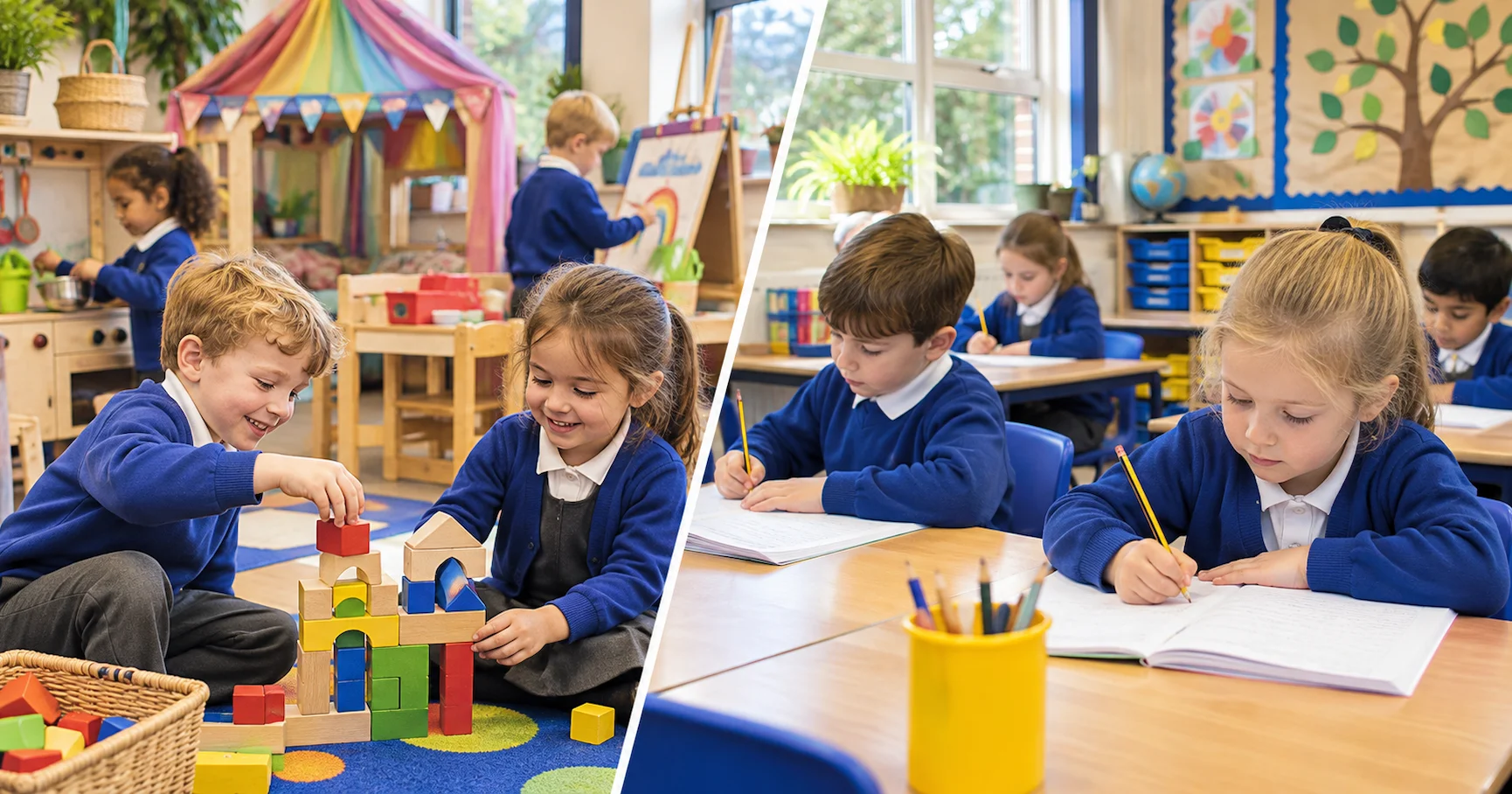
The move from Reception to Year 1 is one of the most significant transitions in a child's primary school journey — and one that parents often find harder to navigate than the children themselves. Your child will shift from the Early Years Foundation Stage (EYFS), with its flexible, play-based approach, into Key Stage 1 of the National Curriculum, where learning becomes more structured, subject-specific and formally recorded. This guide explains exactly what changes, why, and what you can do at home to help the transition go smoothly.
In Reception, children follow the EYFS statutory framework, focusing on seven broad areas of learning through play and exploration. In Year 1, they step onto the National Curriculum for the first time, with distinct subjects (English, Maths, Science, History and so on) taught in a more formal, adult-directed way. Most children move into Year 1 aged 5 or 6 — often before they are ready to sit still for long stretches. Good schools manage this with a gradual bridge rather than an abrupt switch.
What Reception Looks Like: EYFS and Play-Based Learning
Reception sits within the Early Years Foundation Stage, which governs the education of all children from birth to the end of their Reception year. The EYFS framework covers seven areas of learning:
- Prime areas: Communication and Language; Physical Development; Personal, Social and Emotional Development
- Specific areas: Literacy; Mathematics; Understanding the World; Expressive Arts and Design
Learning in Reception is largely driven by continuous provision — a learning environment (usually both indoor and outdoor) where children choose activities, explore, role-play, construct and create, while adults observe, prompt and extend their thinking. Formal whole-class teaching happens in short, focused bursts; the rest of the day is fluid and responsive to the children's interests and developmental stage.
At the end of Reception, children are assessed against the Early Learning Goals (ELGs) — whether they are "Expected," "Emerging" or "Exceeding" in each area. This is the Early Years Foundation Stage Profile (EYFSP), completed by the teacher based on observation rather than formal tests.
What Year 1 Looks Like: Entering the National Curriculum
From September of Year 1 (age 5–6), children move into Key Stage 1, which covers Years 1 and 2. They are now subject to the statutory National Curriculum, which introduces distinct subjects with defined content and programmes of study.
The key subjects taught in Year 1 include: English (reading, writing, spoken language, spelling and grammar), Mathematics, Science, History, Geography, Art and Design, Design and Technology, Computing, Music, Physical Education, and Religious Education. The school day is divided into timetabled lessons with clear learning objectives, and children are expected to work in exercise books and produce recorded written outputs to a much greater degree than in Reception.
The Five Biggest Changes: What Parents Notice
| Area | Reception (EYFS) | Year 1 (National Curriculum) |
|---|---|---|
| Curriculum | 7 broad areas of learning, child-led exploration | Distinct named subjects with programmes of study |
| Teaching style | Play-based, child-initiated, adult scaffolding | More adult-directed, whole-class teaching, structured tasks |
| Environment | Free-flow indoor/outdoor access, role-play areas | Desks and chairs, timetabled sessions, outdoor play at set times |
| Writing | Single words or a simple sentence; mark-making to communicate | Connected sentences, capital letters, full stops, conjunctions |
| Reading | Phonics Phases 2–3, blending simple decodable words | Phase 5 phonics, reading comprehension, June Phonics Screening Check |
1. From Play-Based to More Formal Learning
This is the change parents notice most visibly. In Reception, a significant proportion of the day — sometimes up to half or more — is child-initiated play: children choose what to do, adults join them, ask questions and extend their learning. In Year 1, the balance shifts decisively towards whole-class teaching and adult-directed tasks. Children are expected to sit at a table for longer periods, follow multi-step instructions and sustain concentration on a task independently.
Many schools manage this transition thoughtfully. A good Year 1 class in the autumn term will often retain elements of continuous provision and hands-on learning during the first half-term, gradually introducing more formal desk-based work as children build their concentration stamina. If you notice your child is exhausted in the first half of the autumn term — this is entirely normal and is a sign they are expending real cognitive effort adapting to the new environment.
2. Writing Expectations Jump Considerably
The gap between the writing expected at the end of Reception and the writing expected by the end of Year 1 is one of the steepest in all of primary school. By the end of Reception, the Early Learning Goals require children to hold a pencil effectively, write most letters correctly, and write a simple sentence or short phrase. By the end of Year 1, the National Curriculum expects children to:
- Write sentences independently, with ideas connected across more than one sentence
- Use capital letters, full stops, question marks and exclamation marks correctly
- Join clauses using the conjunction "and"
- Spell common exception words correctly (the "Year 1 common exception word list")
- Apply basic spelling rules — adding -s, -es, -ed, -ing, -er, -est
- Write with legible, correctly formed letters, and some schools begin to introduce pre-cursive or joined handwriting
 AI-generated image
3. Phonics: Moving From Phase 3 to Phase 5
Phonics teaching continues at pace in Year 1. Most children leave Reception having covered Phases 2 and 3 of systematic synthetic phonics — learning individual letter sounds, basic digraphs (sh, ch, th, ee, oo) and blending them to read simple words. In Year 1, children consolidate Phase 4 and move rapidly into Phase 5, which introduces alternative spellings for the same sound (for example, the "ee" sound can be spelled as ee, ea, e-e, ey or ie). This is often the stage where children who struggled with the basics in Reception find reading harder, and where those who were secure find it becomes more instinctive.
The statutory Year 1 Phonics Screening Check takes place in June of Year 1. Children read 40 words — 20 real words and 20 "pseudo-words" (nonsense words like snorb or blim that test decoding rather than sight recognition). The check is low-key and usually conducted one-to-one with the teacher. Children who do not reach the expected standard (currently 32 or more out of 40) retake it in Year 2. For more detail on how the check works, see the guide on the Year 1 Phonics Screening Check.
4. Reading Comprehension Becomes Explicit
In Reception, the focus is almost entirely on decoding — translating letters into sounds and sounds into words. In Year 1, the National Curriculum adds an explicit requirement for reading comprehension: children are expected not just to read words accurately but to discuss what they have read, respond to questions about text, make predictions, and link what they read to their own experience and to other texts. This shift from reading as decoding to reading as understanding continues to deepen throughout KS1 and KS2.
5. Mathematics Becomes More Formal
In Reception, maths is woven into everyday activities — counting blocks, comparing sizes, exploring patterns in play. In Year 1, the National Curriculum introduces more formal mathematical content with specific objectives. Year 1 mathematics covers:
- Number and place value: counting to and across 100, reading and writing numbers to 20
- Addition and subtraction: number bonds to 10 and 20, adding and subtracting within 20
- Multiplication and division: early concepts through counting in 2s, 5s and 10s
- Fractions: finding half and a quarter of shapes and quantities
- Measurement: comparing, describing and solving problems with length, weight, capacity and time
- Geometry: properties of shapes, position and direction
Many primary schools in England use a deliberate soft transition approach in September — keeping elements of continuous provision, outdoor learning and child-initiated activity in the Year 1 classroom for the first half-term, before gradually increasing the formal structure. This is recognised as good early years practice and reflects research showing that an abrupt switch to a rigid, desk-bound environment can disrupt children's wellbeing and learning. If your child's school does this, it is a sign of thoughtful transition planning — not a sign that Year 1 is not "proper school."
 AI-generated image
How to Help Your Child at Home
The best home support for the Reception–Year 1 transition is practical and low-pressure:
Keep Up Daily Reading
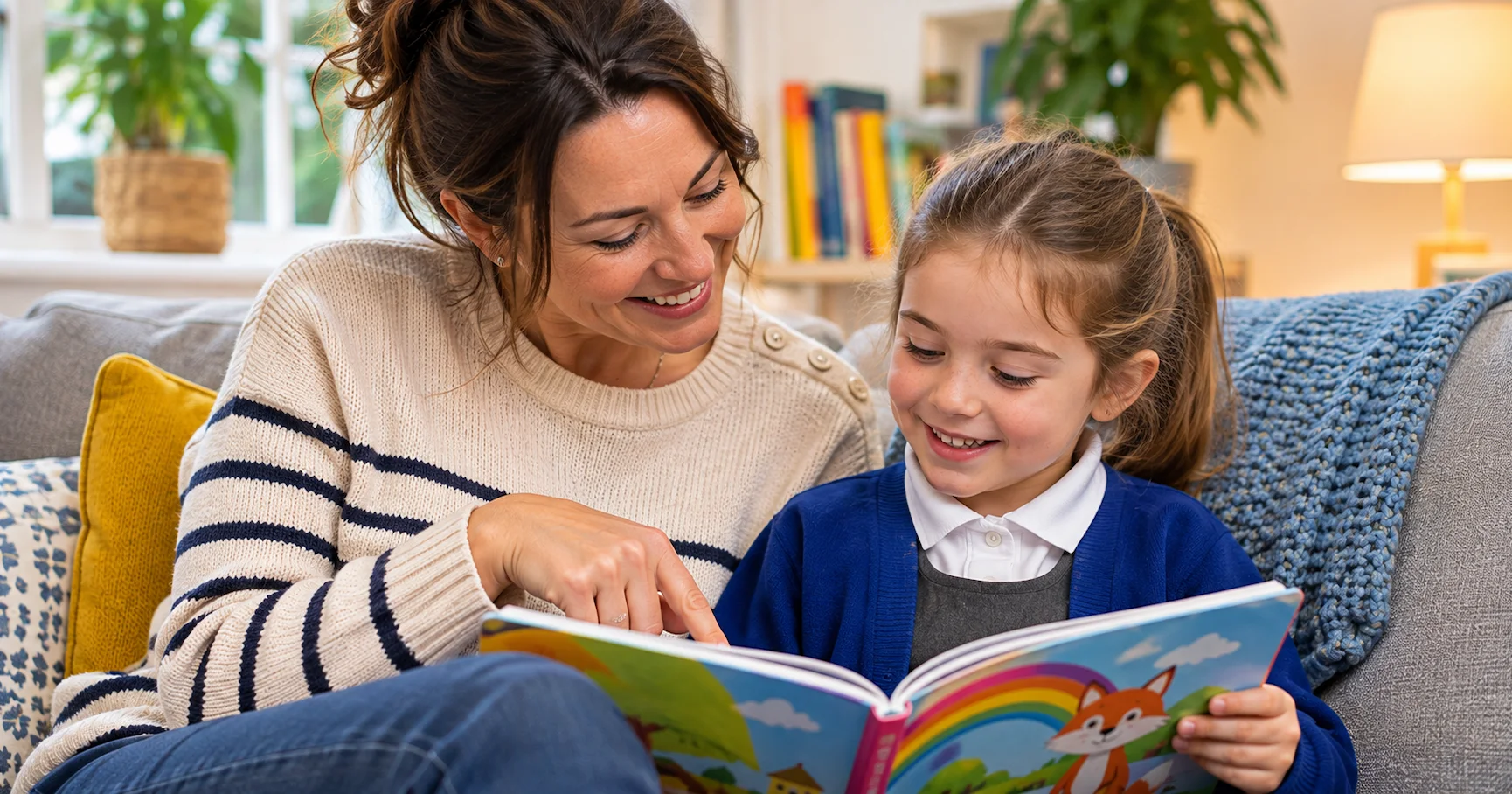
Aim for 10–15 minutes of reading every day. Practise sounding out words using phonics rather than guessing from pictures or context. Ask simple comprehension questions as you read: "What do you think will happen next?" "Why did she do that?" Do not worry if your child finds pseudo-words puzzling at first — practising with nonsense words is an excellent decoding workout and directly prepares them for the June phonics check.
Build Writing Stamina Gently
Many children find the writing demands of Year 1 physically tiring — pencil grip, letter formation and sitting upright for extended periods all require muscular effort they have not yet fully developed. At home, encourage drawing, colouring, cutting, threading and other fine motor activities. Writing shopping lists, postcards, birthday cards or simple diary entries together — without pressure about neatness — helps build the habit of putting thoughts into writing.
Practise Number Facts
Year 1 maths moves fast. Spending a few minutes each day on number bonds to 10 and then to 20 pays dividends. Use everyday moments — setting the table, counting steps, halving an apple — to make numbers feel normal rather than formal.
Support Independence
Year 1 teachers expect children to manage more independently: hanging up their own coat, opening their own lunch box, asking an adult for help rather than waiting. Over the summer and in the first weeks of term, encourage your child to do these things themselves. It reduces classroom friction and builds the self-confidence that helps children settle faster into the new environment.
Keep an Eye on Emotional Wellbeing
The transition can be tiring, even for children who seem to take it in their stride. A child who comes home grumpy, clingy or unusually tearful in September is not struggling — they are recalibrating after spending a day in a more demanding environment than they are used to. Give them time to decompress through unstructured play before asking about their day. If unsettledness persists beyond the first half-term, speak to the class teacher.
Frequently Asked Questions
Is there a national curriculum in Reception?
No. Reception follows the Early Years Foundation Stage (EYFS) statutory framework, not the National Curriculum. The EYFS covers seven areas of learning (three prime and four specific), assessed at the end of Reception through the Early Years Foundation Stage Profile (EYFSP). Children enter the National Curriculum for the first time at the start of Year 1, when Key Stage 1 begins.
Why does my child seem exhausted in the first half-term of Year 1?
This is entirely normal and very common. The Year 1 environment makes greater cognitive, physical and social demands than Reception. Children must sit for longer periods, follow more complex instructions, record their learning in writing and manage their own organisation to a greater degree. The energy required to regulate behaviour and concentrate in this new environment is significant, and tiredness — along with occasional emotional wobbles — in the first half-term is a healthy sign of adjustment, not a sign of difficulty.
What is the Year 1 Phonics Screening Check?
The Year 1 Phonics Screening Check is a statutory assessment held in June of Year 1. Children read 40 words — 20 real words and 20 pseudo-words (nonsense words that test decoding rather than memorisation) — one-to-one with their teacher. Children who reach the expected standard (currently 32 or more out of 40) pass; those who do not retake it in Year 2. The check is not a stressful event and is designed to identify children who need additional phonics support.
What phonics phases do children cover in Reception and Year 1?
In Reception, most children cover Phases 2 and 3 of systematic synthetic phonics — learning individual letter sounds and basic digraphs (sh, ch, th, ee, oo) and beginning to blend them into words. In Year 1, children consolidate Phase 4 and move into Phase 5, which introduces alternative spellings for the same sounds (e.g., the "ee" sound can be spelled as ee, ea, e-e, ey or ie). This is often where reading begins to feel more fluent as children move beyond simple one-to-one sound-letter correspondences.
My child's Year 1 class still has play areas — is that normal?
Yes, and it is considered good practice. Many schools use a "soft transition" approach in the autumn term, retaining elements of child-initiated learning and continuous provision in the Year 1 classroom during the first half-term before gradually introducing a more formal structure. This bridges the transition rather than switching abruptly from EYFS to desk-based learning. It does not mean your child is not doing "real" Year 1 work — it means the school is applying research-informed transition practice.
What can I do at home to help with the Reception to Year 1 transition?
The most effective home support is: daily reading using phonics (10–15 minutes, with comprehension questions); gentle writing activities like lists, cards or diary entries to build stamina; number bond practice (to 10, then to 20) in everyday contexts; and encouraging independence in self-care tasks like dressing and opening lunch boxes. Emotional support is equally important — allow downtime after school and monitor wellbeing without adding pressure about academic expectations.