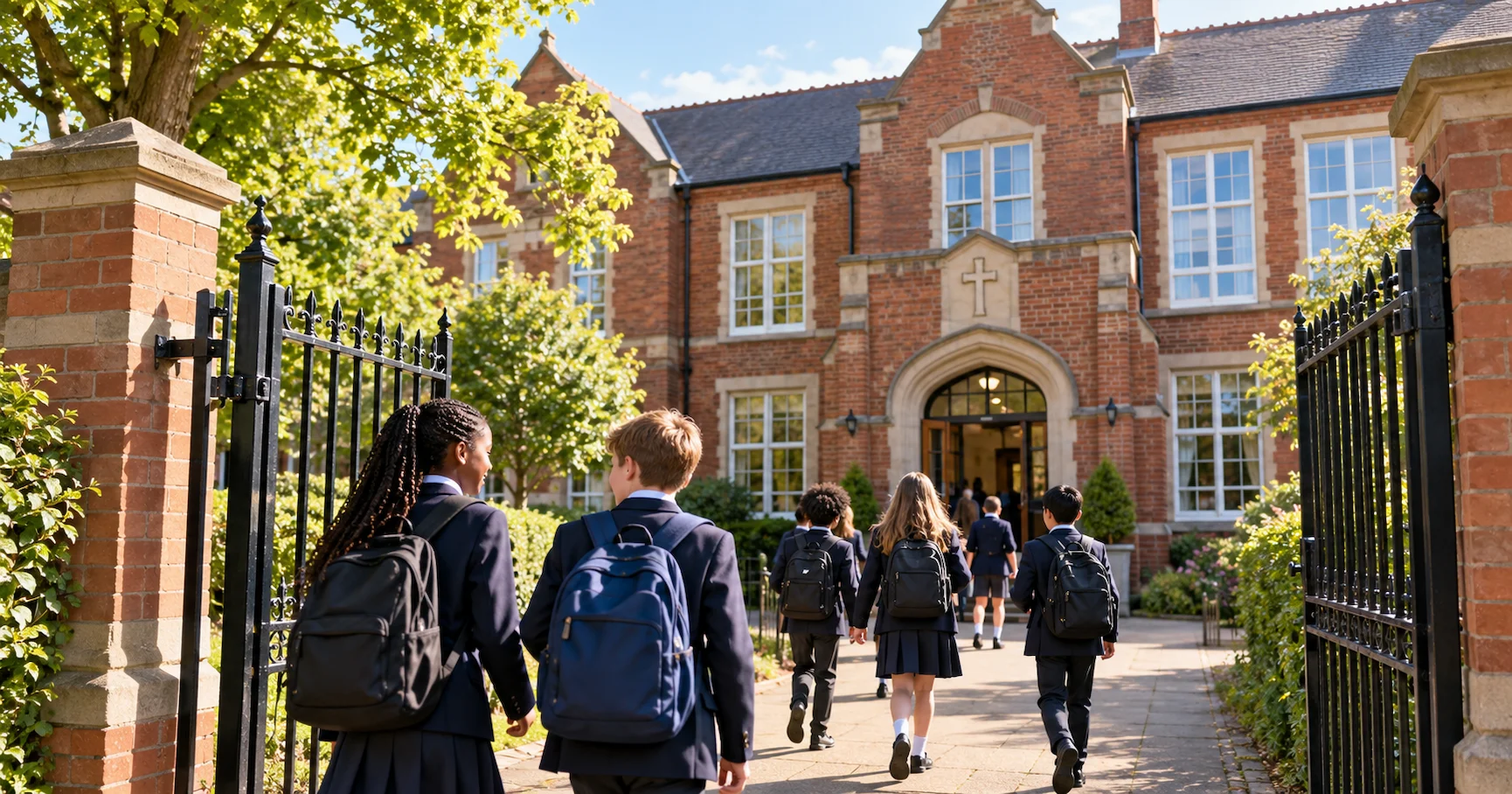
Every state-funded school in England is expected to provide pupils with a broad and balanced education. For the majority of maintained schools — community schools, voluntary aided, voluntary controlled — this means following the National Curriculum, a statutory framework that sets out which subjects must be taught and what pupils should learn at each stage of their education. For academies and free schools, the picture is slightly different, but the core expectation of a rigorous, broad curriculum still applies. This guide explains what is required, by whom, and at which age — covering every key stage from Reception through to GCSE.
The current National Curriculum has been in force since September 2014, following a major review led by then Education Secretary Michael Gove. It applies to maintained schools (community, voluntary aided and voluntary controlled). Academies and free schools are technically exempt from the National Curriculum but must still provide a broad and balanced curriculum including English, mathematics, science and RE. Religious Education and Relationships, Sex and Health Education (RSHE) are compulsory in all state-funded schools.
What Is the National Curriculum and Who Must Follow It?
The National Curriculum is a statutory framework that specifies the subjects schools must teach and the programmes of study pupils must follow at each key stage. It was first introduced in 1988 under the Education Reform Act and has been revised several times, most significantly with the 2014 reforms under Michael Gove.
The National Curriculum applies to all maintained schools in England — community schools, voluntary aided, voluntary controlled and foundation schools. It does not legally apply to:
- Academies and free schools — state-funded but independent of local authority control, legally exempt from the National Curriculum under the terms of their funding agreements
- Independent (private) schools — entirely outside the state sector
Despite this exemption, the vast majority of academies follow the National Curriculum in practice. All state-funded schools — including academies — must provide a curriculum that is broad and balanced and must include English, mathematics, science and Religious Education. RSHE has been statutory at all state-funded schools since September 2020.
Key Stages: How the Curriculum Is Organised
The National Curriculum is divided into four Key Stages:
| Key Stage | School Years | Ages | Phase |
|---|---|---|---|
| KS1 | Years 1–2 | 5–7 | Primary |
| KS2 | Years 3–6 | 7–11 | Primary |
| KS3 | Years 7–9 | 11–14 | Secondary |
| KS4 | Years 10–11 | 14–16 | Secondary (GCSE years) |
Before Key Stage 1 — in nursery and Reception (ages 3–5) — children follow the Early Years Foundation Stage (EYFS) statutory framework, which is separate from the National Curriculum and applies to all state-funded early years settings including academies and free schools.
Primary School: What Must Be Taught at KS1 and KS2?
At primary level, the National Curriculum divides subjects into core subjects and foundation subjects. All are compulsory in maintained schools at both KS1 and KS2, with one exception noted below.
Core Subjects (KS1 and KS2)
- English — reading, writing, grammar, punctuation and spelling
- Mathematics
- Science
Foundation Subjects (KS1 and KS2)
- Art and Design
- Computing
- Design and Technology (DT)
- Geography
- History
- Music
- Physical Education (PE) — including swimming instruction, which must be provided at some point during KS1 or KS2
- Modern or ancient foreign language — compulsory at KS2 only (Years 3–6); not required at KS1
Additional Statutory Requirements
- Religious Education (RE) — compulsory at all maintained schools at every key stage; a separate statutory requirement, not technically part of the National Curriculum
- Relationships Education and Health Education (RHE) — statutory at primary level since September 2020; parents may withdraw children from some elements of sex education (where taught) but not from Relationships or Health Education
The National Curriculum requires all maintained primary schools to provide swimming and water safety instruction at some point during KS1 or KS2. By the end of KS2, pupils should be able to swim at least 25 metres unaided using a range of strokes and have basic water safety knowledge. Schools that cannot provide swimming on-site must arrange access to a pool. Academies are encouraged to follow this requirement but it is not formally binding on them.
Secondary School: What Must Be Taught at KS3?
Key Stage 3 covers Years 7 to 9 (ages 11–14). Pupils study a broad range of subjects before choosing their GCSE options. In maintained schools the following are compulsory:
Core Subjects (KS3)
- English
- Mathematics
- Science
Foundation Subjects (KS3)
- Art and Design
- Citizenship
- Computing
- Design and Technology (DT)
- Geography
- History
- Modern Foreign Languages
- Music
- Physical Education (PE)
Additional Statutory Requirements (KS3)
- Religious Education (RE) — compulsory; parents retain the right to withdraw
- Relationships, Sex and Health Education (RSHE) — statutory since September 2020; parents may withdraw from sex education elements only
 AI-generated image
Secondary School: What Must Be Taught at KS4?
Key Stage 4 covers Years 10 and 11 (ages 14–16) — the GCSE years. The requirements change at KS4: fewer subjects are fully compulsory, but schools must ensure pupils have access to a specified range of subject areas.
Mandatory Subjects (all pupils must study these)
- English Language and English Literature
- Mathematics
- Science — Combined Science (two GCSEs: biology, chemistry, physics) or Triple Science (three separate GCSEs)
- Computing
- Physical Education (PE)
- Citizenship
Entitlement Areas (schools must offer; pupils choose)
Schools must ensure every pupil has access to at least one subject from each of the following four areas:
- Arts — Art and Design, Music, Dance, Drama or Media Arts
- Design and Technology
- Humanities — History or Geography
- Modern Foreign Languages
Additional Statutory Requirements (KS4)
- Religious Education (RE) — compulsory through to the end of KS4
- Relationships, Sex and Health Education (RSHE) — statutory; parents may withdraw from sex education elements until the pupil turns 15
| Subject | KS1 | KS2 | KS3 | KS4 |
|---|---|---|---|---|
| English | ✅ Core | ✅ Core | ✅ Core | ✅ Mandatory |
| Mathematics | ✅ Core | ✅ Core | ✅ Core | ✅ Mandatory |
| Science | ✅ Core | ✅ Core | ✅ Core | ✅ Mandatory |
| Art and Design | ✅ Foundation | ✅ Foundation | ✅ Foundation | Entitlement area |
| Computing | ✅ Foundation | ✅ Foundation | ✅ Foundation | ✅ Mandatory |
| Design & Technology | ✅ Foundation | ✅ Foundation | ✅ Foundation | Entitlement area |
| Geography | ✅ Foundation | ✅ Foundation | ✅ Foundation | Entitlement area |
| History | ✅ Foundation | ✅ Foundation | ✅ Foundation | Entitlement area |
| Modern Foreign Language | — | ✅ Foundation | ✅ Foundation | Entitlement area |
| Music | ✅ Foundation | ✅ Foundation | ✅ Foundation | Entitlement area |
| Physical Education | ✅ Foundation | ✅ Foundation | ✅ Foundation | ✅ Mandatory |
| Citizenship | — | — | ✅ Foundation | ✅ Mandatory |
| RE (statutory, not NC) | ✅ | ✅ | ✅ | ✅ |
| RSHE (statutory, not NC) | ✅ RHE | ✅ RHE | ✅ RSHE | ✅ RSHE |
Computing: The 2014 Change Worth Knowing
One of the most significant changes in the 2014 curriculum reform was replacing Information and Communication Technology (ICT) with a new, more rigorous Computing curriculum. Where ICT had focused primarily on using software — word processing, spreadsheets, presentations — the Computing curriculum introduced programming and coding as statutory content from Key Stage 1 onwards.
At KS1, pupils learn to understand algorithms, create simple programs and predict outcomes. By KS2, they are writing programs in at least two programming languages. At KS3, expectations include computer science concepts such as data representation, boolean logic and how networks function. The change reflected a judgement that 21st-century digital literacy requires understanding how technology works, not just how to use it.
 AI-generated image
RSHE: The 2020 Change Every Parent Should Know
From September 2020, Relationships, Sex and Health Education (RSHE) became statutory at all state-funded schools in England — including academies and free schools. Before 2020, Sex and Relationship Education guidance had not been comprehensively updated since 2000. The 2020 changes introduced three distinct elements:
- Relationships Education — compulsory at primary and secondary. Covers healthy relationships, families, online safety, respectful behaviour and consent (age-appropriately). No right of parental withdrawal.
- Sex Education — compulsory at secondary only. At primary, schools may teach puberty and reproduction but are not required to. Parents may withdraw children from sex education at primary; at secondary, parents may withdraw until the pupil's 15th birthday.
- Health Education — compulsory at all levels. Covers physical health, mental wellbeing, online safety and first aid (at secondary). No right of parental withdrawal.
Do Academies Have to Follow the National Curriculum?
No — academies and free schools are legally exempt. However, this exemption is narrower than it might appear:
- All academies must provide a curriculum that is broad and balanced
- All academies must teach English, mathematics and science
- All academies must provide Religious Education
- All academies must implement RSHE in line with the statutory guidance
- All academies with early years provision must follow the EYFS statutory framework
- Academies are subject to Ofsted inspection under the Education Inspection Framework, which assesses whether the curriculum is ambitious, sequenced and coherent
In practice, the majority of academies follow the National Curriculum or a closely equivalent programme. For a fuller picture of how academies differ from maintained schools, see the guide to state schools, academies and free schools compared. To understand what qualifications your child will sit at the end of KS4, see the guide to GCSEs and the 9–1 grading system.
Frequently Asked Questions
What are the core subjects of the National Curriculum in England?
The three core subjects are English, Mathematics and Science. These are compulsory at KS1, KS2, KS3 and KS4 in all maintained schools. All other National Curriculum subjects — including Art and Design, Computing, History, Geography, Music and PE — are called foundation subjects and are also compulsory at the relevant key stages, though with different requirements at different stages.
Is Religious Education part of the National Curriculum?
No — RE is not technically part of the National Curriculum, but it is a separate statutory requirement. All maintained schools must provide RE at every key stage, from KS1 through KS4. Academies and free schools must also provide RE. In non-faith maintained schools, RE follows the locally agreed syllabus produced by the local SACRE. In faith schools, RE can reflect the tenets of the school's designated faith. Parents have an absolute right to withdraw their children from RE.
When did RSHE become compulsory in English schools?
Relationships, Sex and Health Education (RSHE) became statutory at all state-funded schools from September 2020. Relationships Education and Health Education are compulsory at all levels with no right of parental withdrawal. Sex Education is compulsory at secondary level; parents may withdraw pupils from sex education until the pupil turns 15. The changes were enabled by the Children and Social Work Act 2017.
Do academies have to follow the National Curriculum?
Academies and free schools are legally exempt from the National Curriculum. However, they must provide a broad and balanced curriculum that includes English, mathematics, science and RE, and must implement RSHE. They must also follow the EYFS framework if they have early years provision. Ofsted inspects academy curriculum quality under the Education Inspection Framework. In practice, most academies follow the National Curriculum or something closely equivalent.
What subjects are compulsory at GCSE level (KS4)?
At KS4 in maintained schools, all pupils must study English Language and Literature, Mathematics, Science (Combined or Triple), Computing, PE and Citizenship. Schools must also offer access to at least one subject from each of four entitlement areas: Arts, Design and Technology, Humanities (History or Geography), and Modern Foreign Languages. RE and RSHE remain statutory throughout KS4.
What changed about the National Curriculum in 2014?
The 2014 reform, led by Education Secretary Michael Gove, revised programmes of study across all subjects with a focus on greater rigour and knowledge-based content. The most significant changes were replacing ICT with a new Computing curriculum introducing coding from KS1, and updates to English and Mathematics emphasising grammar, times tables and formal written methods. A controversy over the initially proposed history curriculum — seen as too narrowly nationalist — led to a revised version that maintained a chronological spine while integrating broader perspectives. The reformed curriculum came into force in September 2014.