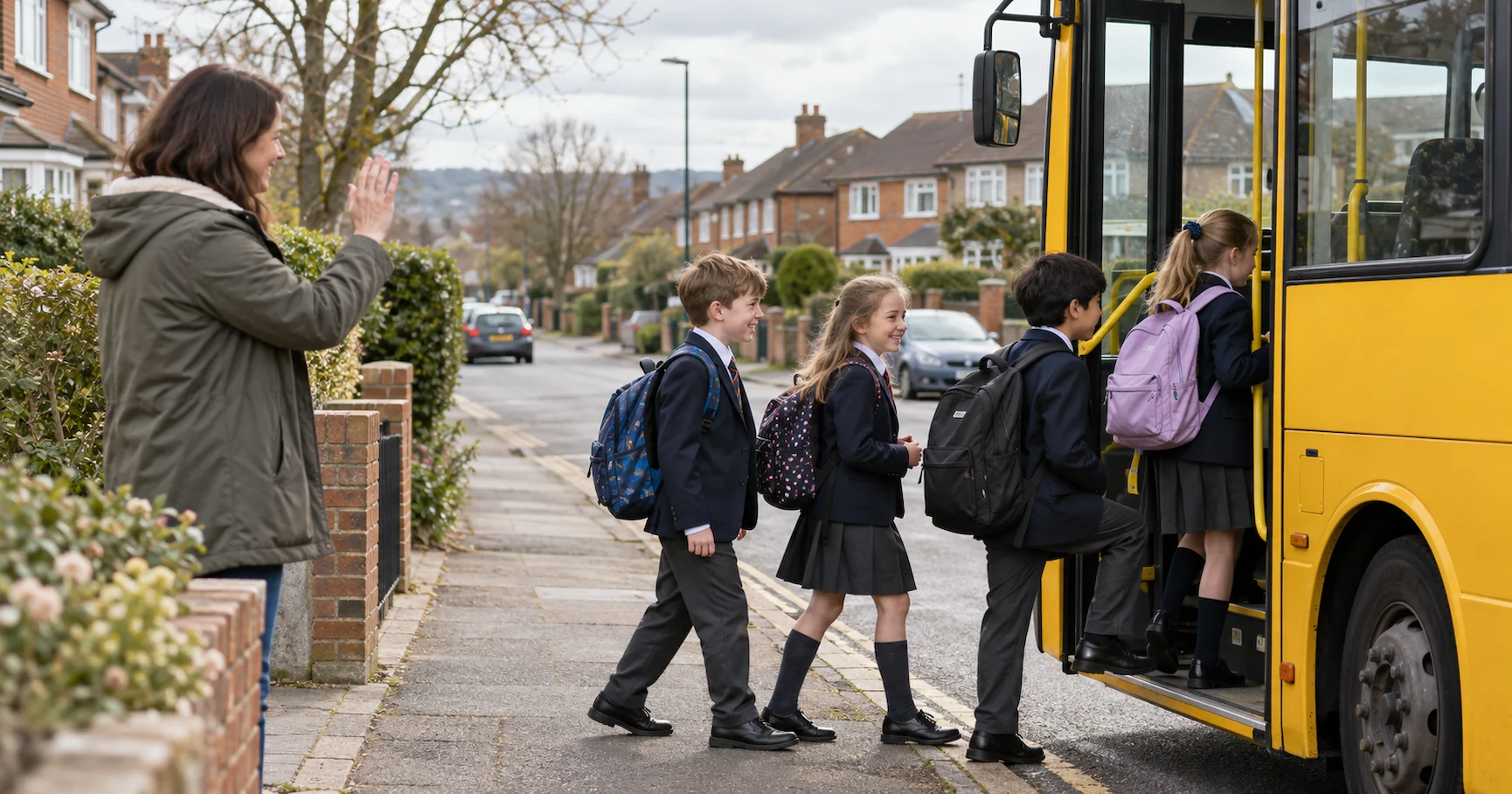
In England, local authorities have a statutory duty to arrange free home-to-school transport for children who meet certain eligibility criteria. Yet many families who qualify are unaware of their entitlement — and many who do know about it are uncertain how to apply, what "nearest suitable school" means in practice, or what to do when a request is refused.
This guide sets out the eligibility rules for the 2026–27 academic year, explains the key terms, and covers what families can do if they believe they should qualify but have been turned down.
Free school transport for eligible children in England is a legal entitlement under the Education Act 1996 and the Department for Education's statutory guidance on home-to-school transport. It is not a discretionary favour from the local authority. If your child meets the criteria, the council must provide it — though the form that provision takes (dedicated bus, route pass, mileage allowance) varies by authority.
Who Is Eligible for Free School Transport?
Eligibility depends on your child's age, the distance between your home and the school, and whether the school is the "nearest suitable school" for your child. There are also additional entitlements for children with low family income and for children with special educational needs and disabilities (SEND).
Distance Thresholds
The basic eligibility rule is based on the walking distance between your home and the school:
| Child's Age | Distance Threshold |
|---|---|
| Under 8 (Reception to Year 2) | More than 2 miles from the nearest suitable school |
| 8 and over (Year 3 to Year 11) | More than 3 miles from the nearest suitable school |
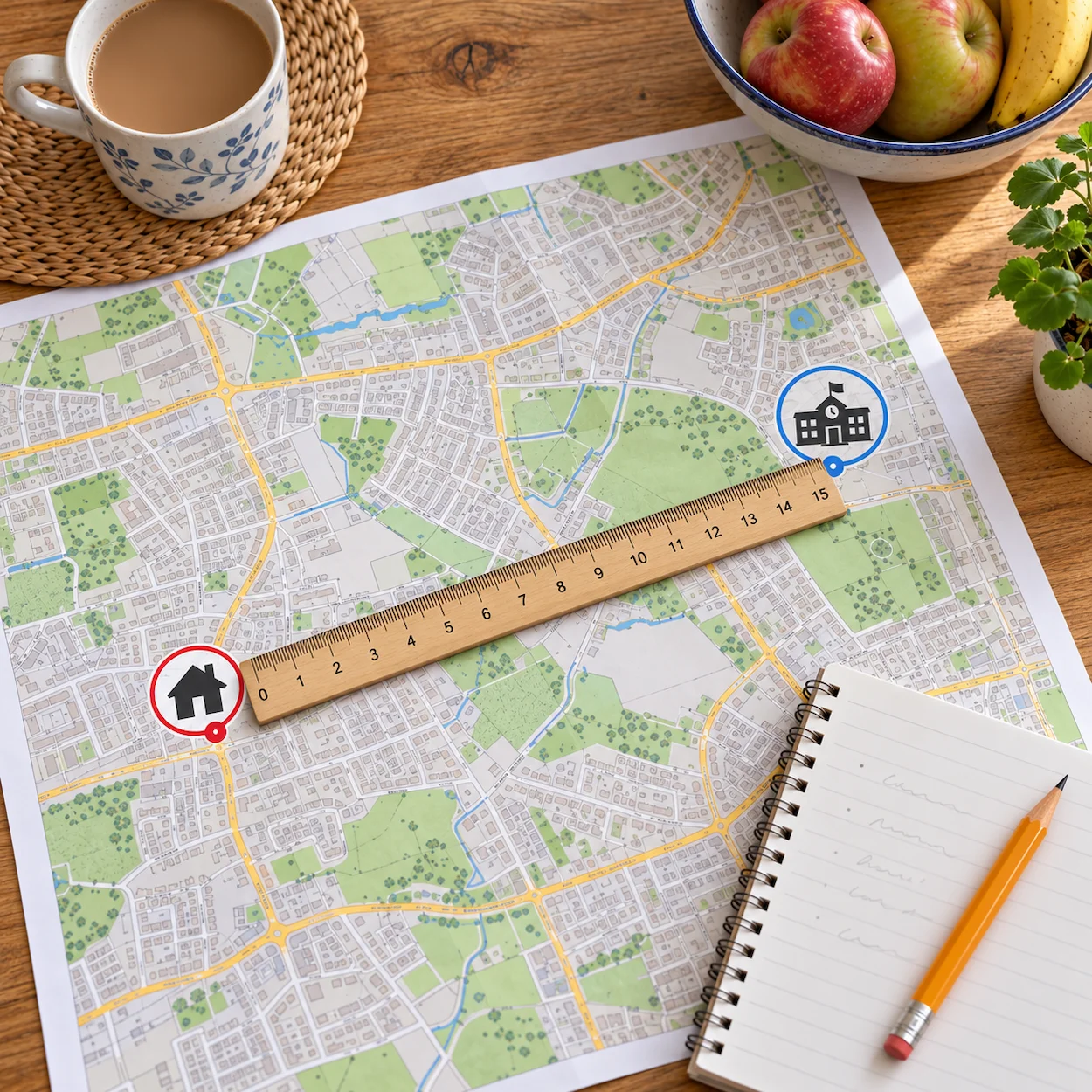
The distance is measured by the shortest available walking route — not the driving distance or the route you would actually use. If the shortest walking route is deemed unsafe (for example, if there is no pavement along a busy road), the local authority must take that into account.
The "Nearest Suitable School" Rule
This is the most commonly misunderstood element of school transport eligibility. The distance thresholds above apply only if the school in question is the nearest suitable school for your child. "Suitable" means a school that:
- Provides education appropriate to the child's age, ability and aptitude
- Provides for any special educational needs the child has
- Is a school at which the local authority could potentially secure a place
If a family chooses a school that is not the nearest suitable school — for example, a school further away that better fits their preferences, or a faith school when a non-faith school is nearer — the local authority is generally not required to provide free transport, even if the distance exceeds the threshold.
 AI-generated image
Extended Eligibility: Low-Income Families
Children from low-income families receive extended transport entitlements under the Education Act. To qualify, the child's family must be receiving one of the following:
- Maximum Working Tax Credit
- A qualifying element of Child Tax Credit (with no Working Tax Credit, or Working Tax Credit in run-off)
- Universal Credit where the equivalent income condition is met
If a child from a qualifying low-income family is in Years 7–11, they are entitled to free transport to one of the three nearest qualifying schools within 6 miles, even if that school is not the absolute nearest. This gives low-income families a genuine element of school choice without losing transport support.
For children of faith — if the child's family holds a religious or philosophical belief, and there is no non-faith school within the standard distance — free transport to the nearest school of that faith (within 15 miles) may be available for low-income families.
SEND: Transport for Children With Special Needs
Children with special educational needs and disabilities may be entitled to free transport regardless of distance if:
- Their EHCP (Education, Health and Care Plan) names a school that is not the nearest school — and transport cannot reasonably be provided by the family
- The child is unable to walk to school by reason of their disability, even if the distance is within the standard threshold
- No suitable walking route exists and the child's needs mean that alternative arrangements (e.g. a parent driving) are not reasonable
The local authority is expected to consider the child's individual needs and the practicality of transport arrangements, not simply apply the standard distance rule. SEND transport is assessed separately from mainstream transport eligibility.
How to Apply for Free School Transport
Applications are made directly to your local authority — not to the school. Each council has its own application process, but the general steps are:
- Check your local authority's transport eligibility criteria on their website (criteria can vary in some areas beyond the statutory minimum)
- Complete the application form — usually available to download or fill in online
- Provide supporting evidence: proof of address, child's school placement confirmation, and (if applying on low-income grounds) evidence of the qualifying benefit
- Submit before the authority's deadline — many councils have early summer deadlines for September transport arrangements
- Receive a decision in writing — the authority must explain the basis for its decision
If you are unsure whether the distance from your home to your child's school meets the threshold, you can use the catchment area and distance tool to check the straight-line distance and get a better sense of whether your situation warrants a formal application.
 AI-generated image
What Counts as a "Safe Walking Route"?
The local authority must assess whether the walking route between home and school is safe for a child of the relevant age to walk, either alone or accompanied. A route is generally considered unsafe if it lacks:
- Adequate pavements or footpaths
- Safe road crossings where needed
- Suitable lighting for winter mornings or evenings
If the walking route is unsafe, the child may be eligible for free transport even if the distance is within the standard threshold. Parents can request that the local authority review the route assessment if they believe it is unsafe.
If Your Application Is Refused: The Appeals Process
All local authorities must have a formal appeals process for school transport decisions. If your application is refused, you can:
- Request a review — submit additional information or evidence and ask the authority to reconsider at Stage 1 of the appeals process
- Appeal to an independent panel — if the Stage 1 review upholds the refusal, you can escalate to a Stage 2 panel, which is independent of the original decision-making team
- Complain to the Local Government and Social Care Ombudsman — if you believe the process has been handled unfairly or unlawfully
Common grounds for a successful appeal include: the authority measured the wrong route, failed to consider whether the route was safe, or applied the wrong eligibility criteria to your child's situation.
When Families Are Not Eligible: Alternatives
If your child does not qualify for free school transport, local authorities sometimes offer:
- Discretionary transport — some councils go beyond the statutory minimum for certain circumstances (at their own cost)
- Subsidised bus passes — season tickets for public transport at a reduced rate
- Mileage reimbursement — for parents who drive their child when no suitable transport arrangement exists
These are discretionary and vary significantly by local authority. Check your council's transport policy document, which should be published on their website.
Key Eligibility Summary
| Situation | Entitlement |
|---|---|
| Under 8, nearest suitable school > 2 miles away | Free transport — statutory right |
| Age 8+, nearest suitable school > 3 miles away | Free transport — statutory right |
| Low income, Years 7–11, within 6 miles of one of three nearest qualifying schools | Free transport — extended statutory right |
| Child with SEND, school named in EHCP is not nearest | Free transport — assessed individually |
| School chosen by preference (not nearest suitable) | No statutory entitlement — discretionary only |
| Walking route deemed unsafe | Free transport may apply even within distance threshold |
Frequently Asked Questions
Does free school transport apply to secondary schools as well as primary?
Yes. The statutory entitlement applies to children of compulsory school age — from Reception through to Year 11. The distance thresholds differ (2 miles for under-8s, 3 miles for age 8 and over), but the right applies to both primary and secondary phases. Sixth-form students (post-16) are not covered by the statutory home-to-school transport duty, though some local authorities offer discretionary post-16 transport support.
We chose a school further away than the nearest school. Do we still qualify?
Not automatically. The statutory entitlement is linked to the nearest suitable school. If you chose a school further away — even for valid personal or educational reasons — the local authority is not required to fund transport. However, if you can demonstrate that the nearer school was not in fact "suitable" for your child (for example, it could not meet their educational or SEND needs), you may have grounds to challenge this. The definition of "suitable" is not simply about whether the school has places.
How does the local authority measure the walking route?
Local authorities typically use mapping software to identify the shortest walking route between the home address and the school. This is not the same as the driving distance or the route you would actually choose. If you believe the measurement is incorrect — for example, it includes a route through private land or across a road without a crossing — you can request the authority review the route as part of an appeal.
My child has an EHCP — does that automatically entitle them to free transport?
Not automatically, but having an EHCP means the local authority must assess transport needs individually rather than simply applying the distance rule. If the EHCP names a school that is not the nearest school, and the reason for naming that school is related to the child's needs, transport is likely to be provided. The local authority cannot simply refuse on the basis of distance if the child's placement is determined by their EHCP.
Can the local authority change the transport arrangement during the year?
Yes, in some circumstances — for example, if a child's school placement changes, or if a new transport contract means a different bus route is used. The authority should notify families before making changes. If a change significantly affects your child (for example, a much longer journey), you can raise a formal concern and request a review of the arrangement.
What if no school bus serves our route — can we claim mileage instead?
In some cases, yes. If the local authority cannot arrange suitable transport to an eligible child's school, it may offer a mileage reimbursement or personal transport budget for the parent to drive the child or arrange alternative transport. The rate and conditions vary by council. This is worth asking about specifically if you live in a rural area where bus routes are limited.