
St George's Day falls on 23 April each year and is England's national day — the feast day of St George, England's patron saint. Despite being one of the four patron saint days across the United Kingdom (alongside St Andrew's Day for Scotland, St David's Day for Wales and St Patrick's Day for Ireland), St George's Day tends to attract considerably less fanfare than its Celtic counterparts.
In recent years, however, there has been a growing movement in English primary and secondary schools to mark the occasion — both as a celebration of English identity and as a rich starting point for history, art and literacy work. This guide covers the origins of St George's Day, the symbolism of the flag, and practical classroom and home activity ideas suitable for different age groups.
Despite being England's patron saint, St George was born in what is now Turkey, likely around 275 AD, and died in what is now Israel in 303 AD. He was a Roman soldier of Greek origin who was executed for his Christian faith. He was adopted as England's patron saint in the 14th century — primarily because of his association with Christian chivalry and courage. The dragon legend, while not historically documented, became a popular allegorical story across medieval Europe.
Who Was St George?
The historical St George was a Roman soldier and Christian martyr. Very little is known about him with certainty beyond the fact that he was executed at Lydda (now Lod, Israel) on 23 April 303 AD, during the reign of Emperor Diocletian, for refusing to renounce his Christian faith.
George was venerated as a saint across the Christian world from early on, and his cult spread widely through the Byzantine Empire and then into Western Europe during the Crusades. English Crusaders adopted him as a protective figure, and Edward III placed the Order of the Garter — the highest order of chivalry in England — under the patronage of St George in 1348. By the 15th century, 23 April had been established as a major feast day in England, celebrated with processions, feasts and church services.
The St George and the Dragon Legend
The most famous story associated with St George is the legend of the dragon — an allegorical tale that became widely popular in medieval Europe through the Golden Legend, a 13th-century collection of saints' lives by Jacobus de Voragine.
In the most popular version of the story:
- A fearsome dragon terrorises the town of Silene (in Libya, in the legend)
- The townspeople appease the dragon with offerings of sheep and, eventually, people selected by lottery
- A princess is chosen by lottery and is led to the dragon
- George, passing through, kills the dragon and rescues the princess
- The town converts to Christianity in gratitude
Scholars interpret the story as an allegory for Christianity conquering evil — the dragon representing paganism or sin. In this reading, St George is a symbol not of military conquest but of moral courage. This makes the legend a rich text for discussion with children about symbolism, allegory and medieval storytelling.
 AI-generated image
The Flag of St George
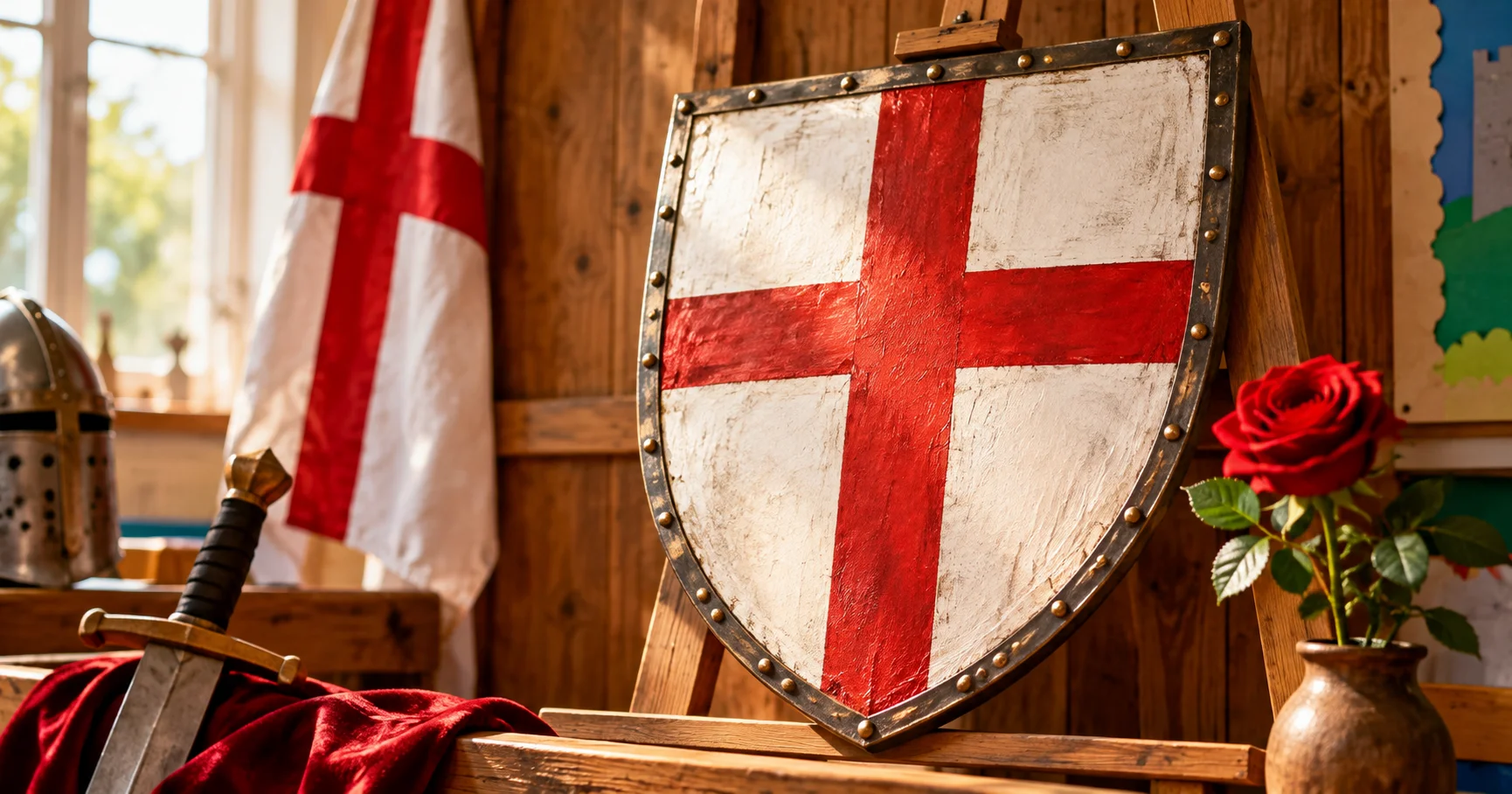
The St George's Cross — a red cross on a white background — is one of the most recognisable national symbols in the world. It forms the basis of the Union Jack (the flag of the United Kingdom), combined with the Scottish saltire (St Andrew's Cross, a white diagonal cross on blue) and the Irish cross of St Patrick (a red diagonal cross on white).
Key facts for classroom discussion:
- The St George's Cross is England's flag — not the same as the Union Jack, which represents the whole United Kingdom
- The flag has been used in England since at least the 13th century
- Red crosses on white were used by Crusader armies as identification markers
- The rose of England — a red Tudor rose — is a complementary national symbol
- The flag is flown on government buildings on 23 April by royal proclamation
Classroom Ideas for Primary Schools
St George's Day falls in the summer term and offers a wealth of cross-curricular opportunities. The activities below are organised by subject area and are suitable for different key stages.
History and PSHE (KS1 and KS2)
- Who was St George? A guided discussion on what we know and what is legend — a useful introduction to the concept of historical evidence versus storytelling
- Patron saints of the UK: Research the four patron saints, compare their feast days and countries, and discuss what makes a national symbol
- Medieval England: Use the Crusades and Order of the Garter as entry points into a wider topic on medieval history
- English identity discussion: What does it mean to be English? What do we celebrate? A reflective PSHE topic suitable for Year 5 and 6
Art and DT
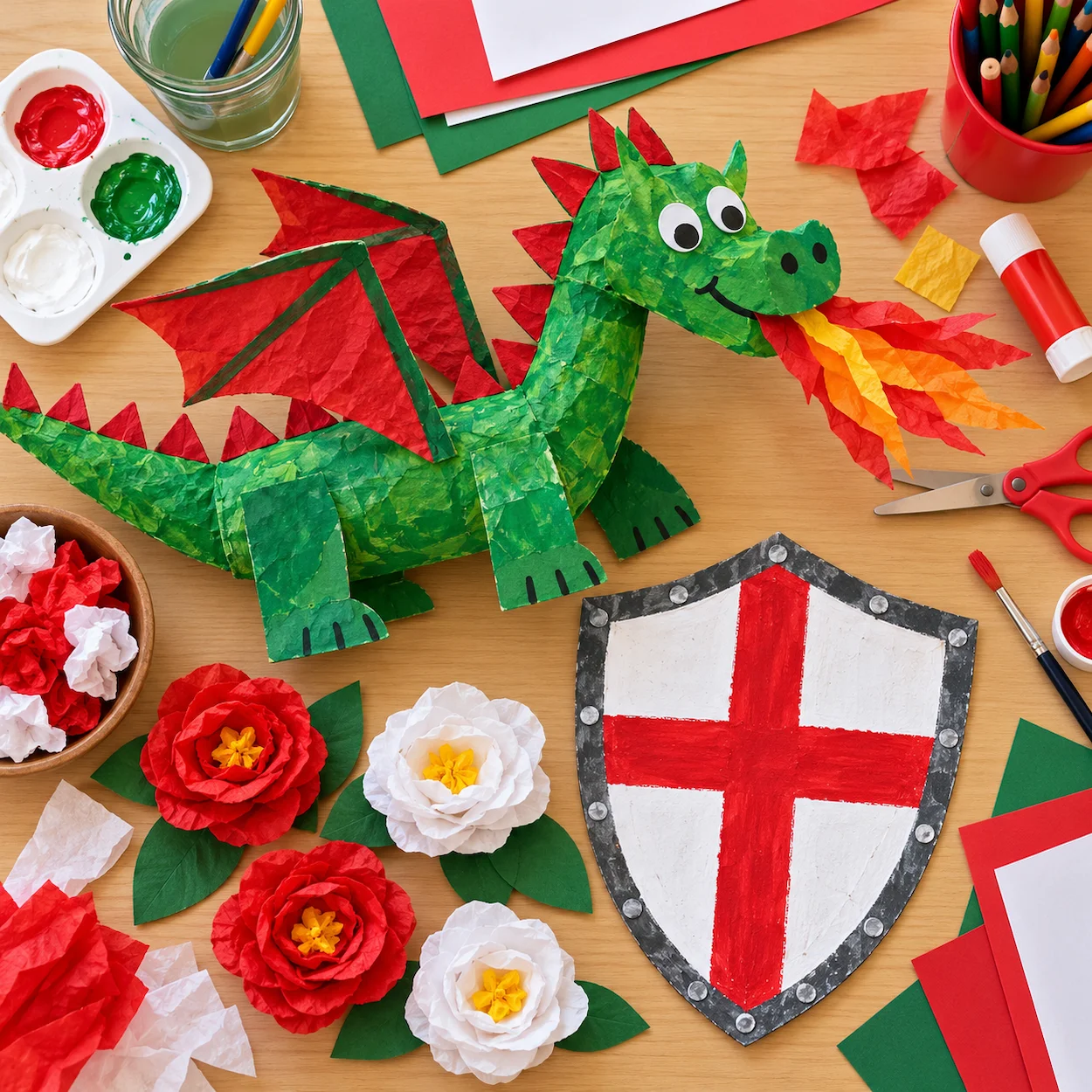
- Design a shield: Using the heraldic tradition of the medieval period, children design their own coat of arms or shield, incorporating symbols that represent them
- Make a dragon: Paper-maché, clay or collage dragons — green or any colour chosen — make excellent art projects tied to the legend
- Red rose craft: Paper roses using tissue paper, red card or origami techniques, tied to the national flower of England
- Flag design: Explore how the Union Jack was formed by layering St George's Cross, St Andrew's Saltire and St Patrick's Cross — children can recreate this with coloured paper
English and Literacy
- Retelling the legend: Children read or hear the St George and the Dragon story and rewrite it from the dragon's point of view — a perspective-taking exercise
- Poetry: Write a poem about St George, England, the red rose or the dragon — acrostics work well for younger children
- Setting description: Use the medieval setting of the legend to practise descriptive writing — describe the dragon's cave, the town of Silene, or the knight arriving
- Research project: Year 5–6 pupils research the historical St George versus the legendary version and present findings distinguishing fact from fiction
 AI-generated image
Maths (Cross-Curricular)
- Flag symmetry: The St George's Cross is a good example of line symmetry — use it for symmetry activities in lower KS2
- Timeline: Place key dates in the St George story (275 AD birth, 303 AD martyrdom, 1348 Order of the Garter, 1415 Agincourt, 1606 Union Jack creation) on a timeline to practise chronology and large numbers
Ideas for Celebrating at Home
If your child's school does not mark St George's Day, there are simple ways to acknowledge it at home:
- Cook a traditional English meal — roast dinner, fish and chips, a ploughman's lunch, or Eton mess for dessert
- Read a version of the St George and the Dragon story together (picture book versions by Margaret Hodges or Geraldine McCaughrean are highly recommended)
- Watch a short documentary about English history or symbols
- Visit a local castle, cathedral or medieval site — many have connections to the Crusades, the Order of the Garter or English heritage more broadly
- Grow a red rose from seed — a slow but meaningful connection to the national flower
Frequently Asked Questions
Is St George's Day a public holiday in England?
No — St George's Day (23 April) is not a bank holiday in England. Unlike St Patrick's Day in Ireland, which is a public holiday on both sides of the border, St George's Day passes as a regular working and school day. There have been periodic campaigns and parliamentary discussions to make it a bank holiday, but as of 2026, this has not been legislated. Some businesses, schools and local authorities choose to mark the day with events regardless.
Why is St George the patron saint of England if he never went there?
Being a patron saint does not require the saint to have visited the country — it is about the values and qualities the saint represents and how those became associated with the nation over time. St George was adopted by English Crusaders and then by the monarchy as a symbol of Christian chivalry, courage and martial virtue. These qualities aligned with the ideals of English knighthood in the medieval period. By the 14th century, he had become firmly embedded in English royal and religious culture, well before the concept of English national identity in its modern form had developed.
Did St George really fight a dragon?
No — there is no historical evidence for the dragon legend. The story as we know it was popularised in the 13th century in the Golden Legend and was understood by educated medieval audiences as an allegory, not a literal account. The dragon represents evil or paganism, and George's victory represents the triumph of Christian faith. The allegorical interpretation is the one accepted by historians and theologians.
Why is St George's Day less celebrated than St Patrick's Day?
Several historical and cultural factors are often cited: the strong Irish diaspora worldwide, particularly in the United States, has amplified St Patrick's Day into a global celebration. St George's Day has historically been associated more quietly with English national identity, which in the 20th century became somewhat entangled with debates about nationalism. There has also been a general trend of English cultural identity being expressed through Britishness rather than Englishness. In recent years, local authorities, schools and communities across England have been actively working to reclaim St George's Day as a positive, inclusive celebration.
What is the red rose's connection to England?
The red rose has been a symbol of England since the medieval period. It became famous as the emblem of the House of Lancaster during the Wars of the Roses (1455–1487), in which the Lancastrian red rose and the Yorkist white rose were rival dynastic symbols. When Henry VII (a Lancastrian) married Elizabeth of York after his victory, the Tudor Rose — a combined red and white rose — was created as a symbol of the unified House of Tudor. The red rose remained associated with England, and today it is the official national flower, used in everything from the England rugby team badge to official government ceremonies.
Is St George's Day appropriate to celebrate in diverse and multicultural schools?
Yes — when framed as a cultural and historical celebration rather than a narrow nationalist one. The story of St George is genuinely multicultural: the historical George was Turkish-born, of Greek heritage, a Roman soldier, and venerated across the Middle East, Eastern Europe, and Africa long before England adopted him. This makes him an unusually fitting patron for a diverse nation. Schools can frame St George's Day as an exploration of English identity in all its complexity, including its medieval, immigrant and multicultural dimensions — which makes for rich and inclusive educational discussion.