
From November 2025, Ofsted replaced its single overall grade with a new School Report Card — a multi-section document that assesses schools across several distinct areas rather than collapsing everything into one word. For parents who are used to looking up whether a school is "Outstanding" or "Good", the new format takes some getting used to.
This guide explains how to find a school's Report Card, what each section means, how the five-point rating scale works, and how to use the information to form a genuine picture of a school.
The single overall grade — Outstanding, Good, Requires Improvement or Inadequate — was widely criticised for oversimplifying complex schools. A school rated Good might have excellent behaviour but weak curriculum design; a school rated Outstanding might have a very narrow intake. The new Report Card attempts to capture this nuance by assessing multiple areas separately.
Where to Find a School's Report Card
Ofsted inspection reports — including the new Report Cards — are published on the Ofsted website at reports.ofsted.gov.uk. Every maintained school and academy in England has a profile page where all inspection reports are listed chronologically, with the most recent first.
To find a report:
- Go to reports.ofsted.gov.uk
- Search by school name, postcode or local authority
- Select the school from the results
- The most recent report appears at the top — look for the date to confirm whether it is a full Report Card inspection (from November 2025 onwards) or an older-format report
Note that schools inspected before November 2025 will still have their previous Ofsted grade displayed on their profile until a new inspection takes place under the Report Card framework. The transition is taking place over time as schools come up for their next inspection cycle.
The Five-Point Rating Scale
Under the Report Card system, each area of the school's work is assessed on a five-point descriptive scale. Unlike the old four-grade system, the new scale uses descriptive labels rather than single adjectives:
| Rating | What It Means |
|---|---|
| Causing concern | Serious failures in this area that require immediate action. The equivalent of Inadequate. |
| Getting there | Below standard in this area. Improvement is needed but the school is making progress. |
| Meets the standard | Broadly adequate — this area is functioning satisfactorily. Broadly equivalent to Requires Improvement in specific areas. |
| Strong | Above the minimum standard — pupils are being well served in this area. Broadly equivalent to Good. |
| Exemplary | Exceptional practice that others can learn from. The equivalent of Outstanding. |
Crucially, a school can receive different ratings for different areas. A school might be Exemplary for Personal Development but only Meets the Standard for Quality of Education. There is no single overall score combining them — parents must read each area individually.
 AI-generated image
The Main Inspection Areas Explained
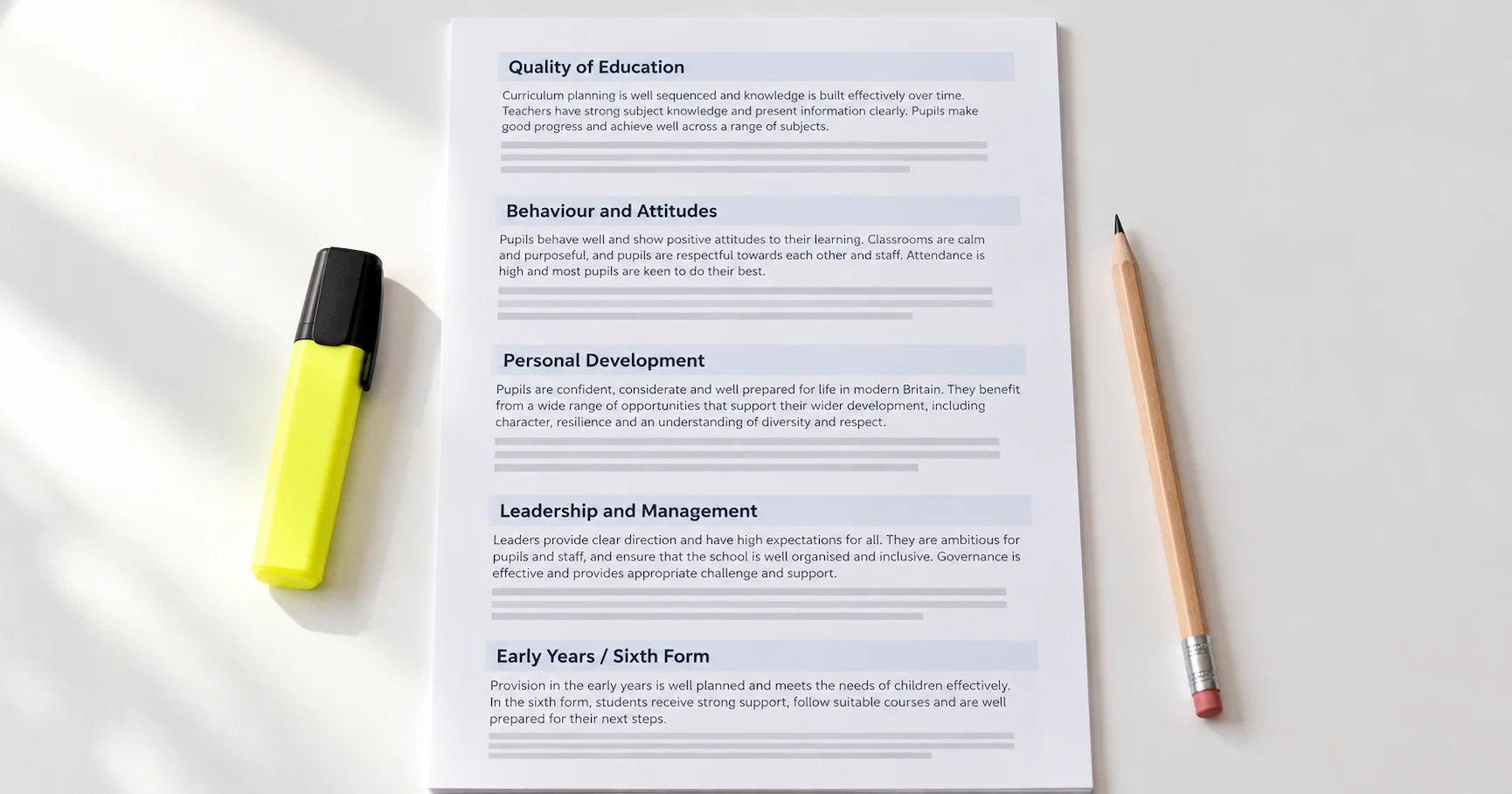
The Report Card assesses the following areas. Not all areas appear for every school — a primary school without a sixth form, for example, will not receive a sixth-form judgement.
1. Quality of Education
This is the most substantial section and covers the curriculum — what is taught, in what order, and to what depth — as well as how effectively teachers deliver it and how well pupils learn and retain knowledge over time.
Inspectors look at:
- Whether the school's curriculum is ambitious and well-sequenced
- Whether teaching enables pupils to remember and apply what they have learned
- Whether assessment is used effectively to identify and address gaps
- Whether reading is given sufficient priority, especially in primary schools
For parents: This is arguably the most important section for understanding academic provision. A "Strong" or "Exemplary" rating here indicates that the school has thought carefully about what children learn and how.
2. Behaviour and Attitudes
This section assesses how well pupils behave in school, their attendance and punctuality, and whether the school has an effective culture of high expectations.
Inspectors consider:
- Whether the school manages behaviour consistently and fairly
- Pupil attendance rates and how the school supports those who are persistently absent
- Whether pupils feel safe and report feeling respected by peers and staff
- How the school responds to bullying and low-level disruption
For parents: This section gives useful context for what day-to-day school life feels like. It is worth reading the narrative alongside the rating, as inspectors often give specific examples.
3. Personal Development
Personal Development assesses whether pupils are given opportunities to develop beyond their academic studies — including their understanding of British values, mental health and wellbeing, extracurricular provision, and preparation for life in modern Britain.
Inspectors look at:
- Careers education, information and guidance (particularly in secondary schools)
- Relationships and Sex Education (RSE) and Personal, Social, Health and Economic (PSHE) education
- Pupils' voice and how the school listens to and acts on pupil feedback
- Cultural capital — exposure to arts, sport, debate, community engagement
4. Leadership and Management
This section evaluates the quality of the school's leadership team — the headteacher, senior leaders and governors — and how effectively they manage the school, develop staff, and drive improvement.
Inspectors consider:
- Whether leaders have an accurate picture of the school's strengths and weaknesses
- How staff wellbeing and professional development are managed
- Safeguarding — whether the school has effective policies and practices to keep pupils safe
- The role of governors or trustees in providing oversight and challenge
For parents: A weak rating here often precedes broader problems. Inspectors link leadership quality directly to whether improvement is likely over time.
5. Early Years Provision (where applicable)
For schools with a Nursery or Reception class, the Early Years section assesses the quality of provision for children aged 2–5. It covers curriculum, relationships with families, the learning environment, and readiness for Year 1.
6. Sixth Form Provision (where applicable)
Secondary schools with a sixth form receive a separate judgement on their post-16 provision, covering curriculum, teaching quality, destinations (where students go after sixth form) and the effectiveness of academic and personal guidance.
 AI-generated image
How to Read a Report Card as a Parent
When reviewing a school's Report Card, the following approach will help you get the most useful information:
Step 1: Check the Inspection Date
Always note when the inspection took place. A report from several years ago may not reflect the current school — leadership may have changed, or a school may have improved or declined since. For schools inspected before November 2025, the old four-grade format applies.
Step 2: Read Each Section Separately
Do not attempt to average the ratings. A school that is "Getting There" on Quality of Education but "Exemplary" on Behaviour presents a very different picture from one that is the reverse. Identify which areas matter most for your child.
Step 3: Read the Written Narrative
The ratings are summaries — the written text beneath each section gives specific evidence. Phrases like "pupils read fluently by the end of Year 2" or "attendance is above the national average" carry more weight than the rating alone. Look for concrete, specific observations rather than generic positive language.
Step 4: Look at What Inspectors Say Needs Improving
Every report includes a section on what the school needs to do to improve. This is often the most revealing part — even for schools rated "Strong" overall. It tells you where the weaknesses are and whether they are being addressed.
Step 5: Compare With Context
A school serving a highly deprived area that is rated "Strong" across all areas is achieving something significant. A school in an affluent area with high prior-attainment pupils that is only "Meets the Standard" may be performing less impressively than its results suggest. The narrative will often give contextual information to help you interpret this.
How Does the New Report Card Compare to the Old System?
| Feature | Old System (pre-Nov 2025) | New Report Card (from Nov 2025) |
|---|---|---|
| Overall grade | One of four: Outstanding / Good / RI / Inadequate | No single overall grade |
| Rating scale | 4-point | 5-point descriptive scale |
| Areas assessed | 4 main areas + subsets | Multiple separate areas, each with own rating |
| Headline simplicity | Simple — one word captures all | More nuanced — requires reading in full |
| Differentiation between areas | Possible but overshadowed by overall grade | Explicit — each area stands independently |
If you want to understand how the previous four-grade system worked and how it is being phased out, see the full explanation in the guide on Understanding Ofsted Ratings: What "Outstanding" vs "Good" Really Means.
Using the Report Card Alongside Other Information
The Ofsted Report Card is one useful source — but it should not be used in isolation. Combine it with:
- School performance tables — published by the Department for Education, showing attainment and progress data
- The school's own website — curriculum statements, policy documents and values
- Open evening visits — where you can form your own direct impression
- Parent and pupil surveys — Ofsted publishes summaries of surveys conducted before inspections
You can also search for and compare schools in your area to view available information side by side when making admission decisions.
Frequently Asked Questions
My child's school still shows an old Ofsted grade — is this still valid?
Yes. Schools inspected before November 2025 retain their previous Ofsted grade (Outstanding, Good, Requires Improvement or Inadequate) until they receive a new inspection under the Report Card framework. The old grade remains the most recent publicly available assessment of that school. Over time, as schools are re-inspected, the older grades will be replaced by Report Cards.
How often are schools inspected under the new system?
Ofsted's inspection frequency depends on a school's previous rating and context. Schools with concerns may be inspected more frequently; schools with strong track records may have longer gaps between full inspections. Ofsted also conducts monitoring visits for schools that require improvement. The exact cycle is determined by Ofsted and published in its inspection framework.
Can a school be Exemplary in some areas and Causing Concern in others?
Yes, in theory — though this combination would be unusual. In practice, serious weakness in one area tends to affect others. A school "Causing Concern" for Leadership and Management, for example, is unlikely to be "Exemplary" for Quality of Education, since strong curriculum design and teaching require effective leadership. The Report Card is designed to surface these nuances.
Does a "Causing Concern" rating automatically mean Special Measures?
Not necessarily — the Report Card terminology and the formal regulatory designations (Special Measures, Serious Weaknesses) are related but distinct. Ofsted can designate a school as requiring Special Measures based on the Report Card judgements, but the process involves specific criteria. A school with one area rated "Causing Concern" is not automatically in Special Measures.
What should I do if I disagree with a school's Ofsted report?
Ofsted has a formal complaints procedure for challenging the factual accuracy of a published report. Parents and staff can submit a complaint within a specific window after the report is published. Ofsted distinguishes between factual inaccuracies (which can be challenged) and professional judgements (which are harder to overturn). Details of the complaints process are available on the Ofsted website.
Is the Report Card available in other languages?
The published reports on the Ofsted website are in English only. However, the website includes accessibility tools, and many browsers offer automatic translation. Schools may also provide translated summaries for their parent communities as part of their own communications — it is worth asking the school directly if language is a barrier.