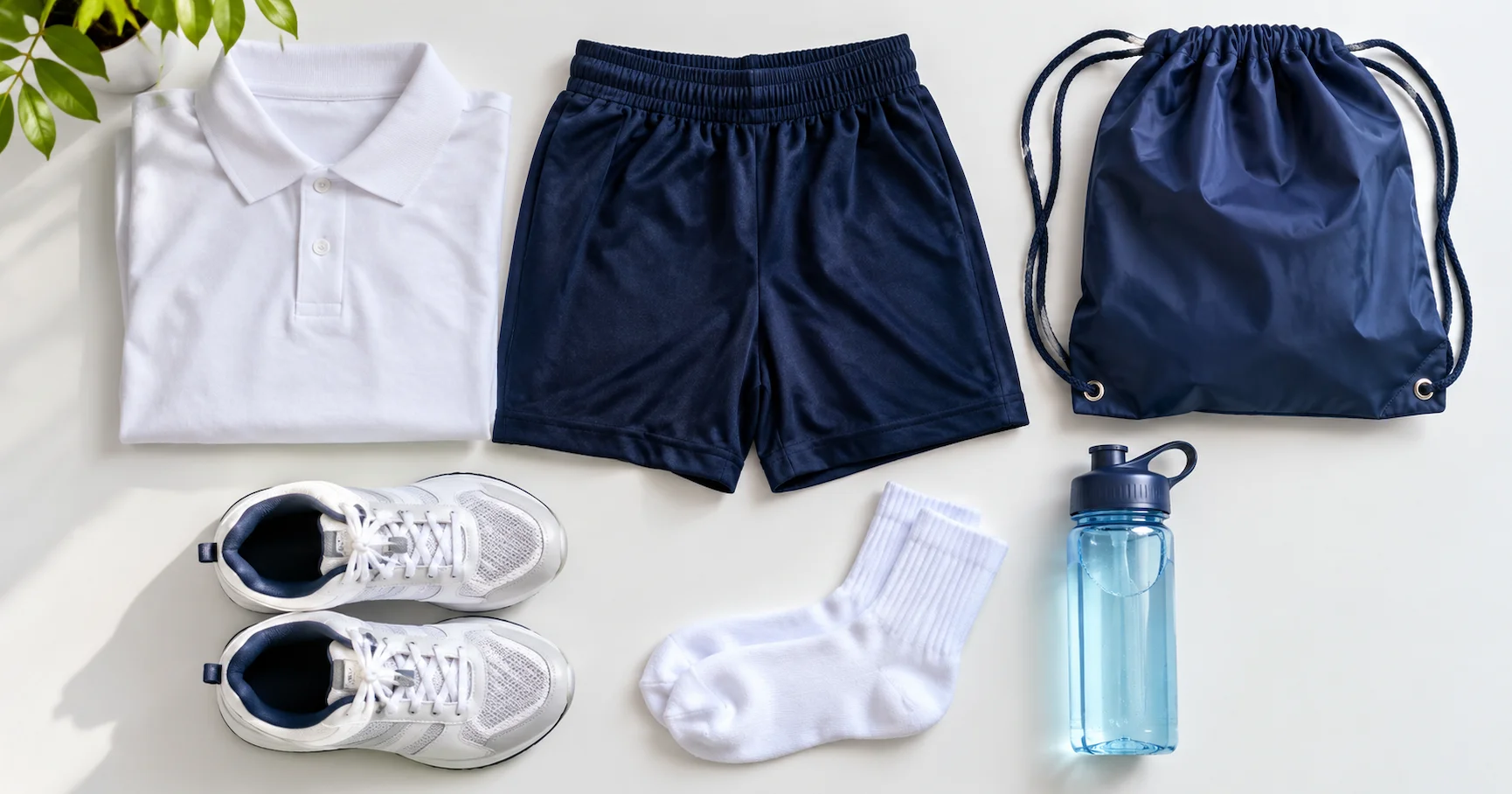
The school PE kit letter can arrive at any time — but it most commonly lands in the first week of term, when you are already juggling uniform shopping, stationery lists and new routines. The challenge is that PE kit requirements vary significantly from school to school in England: some schools have a fully branded compulsory kit that must be purchased from a specific supplier; others give you considerable freedom to choose from general sportswear in the right colours.
This guide cuts through the confusion. It covers what is genuinely essential for primary and secondary school PE in England, what is optional or sport-specific, and how to make smart choices on quality and budget — including what schools are legally allowed to require you to buy and how recent regulations protect families from excessive uniform costs.
- PE is a compulsory subject in every Key Stage from KS1 to KS4 under the National Curriculum
- Schools must keep total uniform and PE kit costs "reasonable" under the DfE's 2021 statutory guidance — they cannot require expensive branded items without justification
- Most primary schools require a very simple kit: a plain T-shirt, shorts and plimsolls — often already owned or easily bought second-hand
- Secondary schools typically add tracksuit bottoms or leggings, a sports top and outdoor trainers for the wider range of sports covered
- Many schools offer a second-hand uniform shop that includes PE kit — always worth checking before buying new
- Children with certain medical or religious needs can request adaptations to the standard PE kit — schools must make reasonable accommodations
The Core PE Kit: What Every Child Needs
Regardless of school, sport or age group, there is a core set of PE kit items that virtually every child in England will need. Think of these as your minimum viable PE kit — everything else is additional.
1. Sports T-Shirt or Polo Shirt
This is the foundation of any PE kit. Most schools specify a colour (commonly white, navy, red or the school's colour) and may specify plain (no logos or branding) or a school-branded top. Key considerations:
- Fabric: Lightweight polyester-cotton blend or a moisture-wicking sports fabric is ideal. Pure cotton absorbs sweat and becomes heavy; a sports blend keeps children cooler and drier during activity
- Fit: Should allow free movement — not so tight it restricts stretching, not so baggy it catches on equipment
- How many: Aim for at least two, ideally three, to allow for washing between PE days without being caught short
- Where to buy: George at Asda, Tu at Sainsbury's and Matalan all stock plain coloured sports tops for primary age from around £3–5. For secondary, Next, Sports Direct and supermarkets cover most colour requirements affordably
2. Shorts
For most indoor PE and warm-weather outdoor PE, shorts are the standard lower garment. Schools typically specify a colour. Things to look for:
- Elasticated waistband: Essential for quick changing between lessons — avoid zips and buttons if possible at primary age
- Length: Most schools prefer shorts that reach approximately mid-thigh. Very short shorts may not be permitted; very long shorts (below the knee) can restrict movement
- Lined vs unlined: Lined shorts (with an inner brief) are preferred by many children for comfort and confidence during gymnastics and other active PE
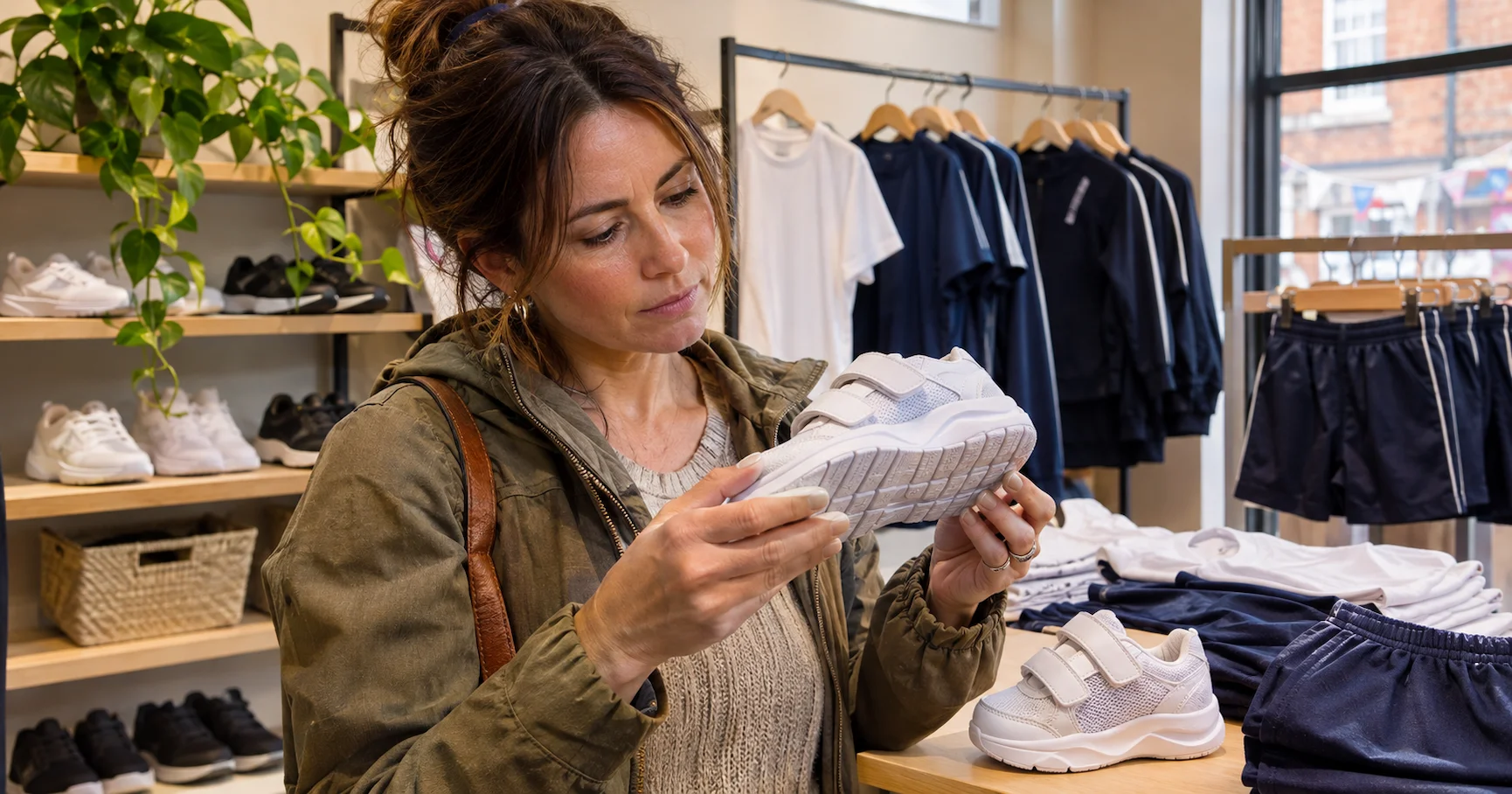
3. Trainers (Outdoor) and Plimsolls or Pumps (Indoor)
Footwear is arguably the most important element of the PE kit — and the one where the distinction between primary and secondary matters most.
Primary school: Most primary PE takes place in a school hall on a wooden or synthetic floor. Schools typically require plimsolls (sometimes called pumps) — lightweight, flat-soled canvas or synthetic shoes in black or white. These are inexpensive (£3–8 from most supermarkets or shoe shops), compact and easy to store in a PE bag. Some primary schools also require trainers for outdoor PE in Years 5 and 6.
Secondary school: The range of sports is wider and more of it takes place outdoors. Secondary PE kit should include:
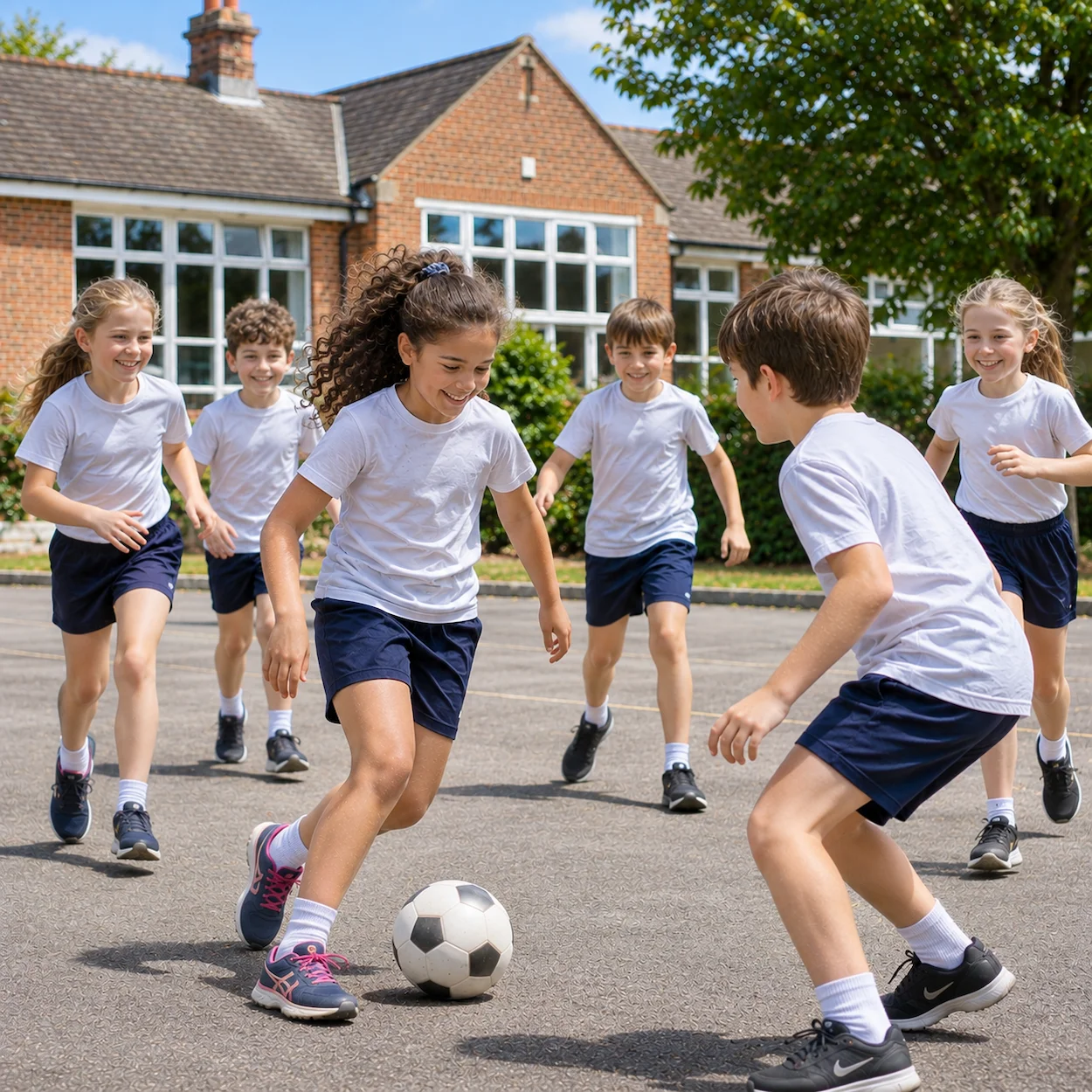
- Trainers with good grip and lateral support for multi-directional sports (football, netball, basketball, athletics). These do not need to be expensive — a mid-range pair from Sports Direct, Decathlon or a supermarket brand is perfectly adequate for school PE
- A separate pair of indoor shoes if the school requires it for sports hall activities — some schools allow the same trainers for both; check the school's guidance
Tip on trainers: Avoid fashion trainers (flat-soled, no lateral support) for PE. Look for shoes with a cushioned sole and a slightly raised heel that are designed for sport rather than streetwear. Your child's feet will thank you, and the shoes will last longer under PE conditions.
 AI-generated image
4. Socks
Often forgotten until the last minute. PE socks should be:
- Sports socks (ankle or crew length with cushioned sole) rather than school uniform socks — they provide better shock absorption and blister prevention
- White is the most commonly required colour, though some schools accept any plain colour
- Have at least three pairs in the kit rotation — they are lost, forgotten and worn out more quickly than any other PE item
5. A PE Bag
A dedicated bag for PE kit prevents the "I forgot my kit" problem that results from rummaging through a school bag. Most schools are happy with any drawstring bag (often sold as a branded item but equally available as a plain bag from £2–3). A drawstring bag is preferable to a zip bag for speed of access. Label it clearly — PE bags are one of the most commonly lost items in secondary schools.
What Secondary Schools Typically Add
Secondary school PE covers a much wider range of activities than primary — often including team sports, athletics, swimming, gymnastics, dance and sometimes outdoor education. The PE kit list therefore tends to be longer.
Tracksuit Bottoms or Leggings
For outdoor PE in cold weather, most secondary schools require either tracksuit bottoms or leggings (the latter increasingly accepted across all genders in English schools). Look for:
- A fabric that is warm enough without being so heavy it restricts movement
- An elasticated waistband — no jeans-style zips or buttons
- The school's specified colour (commonly navy, black or grey)
Many schools also accept sports leggings as an alternative to tracksuit bottoms. If your school's guidance is ambiguous, a quick email to the PE department will clarify.
Sports Hoodie, Sweatshirt or Fleece
For outdoor PE, a sports top layer is essential in autumn and winter. This is often where school branding requirements add cost — many schools require a branded hoodie or sweatshirt from their supplier. Check whether a plain-colour fleece or hoodie in the right colour is an acceptable alternative if the branded item is significantly more expensive.
Sport-Specific Items
Depending on the sports offered by your child's school, additional items may be needed or recommended:
| Sport | Additional Kit | Notes |
|---|---|---|
| Football | Football boots, shin pads | Shin pads required for most school matches; boots optional for training |
| Hockey | Shin pads, gumshield, hockey stick | Sticks often provided by school; shin pads and gumshield are personal |
| Swimming | Swimsuit/trunks, towel, goggles, cap | Schools must offer swimming in KS2; check if goggles/caps are compulsory or optional |
| Cricket/Rounders | Usually none — kit provided by school | White top may be requested for fixtures |
| Athletics | Running spikes (optional) | Only needed if competing in school athletics fixtures; trainers are fine for curriculum PE |
| Dance/Gymnastics | Sometimes bare feet or gymnastics pumps | Check school guidance — some require ballet pumps or bare feet; not trainers |
 AI-generated image
What Schools Can (and Cannot) Require You to Buy
This is an area where many parents do not know their rights. The DfE's statutory guidance on school uniforms (updated 2021, applicable to all maintained schools and most academies) sets clear expectations:
- Cost must be reasonable. Schools must "have regard to the cost of the uniform" and avoid "compulsory branded items of uniform being sold by a single supplier" where this significantly inflates costs
- Essential items should be available from multiple retailers. If a school requires a plain navy T-shirt, you should be able to buy it anywhere — not just from the school shop
- Branded items must be justified. If a school requires a branded PE top, it should be for a clear reason (team identification, professional appearance) and the school should offer good value sourcing options
- Financial hardship must be considered. Schools must have a policy for supporting families who cannot afford full kit — this may include a second-hand shop, grants or discretionary funding
If your school's PE kit requirements seem excessively expensive or require branded items without flexibility, you are within your rights to raise this with the headteacher or governing body, or to contact your local authority. See our related article on the cost of school uniforms and new laws in England for a full breakdown of your rights.
Building a Practical PE Kit on a Budget
Buy Plain Where You Can
The single biggest money-saving decision is choosing plain-colour items over branded ones wherever your school permits it. A plain navy shorts-and-T-shirt combination from a supermarket will cost a fraction of the equivalent branded set from a specialist supplier, and will serve exactly the same purpose in curriculum PE.
Check the School's Second-Hand Shop
Many English schools — particularly secondary schools — run a second-hand uniform and PE kit shop, often managed by the PTA or school office. PE kit in good condition (especially branded items that must be school-specific) appears regularly. Check early in the term or academic year when donation volumes are highest.
Buy the Right Amount — Not Too Much
A common mistake is over-buying at the start of secondary school, before you know which sports your child will actually do, how quickly they grow, and what they will actually wear. Start with the core essentials and only buy sport-specific items when you know they are genuinely needed. Children grow quickly; an expensive branded hockey hoodie bought in September may not fit by February.
Label Everything
PE kit is the most commonly lost category of school clothing in England. Every single item — including individual socks — should be labelled with your child's name. Iron-on labels, fabric stamps and iron-on tape are all effective. A permanent marker on the inside of the waistband is the fastest option. See our guide to the best ways to label school uniforms and gear for a full breakdown of labelling methods.
PE Kit Adaptations: Medical, Religious and SEND Needs
Schools in England are required under the Equality Act 2010 to make reasonable adjustments to uniform and PE kit requirements for pupils with medical conditions, disabilities or religious needs. Common adaptations include:
- Modest sportswear: For pupils whose religious beliefs require more covered clothing, schools should permit sports hijabs, long-sleeved tops and full-length leggings as PE kit alternatives
- Sensory adaptations: For children with sensory processing difficulties, autism or related conditions, tagless sportswear, seamless socks and softer fabrics can be permitted as alternatives to standard PE kit items
- Medical conditions: Children with eczema, joint hypermobility, physical disabilities or other conditions that affect the ability to wear standard PE kit should have adaptations agreed in advance with the SENCO and PE department
If your child needs a PE kit adaptation, put the request in writing to the school's SENCO and the head of PE, and provide supporting evidence from a healthcare professional where applicable. For a broader guide to SEND adaptations in English schools, see our article on SEND support and EHCPs in England.
Frequently Asked Questions
Does my child legally have to do PE at school in England?
Physical Education is a compulsory subject at every Key Stage of the National Curriculum (KS1 to KS4) in England. All maintained schools must provide PE. However, individual pupils can be excused from specific activities for medical reasons, with the appropriate evidence (a GP letter or medical note). Long-term medical excusals are managed through the school's SENCO or medical lead. A note from a parent or carer alone is typically only accepted for a short period (one or two lessons). Refusing to do PE without a valid reason can result in a conduct conversation between the school and the family, but pupils cannot be punished for not having PE kit through exclusion.
Can my child do PE in their school uniform if they forgot their kit?
Most English schools have a policy for forgotten PE kit. Typically, a child who forgets their kit will be offered spare kit from the school's lost property or kit store, or will be expected to participate in their school clothes if safe and practical to do so. Schools cannot refuse to allow a child to participate in PE as a punishment, as this would deprive them of curriculum entitlement. However, repeated kit-forgetting may be noted in the school's behaviour record and communicated to parents. The most practical solution is to leave the PE bag permanently in the school bag and replenish items at home over the weekend.
What trainers are best for school PE in England?
The best trainers for school PE are cross-training or multi-sport shoes — designed for lateral movement, with a cushioned midsole and grippy outsole. Avoid flat-soled fashion trainers (such as canvas pumps or low-profile lifestyle shoes) as they provide no cushioning or lateral support for running and team sports. You do not need to spend a lot: own-brand cross-trainers from Decathlon, Sports Direct, Asda or Lidl/Aldi (when in stock) perform perfectly well for curriculum PE. Look for a shoe with a slight heel-to-toe drop, a breathable upper and a non-marking sole (required on most school sports hall floors).
Does my child need football boots for school PE?
Not necessarily. Football boots are only essential if your child is playing football on grass pitches at school — and even then, most schools only require them for fixtures and inter-school matches, not for curriculum PE lessons. For curriculum football on a school field or MUGA (multi-use games area), trainers are usually sufficient. Ask the PE department directly before buying boots. If boots are needed, they do not need to be expensive — a basic pair of moulded stud boots from Sports Direct, Decathlon or a supermarket brand will be perfectly adequate for school use.
Can my school make me buy a specific branded PE kit?
Schools can require branded PE kit items, but the DfE's statutory guidance on school uniforms (2021) requires that they keep costs reasonable, avoid unnecessary branding, and consider the financial impact on families. Schools should not require branded items that are exclusively available from a single high-cost supplier without offering alternative sourcing or a second-hand option. If your school's branded PE kit requirement seems excessive, raise this with the headteacher or the governing body. For a full summary of your rights, see our article on the cost of school uniforms and the law in England.
My daughter wears a hijab for religious reasons. Can she wear it for PE?
Yes. Under the Equality Act 2010, schools must make reasonable adjustments for pupils' religious needs. A sports hijab (a close-fitting, lightweight hood designed for physical activity) is widely available and is an accepted adaptation in the majority of English schools. Schools should also permit long-sleeved sports tops and full-length leggings as alternatives to short-sleeved tops and shorts for pupils whose religious beliefs require more covered clothing. If your child's school has not automatically accommodated this, speak to the SENCO or the head of PE and make the request in writing as a religious reasonable adjustment.