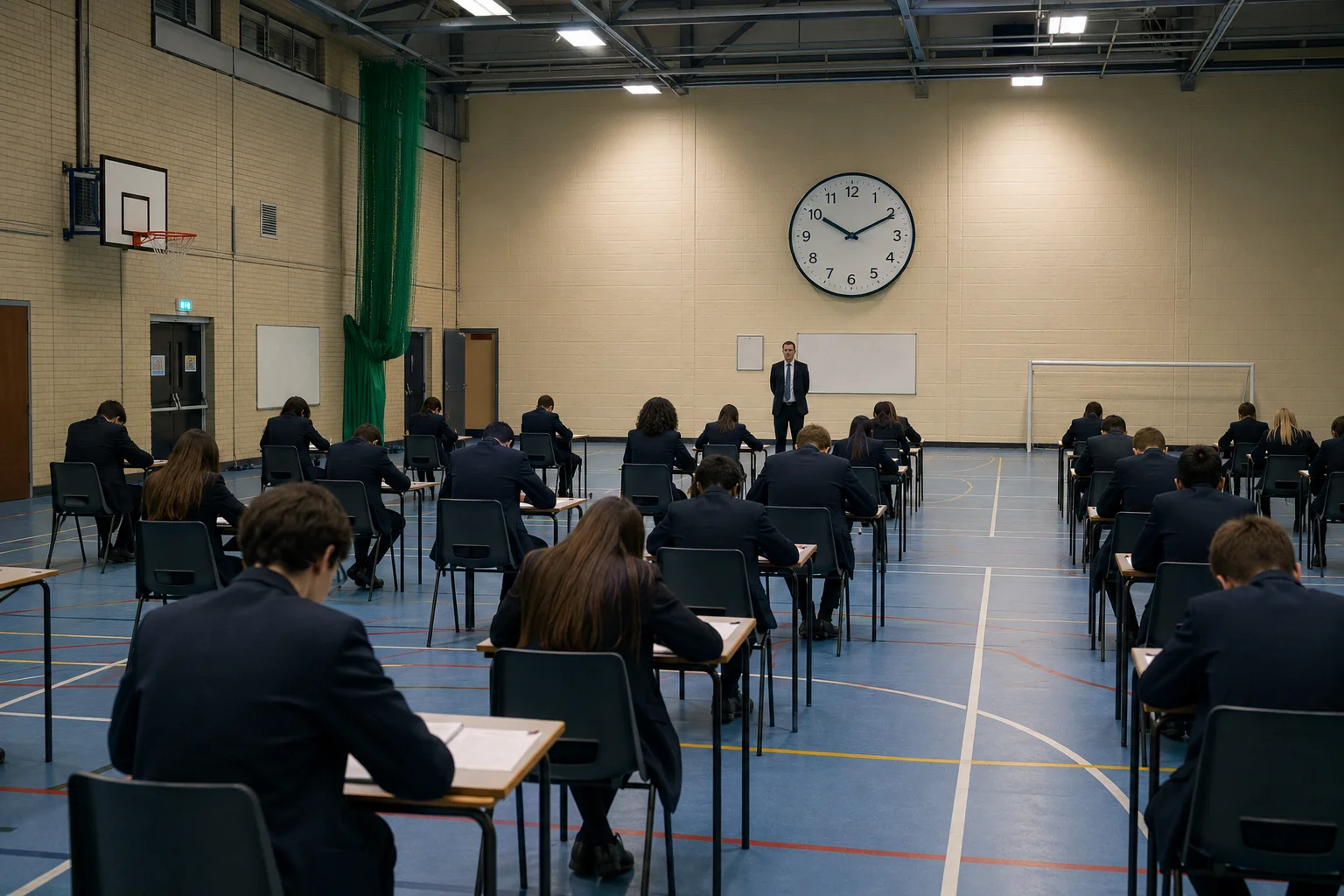
After GCSEs, most young people in England face one of their earliest significant educational decisions: where to study post-16. The two most common routes are a school sixth form and a further education (FE) college. Both lead to recognised qualifications — but the environments, cultures, course options and levels of independence they offer are meaningfully different.
This guide sets out the key differences clearly so that Year 11 pupils and their parents can make a well-informed choice.
Under the Education and Training (Welfare of Young Persons) Act, all young people in England must remain in education or training until the age of 18. This does not mean staying in full-time school — an apprenticeship, part-time study combined with work, or a traineeship also counts. The choice of where to study is significant, but the requirement to be in some form of learning is fixed.
What Is a Sixth Form?
A sixth form is a post-16 provision attached to — or run alongside — a secondary school. Most comprehensive, grammar, and independent secondary schools in England have their own sixth forms. Some schools operate a sixth form consortium, sharing sixth-form provision across two or more nearby schools.
Sixth forms primarily offer:
- A-Levels — the most common post-16 qualification, typically taken in three subjects over two years
- AS-Levels — one-year standalone qualifications (less common since 2017 decoupling)
- BTECs or other applied qualifications — though the range is usually narrower than at FE colleges
- EPQ (Extended Project Qualification) — an independent research project valued by universities
The atmosphere of a sixth form is usually an extension of the school environment. Pupils are in the same building they attended for Years 7–11, with many of the same teachers and pastoral staff.
What Is an FE College?
A further education (FE) college is an independent educational institution that offers post-16 and adult learning. Colleges are typically larger than school sixth forms, draw students from a wider geographic area, and offer a significantly broader range of courses and qualification types.
FE colleges typically offer:
- A-Levels — often across a wide range of subjects
- BTECs — including vocational and applied courses at Level 2 and Level 3
- T Levels — the newer technical qualifications with industry placement components
- Functional Skills — including resit courses in GCSE English and Mathematics
- Access to Higher Education diplomas — for mature learners
- Apprenticeship training — some colleges also deliver the off-the-job training element
The college environment is distinctly different: students are not in school uniform, they manage more of their own time, and the student body is typically older and more diverse than a school sixth form.
 AI-generated image
Key Differences Side by Side
| Feature | School Sixth Form | FE College |
|---|---|---|
| Setting | Attached to a secondary school | Standalone independent institution |
| Uniform / dress code | Often smart-casual or modified uniform | No uniform — own clothing |
| Size of cohort | Smaller — typically 100–400 students | Larger — often 1,000–5,000+ students |
| Course range | Mainly A-Levels ± limited BTECs | Wide: A-Levels, BTECs, T Levels, vocational |
| Structure and supervision | More structured, closer pastoral oversight | Greater independence, less day-to-day monitoring |
| Social environment | Familiar faces from secondary school | Wider mix of people and ages |
| Free periods | Usually supervised study or common room | Self-directed — library, café, off-site |
| Travel required | Often the same school already attended | May require bus, train or longer journey |
| GCSE resits available | Rarely | Usually yes — English and maths resits common |
Which Environment Suits Which Student?
A Sixth Form May Be Better If…
- Your child thrives in a structured, familiar environment and benefits from close pastoral support
- They are confident in A-Level choices and those subjects are well taught at the school
- They want continuity — staying with teachers they know and trust
- The school's sixth form has a strong track record in the subjects they want to study and good university progression data
- They are applying to highly competitive university courses where a school sixth form's support network (personal statement help, predicted grades, references) is an advantage
An FE College May Be Better If…
- Your child wants to study vocational, technical or applied qualifications alongside or instead of A-Levels
- They are ready for a more independent, adult environment and find the school setting restrictive
- They need to resit GCSE English or Maths alongside their main programme
- They want to meet a wider range of people and are comfortable navigating a larger institution
- The local sixth form does not offer the subject combination or qualification type they need
- They are considering a T Level — a technical qualification most likely to be found at an FE college
 AI-generated image
Course Choice: The Most Practical Difference
For many students, the decision comes down to course availability. If the preferred subject combination is available at both types of institution, the environmental and cultural differences become more important. But if a student wants a particular BTEC, a T Level, or a vocational course that their local sixth form does not offer, the choice is effectively made for them.
Before deciding, it is worth compiling a shortlist of courses from each option and checking whether the institution has a track record of strong results in those subjects. Ofsted reports, published A-Level results data, and destination data (where students go after their two years) are all publicly available.
You can use the school search tool to find sixth forms in your area and filter by region to see which institutions are available to you.
Practical Matters to Consider
| Consideration | What to Ask |
|---|---|
| Entry requirements | What GCSE grades does each institution require for your preferred subjects? |
| Travel and cost | How far is each option? Is there a 16–19 travel bursary available? |
| Open events | Has your child visited both types? First impressions of environment matter. |
| Financial support | FE colleges often have 16–19 bursary funds for eligible students to help with costs. |
| Class sizes | A-Level groups at sixth forms can be small; college groups vary widely. |
| Results data | Check published A-Level pass rates and value-added scores where available. |
If a student is unsure which qualification route is right — not just which institution — it is worth reading the guide on sixth form entry requirements to understand what each type of institution will expect, and how to evaluate whether requirements are realistic based on current GCSE performance.
For students interested in working alongside study rather than full-time education, the guide on apprenticeships after Year 11 covers the entry routes and what to expect from that pathway.
Frequently Asked Questions
Can I apply to both a sixth form and an FE college at the same time?
Yes. There is no central application system for post-16 education in England (unlike UCAS for universities). Students apply directly to each institution, usually in January or February of Year 11, and can hold offers from multiple providers simultaneously. You will typically need to confirm your final choice after receiving GCSE results in August. Applying to more than one option is strongly advisable.
Are A-Level results better at sixth forms or FE colleges?
This varies enormously by individual institution and cannot be generalised. Some FE colleges produce excellent A-Level results that rival selective sixth forms; others focus primarily on vocational routes where A-Level provision may be less specialist. The only reliable approach is to look at each institution's specific published results data, not to assume quality based on type alone.
Do universities prefer applicants from sixth forms over FE colleges?
No. Universities assess applicants primarily on their A-Level (or equivalent) grades and personal statements. The type of institution attended post-16 is not a factor in standard admissions decisions. Some universities actively recruit from FE colleges as part of widening participation initiatives. What matters to universities is the qualification attained and the predicted grades, not whether the applicant attended a school or college.
What if my GCSE grades are not strong enough for my preferred sixth form?
Most sixth forms publish minimum entry requirements, typically including a minimum grade in the specific subject you want to study at A-Level. If predicted grades are borderline, it is worth applying anyway — some schools make conditional offers based on summer results. An FE college may have lower entry thresholds and the option to resit GCSEs alongside your programme if needed.
Is there a difference in how students are supported emotionally and pastorally?
Generally yes. School sixth forms tend to have more established pastoral structures — form tutors, heads of year, school counsellors — carried over from the main school. FE colleges have pastoral and wellbeing support but the approach is more self-directed: students typically need to seek support rather than having it proactively offered. Neither is inherently better, but students who benefit from consistent check-ins may find a sixth form environment more supportive.
Can I switch from a sixth form to an FE college (or vice versa) after starting?
It is possible, but rarely straightforward. Timetables, module schedules and entry requirements mean that switching mid-year can result in lost learning and complications with qualification completion. Switching between institutions at the end of Year 12 (between the first and second year of A-Levels) is more feasible — but the receiving institution must have places and accept your completed Year 12 work. Prevention is better than cure: visit both options carefully before committing.