When students approach their GCSE options, one of the most consequential science decisions they will make is whether to study Combined Science or take Biology, Chemistry and Physics as three separate GCSEs. Both routes are legitimate paths to A-Level science and beyond — but they differ in breadth, assessment structure, and the grades they can award.
This guide explains both routes in plain terms so that pupils and parents can make a well-informed choice, ideally in consultation with the school's science department.
The majority of state secondary schools in England offer Combined Science as their default route. Separate Sciences — sometimes called Triple Science — are typically offered as an option for pupils who show particular aptitude or interest, though availability varies significantly by school.
What Is GCSE Combined Science?
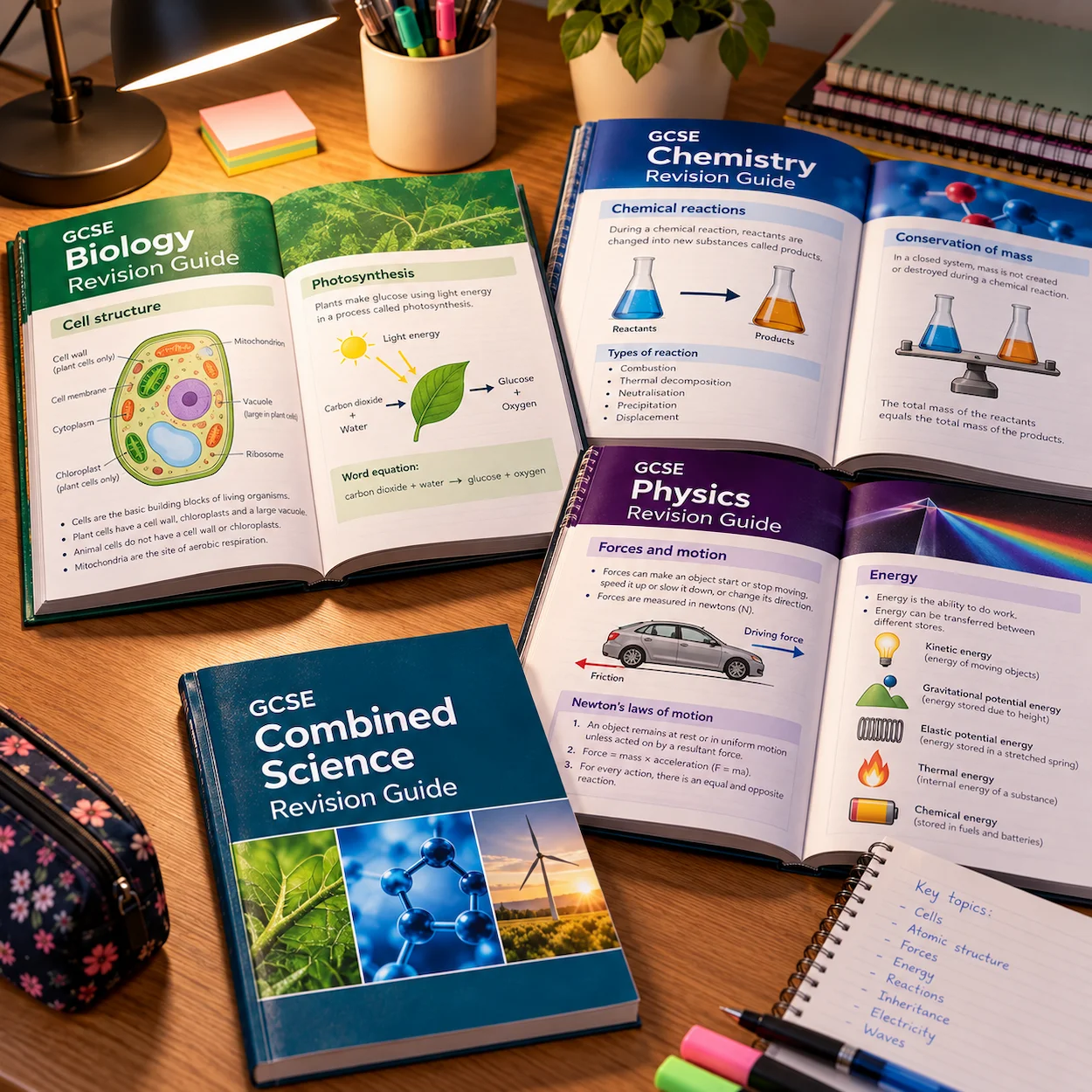
GCSE Combined Science — officially titled Combined Science: Trilogy (AQA) or equivalent — covers all three science disciplines in a single, integrated qualification. Pupils study elements of Biology, Chemistry and Physics across six exam papers (two per subject), but the overall award is counted as two GCSEs, not three.
How Combined Science Grades Work
Because it is worth two GCSEs, Combined Science uses a double grade format on a scale from 1–1 (lowest) to 9–9 (highest), with grades running through combinations such as 4–4, 5–4, 5–5, 6–5, and so on. The two grades can only differ by one point — you cannot receive a 9–4, for example.
This means that for the purposes of university entrance and sixth-form admissions, Combined Science appears as two GCSE grades on a transcript. Most sixth forms and universities accept it as the equivalent of two science GCSEs.
How Much Content Is Covered?
Combined Science covers approximately 75–80% of the content covered in Separate Sciences. The topics that are removed tend to be the more detailed or specialist areas within each subject — for instance, some of the depth on genetics in Biology or thermodynamics in Physics may be reduced compared to the separate route.
 AI-generated image
What Are Separate Sciences (Triple Science)?
Separate Sciences — sometimes called Triple Science — means a pupil sits full, individual GCSEs in Biology, Chemistry and Physics. Each is a standalone qualification graded on the standard 1–9 scale, giving the pupil three separate GCSE grades.
How Separate Science Grades Work
Each subject is graded independently from 1 to 9. A pupil could, for example, achieve a 7 in Biology, a 6 in Chemistry and a 5 in Physics — three distinct grades reflecting performance in each discipline separately. This granularity can be advantageous for pupils who excel in one or two sciences but not all three.
Greater Depth and Additional Content
Separate Sciences include content not examined in Combined Science. This additional material provides a stronger foundation for A-Level study. Pupils who intend to read Medicine, Biochemistry, Physics or Engineering at university will often benefit from the deeper grounding in all three subjects.
To understand how science paper tiers affect the grade range available to you, it is worth reading about the Higher and Foundation tier structure, which applies to both routes.
Side-by-Side Comparison
| Feature | Combined Science | Separate Sciences |
|---|---|---|
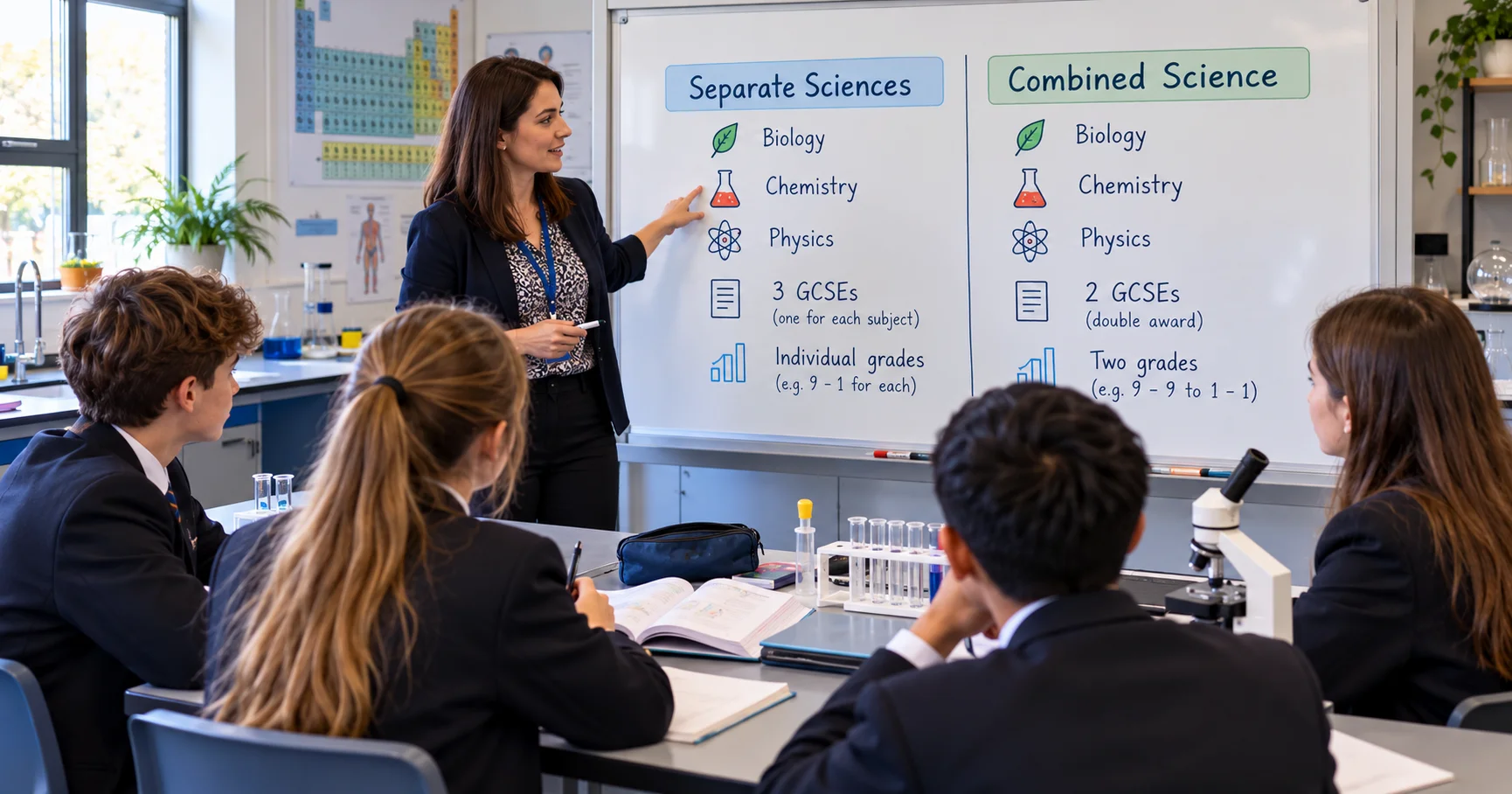
| Number of GCSEs awarded | 2 (double award) | 3 (one per subject) |
| Grading format | Double grade (e.g. 6–6, 5–4) | Individual 1–9 grade per subject |
| Number of exam papers | 6 (2 per subject) | 6 (2 per subject each = 6 total) |
| Content coverage | ~75–80% of each subject | Full content for each subject |
| Timetable impact | Fewer timetabled lessons | Significantly more lessons required |
| A-Level science pathway | Accepted by most sixth forms | Standard route; stronger preparation |
| Typically available to | All pupils (default route) | Selected pupils — varies by school |
 AI-generated image
Which Route Is Right for Your Child?
There is no universal answer — the right choice depends on the pupil's interests, aspirations, and school timetable. Here are the key questions to consider:
Choose Combined Science if…
- Your child finds science interesting but does not plan to specialise heavily in it at A-Level or beyond.
- They want to keep their GCSE options broad — the additional GCSE slot freed up by Combined Science can be used for an art, language, or vocational qualification.
- They are not consistently high-performing across all three sciences. Combined Science can be a more manageable workload and may produce stronger grades overall.
- Their school does not offer Separate Sciences, or reserves it for a limited cohort.
Choose Separate Sciences if…
- Your child is aiming for science-heavy A-Levels such as Physics, Chemistry, Biology, or Further Mathematics.
- They have career aspirations in Medicine, Dentistry, Engineering, Biochemistry, or Pharmacy — fields where a strong, distinct science foundation is expected.
- They are performing strongly and consistently across all three science subjects and enjoy the level of challenge.
- Their school offers and recommends Separate Sciences for their ability group.
Speak to your child's science teacher or Head of Science before making this decision. Many schools use internal assessments and teacher judgement to guide — and sometimes restrict — access to the Separate Sciences route. A pupil who is borderline may find Combined Science less stressful and ultimately more productive in terms of final grades. For pupils considering whether Triple Science is the right fit, there is more detailed guidance available on what the route demands.
Does Combined Science Limit A-Level Options?
This is one of the most common concerns among parents. The short answer is: for most pupils, no.
The majority of sixth forms and colleges in England accept Combined Science (Double Award) as a qualification for entry onto A-Level Biology, Chemistry or Physics — provided the pupil achieved the relevant grade (typically 6–6 or 7–7 for the sciences, though this varies by institution). A-Level specifications are designed with the expectation that many students will arrive from Combined Science.
However, some highly selective independent schools or sixth-form colleges may prefer or require Separate Science GCSEs for entry onto their science A-Level courses. If your child is aiming for such an institution, it is worth checking that school's entry requirements directly.
What About University Admissions?
At the point of university application, GCSE science grades matter primarily as a threshold — most universities are far more interested in A-Level grades than in the specific GCSE route taken. Combined Science is widely recognised. If a student has Combined Science at GCSE but performs strongly at A-Level Biology and Chemistry, this will not disadvantage their university application in the vast majority of cases.
The exception is Medicine. Several medical schools specify particular GCSE grade requirements and may look at science grades closely. Prospective medical students are advised to check the entry requirements of their target medical schools at GCSE level, ideally before making GCSE option choices.
When Are GCSE Options Typically Chosen?
In most English secondary schools, pupils choose their GCSE options at the end of Year 8 or during Year 9, with the chosen route beginning in Year 9 or Year 10 depending on the school. This means the decision often needs to be made when a pupil is 13 or 14 years old — before their interests and abilities are fully settled.
For practical study advice once the route has been chosen, see the guide on planning revision across Biology, Chemistry and Physics.
Frequently Asked Questions
Is Combined Science easier than Separate Sciences?
Not necessarily easier in absolute terms, but the workload is lighter and the content slightly narrower. Combined Science covers roughly 75–80% of the material in Separate Sciences and results in two GCSEs rather than three. Some pupils find they achieve stronger grades in Combined Science because the workload is more manageable, particularly if they are less confident in one of the three sciences.
Can you do A-Level Physics with Combined Science GCSE?
Yes, in most schools and colleges. A-Level Physics entry requirements typically specify a minimum grade in the Physics component of Combined Science (often 6 or 7 in the double grade) or an equivalent Separate Science Physics grade. Check the specific entry requirements of the sixth form or college your child is applying to, as these vary.
Does Combined Science count as two GCSEs for university entry?
Yes. Combined Science (Double Award) is counted as two GCSEs in the 9–1 grading system and is recognised as such by universities across the UK. It will appear as two distinct grades (e.g. 7–6) on a pupil's results certificate and UCAS profile.
What if a school does not offer Separate Sciences?
Not all schools offer Separate Sciences — particularly smaller secondaries and many comprehensive schools that cannot timetable three full science GCSEs alongside all other subjects. If this is the case, Combined Science is simply the pathway available. It remains a strong qualification and does not close off A-Level science options for the majority of pupils.
Which exam boards offer GCSE Combined Science and Separate Sciences?
The main exam boards in England — AQA, OCR, Edexcel (Pearson) and WJEC/Eduqas — all offer both Combined Science and Separate Science specifications. The specific papers, content order and required practicals differ between boards, so it is worth checking which board your school uses and reviewing that board's specification directly on their website.
Can a pupil switch from Combined Science to Separate Sciences mid-course?
In most schools, switching routes mid-GCSE course is very difficult or impossible due to timetabling and content coverage. The decision is most effectively made at the options stage. If a pupil realises they want to pursue Separate Sciences after starting Year 10, they should speak to the Head of Science urgently — some schools may accommodate a move early in Year 10, but this becomes progressively harder as the course progresses.