
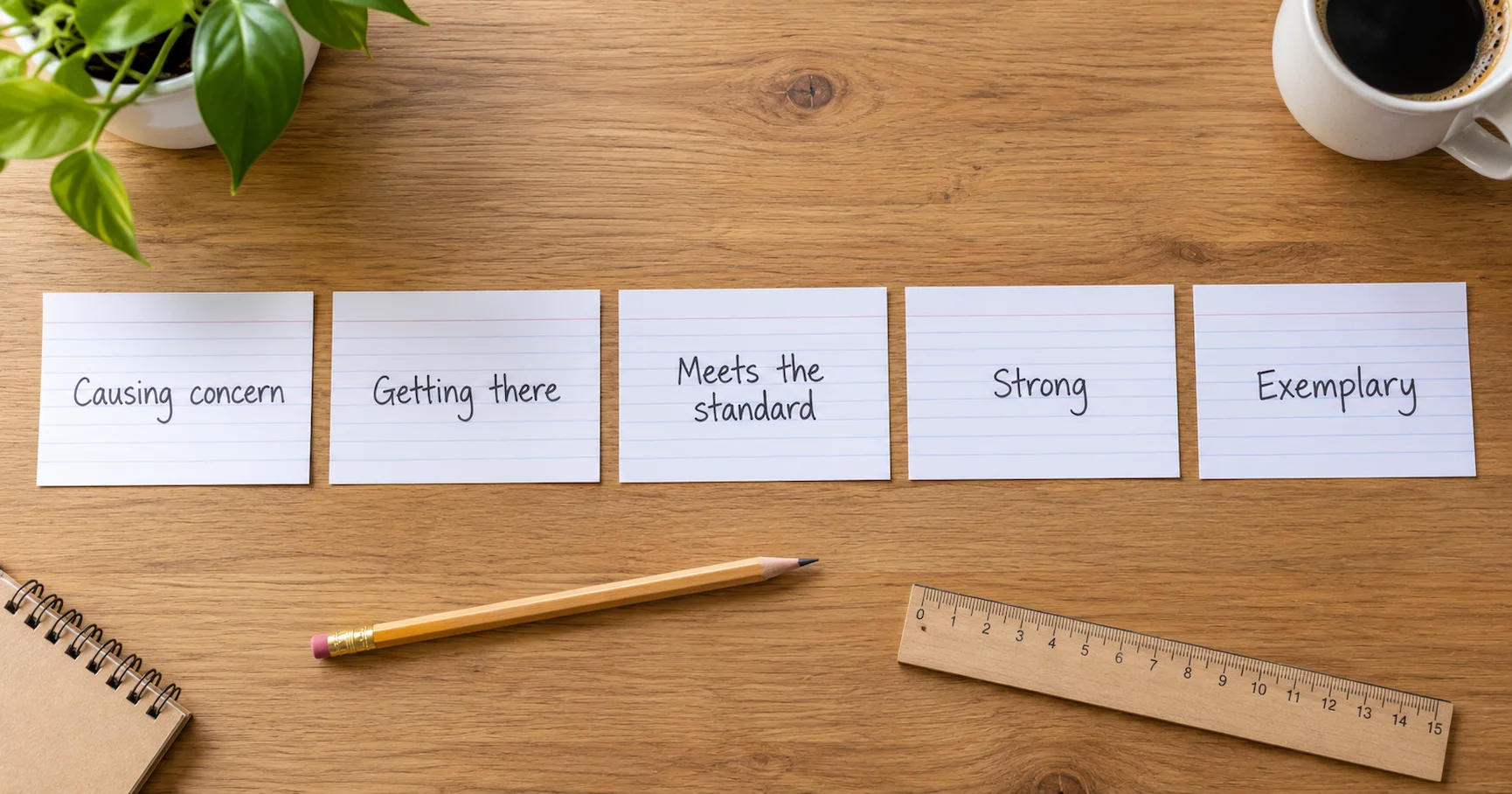
When Ofsted replaced its single overall grade with the new School Report Card in November 2025, it also introduced a new rating scale. Instead of four overall judgements (Outstanding, Good, Requires Improvement, Inadequate), schools are now assessed on a five-point descriptive scale across multiple separate areas.
For many parents, the new language is unfamiliar. What does it mean in practice for a school to be "Getting There"? Is "Meets the Standard" the same as "Good"? How much better is "Exemplary" than "Strong"? This guide answers those questions in plain terms.
Unlike the old system, the new Report Card does not produce one overall grade that covers everything. Each area — Quality of Education, Behaviour, Personal Development, Leadership, and others — receives its own rating on the five-point scale. A school can be "Strong" in one area and "Getting There" in another. Understanding what each rating means is therefore essential for making sense of a school's full report.
The Five Points: An Overview
| Rating | Plain-English Meaning | Old System Equivalent |
|---|---|---|
| Causing concern | Serious failures that require immediate action | Inadequate |
| Getting there | Below acceptable standard — improvement is needed and expected | Requires Improvement |
| Meets the standard | Broadly satisfactory — this area is functioning adequately | Broadly Requires Improvement (upper end) or lower Good |
| Strong | Above the minimum — pupils are being well served in this area | Good |
| Exemplary | Exceptional — this area represents best practice | Outstanding |
The five-point scale applies to each separate inspection area — not to the school as a whole. A school cannot be "Exemplary" overall; it can be "Exemplary" in Leadership but only "Meets the Standard" in Quality of Education. This is a deliberate design choice to prevent one strong area from masking weakness in another.
Each Rating Explained in Depth
1. Causing Concern
This is the most serious rating. A school area rated "Causing Concern" has significant, systemic failures that inspectors judge to be directly harming pupils or placing them at risk. This rating triggers formal intervention from Ofsted and, in some cases, from the Regional Director or the Department for Education.
What this looks like in practice:
- Quality of Education: The curriculum is poorly planned, teaching is consistently weak, and pupils are making little or no progress
- Behaviour and Attitudes: Serious, persistent disorder; high fixed-term exclusions; pupils feeling unsafe
- Leadership: Leaders have no accurate picture of what is happening; safeguarding failures; staff morale and retention severely compromised
"Causing Concern" in any area almost always results in a follow-up monitoring visit within a short period. If it is applied to Leadership and Management alongside another key area, the school may be placed in Special Measures — a formal intervention status.
2. Getting There
"Getting There" means the area is below acceptable standards but not failing catastrophically. Inspectors use this rating when they identify clear weaknesses and insufficient progress, but judge that the school has the capacity to improve with appropriate support and will.
What this looks like in practice:
- Quality of Education: The curriculum has gaps; some teachers deliver well but inconsistency is evident across the school; reading development is below expected levels
- Personal Development: PSHE or careers guidance is inconsistent; pupils lack sufficient opportunities for enrichment beyond lessons
- Leadership: Leaders have identified problems but are not yet taking sufficiently decisive action; governor oversight is weak
A school rated "Getting There" in multiple areas, or "Getting There" in Leadership, is unlikely to be left for several years before a return visit. Ofsted monitors the trajectory.
 AI-generated image
3. Meets the Standard
This is perhaps the most misunderstood rating. "Meets the Standard" does not mean a school is failing — it means the area is functioning adequately. Pupils are receiving an acceptable level of provision. There are no systemic failures. But there is clear room for improvement before this area could be considered "Strong".
Many parents assume that "Meets the Standard" is equivalent to "Requires Improvement" from the old system. This is not entirely accurate. "Meets the Standard" sits above the old Requires Improvement — it signals that the minimum standard is being met, not that the school is struggling. Think of it as the lower end of what used to be called "Good".
What this looks like in practice:
- Quality of Education: The curriculum covers what is required; teaching is generally effective; most pupils make adequate progress, but ambition and stretch for high-attaining pupils may be limited
- Behaviour: Behaviour is broadly managed; there are no systemic issues, but consistency may vary across year groups or subject areas
- Leadership: Leaders manage the school competently, maintain safeguarding appropriately, but strategic planning lacks ambition or vision beyond the immediate term
For parents, a school that "Meets the Standard" across all areas is one that is doing its job — but is not excelling. It may be on a journey towards "Strong" or it may be settled at this level.
4. Strong
"Strong" is the rating that replaces the old "Good" as the benchmark of quality provision. A school area rated "Strong" is above the minimum standard — inspectors judge that pupils are being genuinely well served in this area. Evidence is consistent across year groups, subjects and pupil groups.
What this looks like in practice:
- Quality of Education: The curriculum is ambitious and well-sequenced; teachers have strong subject knowledge; assessment is used effectively; reading is prioritised across the school; most pupils make good progress
- Personal Development: Pupils have diverse enrichment opportunities; PSHE is well planned; careers guidance is effective and regularly reviewed; pupil voice is meaningfully acted upon
- Leadership: Leaders have an accurate and honest understanding of strengths and areas for development; they manage staff well and invest in professional development; governors provide genuine challenge
"Strong" across all areas represents a genuinely good school in Ofsted's view. For most families, a school rated "Strong" in Quality of Education and Behaviour should be considered a solid, reliable choice.
5. Exemplary
"Exemplary" is the highest rating and is deliberately rare. It is reserved for areas where inspectors judge the school's practice to be exceptional and replicable — something that other schools could learn from and adopt. It is not simply "very good" — it requires Ofsted to be confident that the approach represents best practice at a national level.
What this looks like in practice:
- Quality of Education: The curriculum goes beyond statutory requirements; teaching is consistently challenging and responsive; pupils — including those with SEND and disadvantaged pupils — make exceptional progress; the school is developing approaches that inspectors highlight as transferable to other settings
- Leadership: Leadership is transformational and evidence-led; the school supports other schools in the system; safeguarding is not just compliant but embedded in culture; staff development is strategic and effective
Parents should note that "Exemplary" in one or two areas does not make a school outstanding overall. A school with one "Exemplary" rating and three "Meets the Standard" ratings is a mixed picture — the strong area does not offset the weaker ones.
 AI-generated image
Questions to Ask Using the Five-Point Scale
Once you understand what each rating means, the Report Card becomes a tool for asking targeted questions — at open evenings, in conversations with the school, or in your own research. Useful questions include:
| If the school is rated… | Ask the school… |
|---|---|
| "Getting There" in any area | "What specific steps is the school taking to address this, and what is the timeline?" |
| "Meets the Standard" in Quality of Education | "What are you doing to move from meeting the standard to being Strong in curriculum and teaching?" |
| "Strong" across most areas | "Are there any areas flagged for improvement in the narrative that are not reflected in the rating?" |
| "Exemplary" in any area | "How does this translate into day-to-day experience for a Year 7 pupil joining in September?" |
| An older (pre-2025) Ofsted grade | "When is the school next due for an inspection? Has anything changed since the last report?" |
For a step-by-step guide to navigating the full Report Card — including where to find it, how each section is structured, and what the written narrative adds beyond the ratings — see the guide on how to read the new Ofsted School Report Card.
If you are comparing multiple schools and want to understand how the old four-grade system worked alongside the new framework, the full background is covered in Understanding Ofsted Ratings: What "Outstanding" vs "Good" Really Means.
When researching schools in your area, you can also use the school search tool to find schools and access their available information directly.
Frequently Asked Questions
Is "Meets the Standard" the same as the old "Requires Improvement"?
No — and this is important. "Meets the Standard" in the new system is broadly equivalent to the lower end of the old "Good" grade, not to "Requires Improvement". The equivalent of the old Requires Improvement is "Getting There". A school rated "Meets the Standard" across all areas is meeting its obligations adequately. It is not failing, and it would not face the same level of scrutiny or intervention as a school rated "Getting There" or "Causing Concern".
Can a school appeal against a rating on the five-point scale?
Headteachers and governors can challenge the factual accuracy of the published report through Ofsted's formal complaints process. They can also raise concerns about the inspection process itself during or immediately after an inspection. However, challenging Ofsted's professional judgements — such as the rating assigned to an area — is more difficult. The complaints process is primarily designed to address factual errors, not to overturn expert assessment.
How do inspectors decide which rating to apply?
Inspectors use published evaluation frameworks and descriptors for each area. They gather evidence through lesson observations, reviews of pupils' work and school documents, conversations with staff and pupils, and analysis of published performance data. Ratings are agreed through a moderation process before the report is finalised — they are not the judgement of a single inspector. The full evaluation framework is published on the Ofsted website.
Will a school rated "Strong" in all areas eventually be inspected again?
Yes. All schools remain subject to future inspections. Ofsted determines inspection frequency based on a school's profile, context and prior judgements, as well as any concerns that arise between inspections (such as a sharp decline in attendance data or a safeguarding referral). A school rated "Strong" across the board will typically have a longer gap before its next full inspection than one with lower ratings, but no school is exempt from future scrutiny.
If a school was Outstanding before 2025, does that still count?
Yes, but with important context. Outstanding was a very high bar and a school that earned it legitimately may still be performing exceptionally well. However, some schools that were rated Outstanding many years ago may have changed significantly — in leadership, staffing, pupil intake or community context. A school that has not been inspected for many years and retains a pre-2025 grade should be researched carefully through its own publications, destination data and open evening visits, not assessed solely on a historical Ofsted grade.
Do all schools get the same five areas assessed?
Not always. The core areas — Quality of Education, Behaviour and Attitudes, Personal Development, and Leadership and Management — apply to all schools. Additional areas apply only where relevant: Early Years is assessed only in schools with Nursery or Reception provision; Sixth Form is assessed only in schools with post-16 provision. The Report Card will clearly indicate which areas have been assessed and which are not applicable.