Reverse percentages — also called reverse percentage problems or finding the original value — are a topic that appears regularly in GCSE Maths and catches many students out. The confusion is understandable: instead of finding a percentage of a number (which most students are comfortable with), you are working backwards from a value after a percentage change to find what the value was before the change.
This guide explains the concept clearly, presents a reliable step-by-step method that works every time, and works through four fully solved examples covering the most common question types.
Reverse percentages appear at both Foundation and Higher tier in GCSE Maths. They are typically worth 2–4 marks and appear in the non-calculator paper as well as the calculator papers — so understanding the method conceptually (not just plugging into a calculator) is important. Common contexts include: sale prices, price increases, population changes, and depreciation.
Why "Working Backwards" Is the Key Idea
Suppose a price has been reduced by 30% and now costs £140. A very common mistake is to calculate 30% of £140 and add it back: that gives £182, which is wrong. The error happens because 30% was taken off the original price — not off £140.
The correct approach is to recognise that if 30% has been removed, then £140 represents 70% of the original price (100% − 30% = 70%). From there:
- £140 = 70% of the original
- Therefore 1% of the original = £140 ÷ 70 = £2
- Therefore 100% (the original) = £2 × 100 = £200
This "find 1%, then scale to 100%" approach is the foundation of the standard reverse percentage method.
The Standard Method: Three Steps Every Time
Use these three steps for any reverse percentage question:
- Work out what percentage the given value represents. If the original was increased by X%, the given value is (100 + X)%. If it was decreased by X%, the given value is (100 − X)%.
- Divide the given value by that percentage to find 1%.
- Multiply by 100 to find 100% (the original value).
Equivalently, steps 2 and 3 can be combined as a single division: divide by the decimal multiplier. A 30% decrease has a multiplier of 0.7 — so divide by 0.7. A 15% increase has a multiplier of 1.15 — so divide by 1.15.
Worked Example 1: Percentage Decrease (Sale Price)
A jacket is on sale for £119. It has been reduced by 15%. What was the original price?
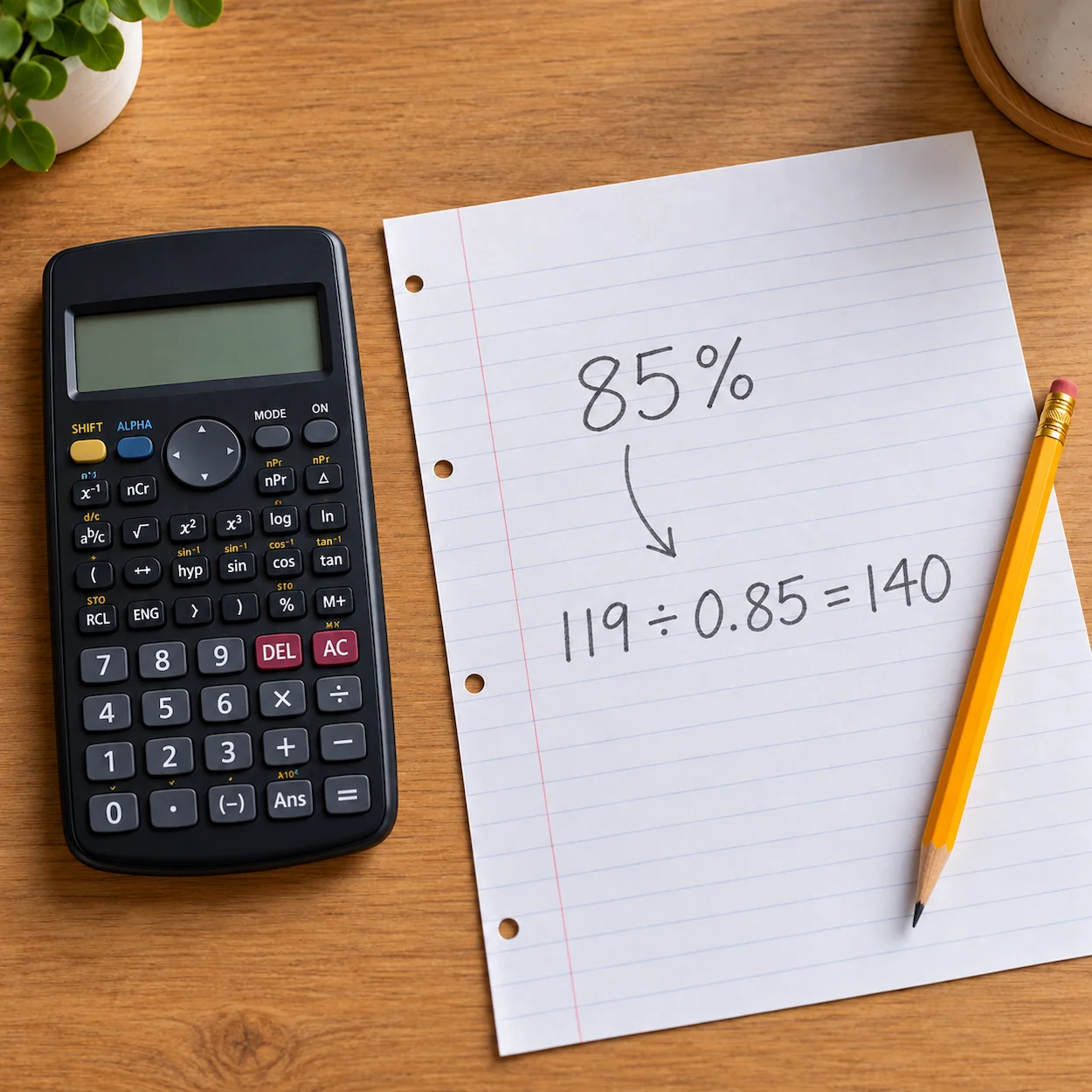
Step 1: The jacket has been reduced by 15%, so £119 represents 100% − 15% = 85% of the original price.
Step 2: Find 1%: £119 ÷ 85 = £1.40
Step 3: Find 100%: £1.40 × 100 = £140
Answer: The original price was £140.
Using the decimal multiplier method: 119 ÷ 0.85 = 140 ✓
  Sale price = 85% of original
  £119 ÷ 0.85 = £140
  Original price = £140
Worked Example 2: Percentage Increase (Price Rise)
A shop increases the price of a TV by 20%. The new price is £480. What was the original price?
Step 1: The price has been increased by 20%, so £480 represents 100% + 20% = 120% of the original.
Step 2: Find 1%: £480 ÷ 120 = £4
Step 3: Find 100%: £4 × 100 = £400
Answer: The original price was £400.
Using the decimal multiplier: 480 ÷ 1.20 = 400 ✓
  New price = 120% of original
  £480 ÷ 1.20 = £400
  Original price = £400
 AI-generated image
Worked Example 3: Non-Calculator Method
A number has been increased by 40%. The result is 350. Find the original number. (No calculator.)
Step 1: 350 represents 140% of the original (100% + 40%).
Step 2: Find 10%: 350 ÷ 14 = 25
Wait — dividing 350 by 140 is awkward without a calculator. Use a more flexible approach:
If 140% = 350, then 10% = 350 ÷ 14 = 25.
Step 3: 100% = 25 × 10 = 250
Answer: The original number was 250.
When dividing by an awkward percentage in a non-calculator question, try finding 10% first (divide by 10% of the total percentage), then scaling up. For example: if the value is 140%, find 10% = value ÷ 14, then ×10 for 100%. This avoids decimal arithmetic when a calculator is not available.
Worked Example 4: Two-Step Problem
A population increased by 25% and then decreased by 10%. The final population is 22,500. What was the original population?
Work backwards through the two changes, starting with the most recent:
Step 1 — Undo the 10% decrease:
The final figure of 22,500 represents 90% of the population after the first change (100% − 10%).
Population after first change = 22,500 ÷ 0.9 = 25,000
Step 2 — Undo the 25% increase:
25,000 represents 125% of the original population (100% + 25%).
Original population = 25,000 ÷ 1.25 = 20,000
Answer: The original population was 20,000.
  Step 1: 22,500 ÷ 0.90 = 25,000   (undo −10%)
  Step 2: 25,000 ÷ 1.25 = 20,000   (undo +25%)
  Original = 20,000
 AI-generated image
Common Mistakes to Avoid
| Mistake | Example of the Error | Why It's Wrong |
|---|---|---|
| Adding/subtracting the percentage directly from the given value | Price after 15% off is £119. Incorrect: £119 + 15% of £119 = £136.85 | 15% was taken off the original, not off £119. The percentages apply to different amounts. |
| Dividing by the wrong percentage | For a 15% decrease, dividing by 0.15 instead of 0.85 | You must divide by what the given value represents (85%), not by the change itself (15%). |
| Treating a multi-step problem as one step | Adding the two percentages together and applying once | Each percentage change applies to a different base. They must be reversed individually. |
| Using the wrong operation (adding instead of dividing) | Finding 1% and then adding it repeatedly instead of multiplying | Always multiply 1% by 100 — adding 1% one hundred times introduces rounding errors. |
Quick Reference: Decimal Multipliers
| Change | Multiplier (to apply change) | Divide by (to reverse) |
|---|---|---|
| 5% increase | × 1.05 | ÷ 1.05 |
| 10% increase | × 1.10 | ÷ 1.10 |
| 20% increase | × 1.20 | ÷ 1.20 |
| 25% increase | × 1.25 | ÷ 1.25 |
| 5% decrease | × 0.95 | ÷ 0.95 |
| 10% decrease | × 0.90 | ÷ 0.90 |
| 15% decrease | × 0.85 | ÷ 0.85 |
| 20% decrease | × 0.80 | ÷ 0.80 |
| 30% decrease | × 0.70 | ÷ 0.70 |
| 50% decrease | × 0.50 | ÷ 0.50 |
Practise Problems
Try these without looking at the worked examples above. Check your answers below.
- A coat costs £63 after a 10% reduction. What was the original price?
- A salary increased by 8%. The new salary is £27,000. What was the original salary?
- A car depreciated by 35%. Its current value is £11,700. What was its original value?
- A value was increased by 60% and then decreased by 25%. The final value is 960. Find the original.
Show Answers
- £63 ÷ 0.90 = £70
- £27,000 ÷ 1.08 = £25,000
- £11,700 ÷ 0.65 = £18,000
- Step 1: 960 ÷ 0.75 = 1,280 | Step 2: 1,280 ÷ 1.60 = 800
Frequently Asked Questions
Is reverse percentages a Foundation or Higher topic at GCSE?
Reverse percentages appear on both Foundation and Higher tier GCSE Maths papers. On the Foundation tier, questions tend to involve straightforward single-step problems with clean numbers. On the Higher tier, questions may involve multi-step changes, non-integer percentages, or be embedded in more complex problem-solving contexts. Both tiers may assess this topic on calculator and non-calculator papers, so the conceptual method — not just the calculator technique — must be understood.
Can I use a formula instead of the three-step method?
Yes. The formula is: Original = Given value ÷ multiplier, where the multiplier is expressed as a decimal (e.g. 0.85 for a 15% decrease, 1.20 for a 20% increase). This is mathematically identical to the three-step method but more compact. On a calculator paper, it is the fastest approach. On a non-calculator paper, the three-step method (find 1%, then multiply by 100) is often more practical because it avoids awkward decimal arithmetic.
What is the most common error students make in reverse percentage questions?
The most common error is applying the percentage change directly to the given (post-change) value rather than working back to the original. For example, if a price after a 20% increase is £180, students sometimes calculate 20% of £180 (= £36) and subtract to get £144 — which is wrong. The correct method is £180 ÷ 1.20 = £150, because £180 represents 120% of the original.
Do I need a calculator for reverse percentage questions in GCSE?
Not always. GCSE Maths has both calculator and non-calculator papers, and reverse percentage questions can appear on either. On the non-calculator paper, questions are usually designed so that the arithmetic is manageable — often using multiples of 10% or clean numbers. Practising the three-step method without a calculator (finding 10% first, then scaling) prepares you for both paper types.
How is reverse percentage different from percentage change?
Percentage change asks: "By what percentage did a value change?" (result = change ÷ original × 100). Reverse percentage asks: "What was the original value before a known percentage change?" They are inverse operations. Students who are confident with percentage change often assume the reverse works the same way — but because the base values are different, the methods are distinct.
Is this the same as finding 100% given a partial percentage?
Yes, essentially. Reverse percentage is the process of finding 100% when you are given a value that represents some other percentage. The three-step method (given value → 1% → 100%) works for any version of this question, not just increase/decrease scenarios. For example, "a school has 420 pupils, which is 60% of its capacity — what is full capacity?" is solved identically: 420 ÷ 0.60 = 700.